Israel endorses independent Kurdish state

Israeli Prime Minister Benjamin Netanyahu. (AP)
Updated 13 September 2017
Follow

Israel endorses independent Kurdish state

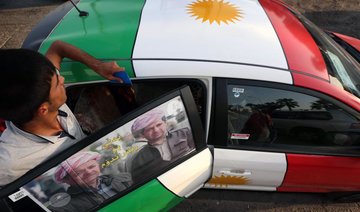
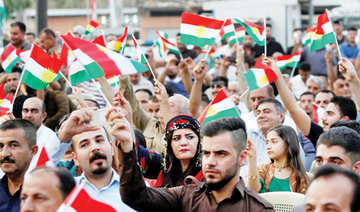
JERUSALEM: Israel supports the establishment of a Kurdish state, Prime Minister Benjamin Netanyahu said on Wednesday, as Kurds in Iraq gear up for a referendum on independence that lawmakers in Baghdad oppose.
Israel has maintained discreet military, intelligence and business ties with the Kurds since the 1960s, viewing the minority ethnic group — whose indigenous population is split between Iraq, Turkey, Syria and Iran — as a buffer against shared Arab adversaries.
On Tuesday, Iraq’s Kurdish leader Massoud Barzani said he would press ahead with the Sept. 25 referendum despite a vote by Iraq’s parliament rejecting it.
“(Israel) supports the legitimate efforts of the Kurdish people to achieve their own state,” Netanyahu said, in remarks sent to foreign correspondents by his office.
Western powers are concerned a plebiscite in Iraq’s semi-autonomous Kurdish region — including the oil-rich city of Kirkuk — could divert attention from the war against Daesh militants.
Netanyahu said Israel does however consider the Turkey-based Kurdistan Workers Party (PKK) a terrorist group, taking the same position as Turkey, the United States and the European Union.
An Israeli general told a conference in Washington last week that he personally did not regard the PKK, whose militants have been fighting Turkey for more than three decades, as a terrorist group.
Netanyahu, who is due to address the UN General Assembly on Sept. 19, voiced support for “the Kurds’ aspirations for independence” in a speech in 2014, saying they deserve “political independence.”
His latest remarks appeared to be a more direct endorsement of the creation of a Kurdish state.
But they will cut little ice in Baghdad, which has no diplomatic relations with Israel and has strong ties with Israel’s arch-foe Iran.
Iraq’s neighbors — Turkey, Iran and Syria — oppose the referendum, fearing it could fan separatism among their own ethnic Kurdish populations.
Kurds have sought an independent state since at least the end of World War One, when colonial powers divided up the Middle East after the collapse of the multi-ethnic Ottoman Empire.


Death toll in Iran protests over 3,000, rights group says

Updated 7 sec ago
Follow

Death toll in Iran protests over 3,000, rights group says

  • The protests erupted on December 28 over economic hardship and swelled into widespread demonstrations calling for the end of clerical rule
  • President Donald Trump, who had threatened ‘very strong action’ if Iran executed protesters, said Tehran’s leaders had called off mass hangings

DUBAI: More than 3,000 people have died in Iran’s nationwide protests, rights activists said on Saturday, while a “very slight rise” in Internet activity was reported in the country after an eight-day blackout.

The US-based HRANA ​group said it had verified 3,090 deaths, including 2,885 protesters, after residents said the crackdown appeared to have broadly quelled protests for now and state media reported more arrests.

The capital Tehran has been comparatively quiet for four days, said several residents reached by Reuters. Drones were flying over the city, but there were no signs of major protests on Thursday or Friday, said the residents, who asked not to be identified ‌for their safety.

A ‌resident of a northern city on the ‌Caspian ⁠Sea ​said ‌the streets there also appeared calm.

The protests erupted on December 28 over economic hardship and swelled into widespread demonstrations calling for the end of clerical rule in the Islamic Republic, culminating in mass violence late last week. According to opposition groups and an Iranian official, more than 2,000 people were killed in the worst domestic unrest since Iran’s 1979 Islamic Revolution.

“Metrics show a very ⁠slight rise in Internet connectivity in #Iran this morning” after 200 hours of shutdown, the ‌Internet monitoring group NetBlocks posted on X. Connectivity ‍remained around 2 percent of ordinary levels, ‍it said.

A few Iranians overseas said on social media that ‍they had been able to message users living inside Iran early on Saturday.

US President Donald Trump, who had threatened “very strong action” if Iran executed protesters, said Tehran’s leaders had called off mass hangings.

“I greatly respect the fact that all scheduled ​hangings, which were to take place yesterday (Over 800 of them), have been canceled by the leadership of Iran. Thank you!” he ⁠posted on social media.

Iran had not announced plans for such executions or said it had canceled them.

Indian students and pilgrims returning from Iran said they were largely confined to their accommodations while in the country, unable to communicate with their families back home.

“We only heard stories of violent protests, and one man jumped in front of our car holding a burning baton, shouting something in the local language, with anger visible in his eyes,” said Z Syeda, a third-year medical student at a university in Tehran.

India’s External Affairs Ministry said on Friday that commercial flights were available and that ‌New Delhi would take steps to secure the safety and welfare of Indian nationals.