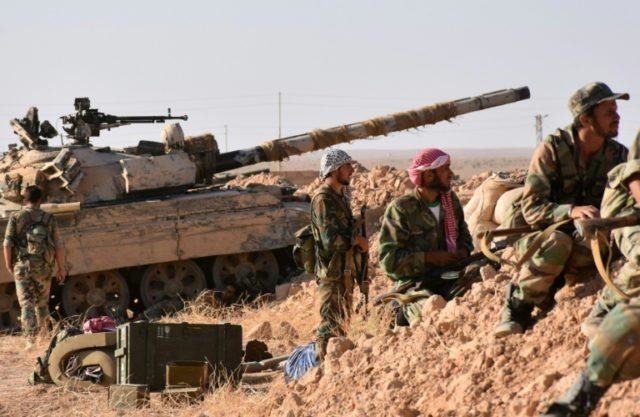
BEIRUT: Tribal figures linked to a US-backed alliance announced plans Monday for a council to run Syria’s Deir Ezzor, as both the alliance and regime troops battle jihadists in and around the city.
Held by the Daesh group, the city is the capital of the eastern province of Deir Ezzor, regarded as a strategic prize by both Syrian troops and the US-backed Syrian Democratic Forces.
With Russian backing, Syrian regime forces have seized western parts of the province and breached Daesh’s years-long siege on parts of the city.
SDF fighters are waging a separate offensive that has captured swathes of territory from Daesh east of the Euphrates River, which cuts across the province.
The SDF has not reached Deir Ezzor city itself, but on Monday its media office said a “preparatory committee” would begin laying the groundwork for a civil council to run the city after Daesh’s defeat.
Local figures would announce “the preparatory committee of the Deir Ezzor Civil Council and the support of the tribes for the SDF,” the media office said in a statement.
It remained unclear whether the Deir Ezzor Civil Council would coordinate with, or rival, government authorities already present in other parts of the city.
Since 2014, Daesh has held swathes of the province and about 60 percent of its capital, encircling two regime-held enclaves in the western half of Deir Ezzor city.
Government troops have broken both jihadist sieges and were preparing on Monday to launch an offensive on the eastern districts still held by Daesh.
“Military reinforcements have been arriving since Sunday night to begin the operation to seize control of the city,” said Rami Abdel Rahman, who heads the Britain-based Syrian Observatory for Human Rights monitoring group.
He said the SDF had advanced to six kilometers (four miles) from the eastern banks of the Euphrates River across from Deir Ezzor city.
The SDF’s advance is backed by the US-led coalition battling Daesh in Iraq and Syria since 2014.
The coalition, the SDF, Syria’s government and Russia have agreed on a “de-confliction line” in northeastern Syria to prevent the two offensives from clashing.

US-backed force plans council for Syria’s Deir Ezzor
UN rights chief Shocked by ‘unbearable’ Darfur atrocities
- Mediation efforts have failed to produce a ceasefire, even after international outrage intensified last year with reports of mass killings, rape, and abductions during the RSF’s takeover of El-Fasher in Darfur
PORT SUDAN: Nearly three years of war have put the Sudanese people through “hell,” the UN’s rights chief said on Sunday, blasting the vast sums spent on advanced weaponry at the expense of humanitarian aid and the recruitment of child soldiers.
Since April 2023, Sudan has been gripped by a conflict between the army and the paramilitary Rapid Support Forces that has left tens of thousands of people dead and around 11 million displaced.
Speaking in Port Sudan during his first wartime visit, UN Human Rights commissioner Volker Turk said the population had endured “horror and hell,” calling it “despicable” that funds that “should be used to alleviate the suffering of the population” are instead spent on advanced weapons, particularly drones.
More than 21 million people are facing acute food insecurity, and two-thirds of Sudan’s population is in urgent need of humanitarian aid, according to the UN.
In addition to the world’s largest hunger and displacement crisis, Sudan is also facing “the increasing militarization of society by all parties to the conflict, including through the arming of civilians and recruitment and use of children,” Turk added.
He said he had heard testimony of “unbearable” atrocities from survivors of attacks in Darfur, and warned of similar crimes unfolding in the Kordofan region — the current epicenter of the fighting.
Testimony of these atrocities must be heard by “the commanders of this conflict and those who are arming, funding and profiting from this war,” he said.
Mediation efforts have failed to produce a ceasefire, even after international outrage intensified last year with reports of mass killings, rape, and abductions during the RSF’s takeover of El-Fasher in Darfur.
“We must ensure that the perpetrators of these horrific violations face justice regardless of the affiliation,” Turk said on Sunday, adding that repeated attacks on civilian infrastructure could constitute “war crimes.”
He called on both sides to “cease intolerable attacks against civilian objects that are indispensable to the civilian population, including markets, health facilities, schools and shelters.”
Turk again warned on Sunday that crimes similar to those seen in El-Fasher could recur in volatile Kordofan, where the RSF has advanced, besieging and attacking several key cities.
Hundreds of thousands face starvation across the region, where more than 65,000 people have been displaced since October, according to the latest UN figures.