Experts welcome Macron’s call for moderation in EU-Turkey ties

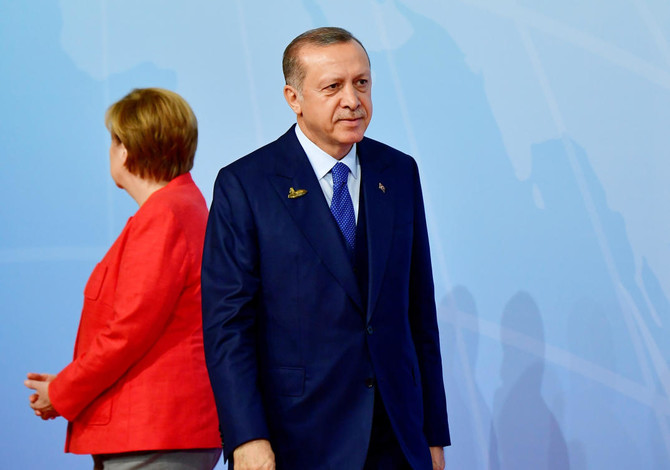
File photo shows German Chancellor Angela Merkel, left, standing next to Turkey's President Recep Tayyip Erdogan at the G-20 summit in Hamburg. (AFP)
Updated 08 September 2017
Follow

Experts welcome Macron’s call for moderation in EU-Turkey ties

ANKARA: Amid heightened tensions with Berlin, Ankara on Thursday received reassuring words from French President Emmanuel Macron.
He said the EU should avoid any deterioration in its relations with Turkey, which is a vital partner in many areas, especially counterterrorism and migration.
But Macron added that Ankara had “objectively distanced itself” from Brussels recently, and showed an “alarming deviation that cannot remain without consequence.”
Macron’s remarks came after German Chancellor Angela Merkel said over the weekend that the EU should stop accession talks with Turkey that have been ongoing for 12 years.
“Macron’s statement is a call for moderation following harsh rhetoric from Berlin for weeks,” Haluk Nuray, Brussels representative of the Economic Development Foundation, told Arab News.
“He doesn’t want to burn bridges with Ankara, and so is opting for softer rhetoric, while acknowledging that Turkey has backtracked in its harmonization steps with the EU in the candidacy process,” Nuray added.
“For a long time, Turkey’s regional policies and political dynamics have been incompatible with Western choices. We don’t speak the same language with the West, so deeper cooperation with the EU on counterterrorism or the refugee challenge seems unlikely for the moment.”
European leaders rely on Turkey to manage the flow of Syrian refugees, following a deal struck with the EU last year to take back irregular migrants from Europe in exchange for visa-free travel for Turks to the EU and €6 billion ($7.25 billion) in aid.
Last month, Turkish border guards seized French journalist Loup Bureau on the border with Iraq on terror charges. He is still in a prison in the south-eastern province of Sirnak.
But Turkey’s ties with France are better than they currently are with Germany. Macron and Turkish President Recep Tayyip Erdogan regularly discuss the situation in Syria and counterterrorism efforts.
Erdogan was one of the first leaders to congratulate Macron on his election on May 7. French Foreign Minister Jean-Yves Le Drian is due in Ankara on Sept. 14.
Muzaffer Senel, an EU expert from Istanbul Sehir University, said Macron’s statement does not mean France supports Turkish accession to the EU. Rather, it is confirmation that relations with Ankara are strategically important.
“It’s about deepening security alliances, not the political partnership,” Senel told Arab News. “There’s an old saying from the Cold War period: ‘Turks are good to fight alongside but not to live with.’ Paris sees Turkey as a privileged partner.”
Senel added: “Paris and Berlin are the most important decision-makers in the EU system. Their statements are crucial, and should be taken into consideration seriously.”


Sudan drone attack on Darfur market kills 10: rescuers

Updated 11 sec ago
Follow

Sudan drone attack on Darfur market kills 10: rescuers

  • According to the UN’s International Organization for Migration, more than 50,000 civilians have fled the region since the end of October

PORT SUDAN, Sudan: A drone attack on a busy market in Sudan’s North Darfur state killed 10 people over the weekend, first responders said on Sunday, without saying who was responsible.
The attack comes as fighting intensified elsewhere in the country, leading aid workers to be evacuated on Sunday from Kadugli, a besieged, famine-hit city in the south.
Since April 2023, Sudan’s army and the paramilitary Rapid Support Forces have been locked in a conflict which has killed tens of thousands of people, displaced nearly 12 million and created the world’s largest displacement and hunger crisis.
The North Darfur Emergency Rooms Council, one of hundreds of volunteer groups coordinating aid across Sudan, said a drone strike hit Al-Harra market in the RSF-controlled town of Malha on Saturday.
The attack killed 10 people, it said.
The council did not identify who carried out the attack, which it said had also sparked “fire in shops and caused extensive material damage.”
There was no immediate comment from either the Sudanese army or the RSF.
The war’s current focal point is now South Kordofan and clashes have escalated in Kadugli, the state capital, where a drone attack last week killed eight people as they attempted to flee the army-controlled city.
A source from a humanitarian organization operating in Kadugli told AFP on Sunday that humanitarian groups had “evacuated all their workers” from the city because of the security conditions.
The evacuation followed the United Nations’ decision to relocate its logistics hub from Kadugli, the source said on condition of anonymity, without specifying where the staff had gone.

- Measles outbreak -

Kadugli and nearby Dilling have been besieged by paramilitary forces since the war erupted.
Last week, the RSF claimed control of the Brno area, a key defensive line on the road between Kadugli and Dilling.
After dislodging the army in October from the western city of El-Fasher — its last stronghold in the Darfur region — the RSF has shifted its focus to resource-rich Kordofan, a strategic crossroads linking army-held northern and eastern territories with RSF-held Darfur in the west.
Like Darfur, Kordofan is home to numerous non-Sudanese Arab ethnic groups. Much of the violence that followed the fall of El-Fasher was reportedly ethnically targeted.
Communications in Kordofan have been cut, and the United Nations declared a famine in Kadugli last month.
According to the UN’s International Organization for Migration, more than 50,000 civilians have fled the region since the end of October.
Residents have been forced to forage for food in nearby forests, according to accounts gathered by AFP.
The conflict has effectively split Sudan in two, with the army controlling the north, east and center while the RSF dominates all five state capitals in Darfur and, with its allies, parts of the south.
Doctors without Borders (MSF) said on Sunday that measles was spreading in three of the four states in Darfur, a vast region covering much of western Sudan.
“A preventable measles outbreak is spreading across Central, South and West Darfur,” the organization said in a statement.
“Since September 2025, MSF teams have treated more than 1,300 cases. Delays in vaccine transport, approvals and coordination, by authorities and key partners are leaving children unprotected.”