Saudi’s Adahi project delivers sacrificial meat to 30m needy people in 27 countries

Every year, 30,000 lambs, cows and camels are slaughtered to be distributed to 30 million poor people and refugees in 27 different countries in Asia and Africa. (SPA)
Updated 07 September 2017
Follow

Saudi’s Adahi project delivers sacrificial meat to 30m needy people in 27 countries

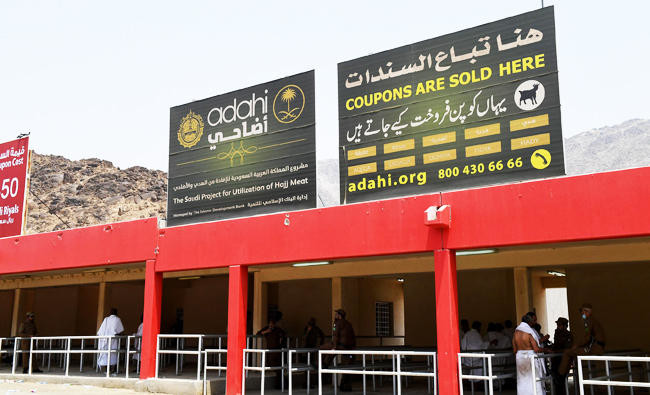
MAKKAH: Adahi is a Saudi Arabian project to distribute Hajj meat to over 30 million people in 27 different countries in Asia and Africa.
During previous Hajj seasons, people used to freeze and ship the excess meat from lamb sacrifices to their countries.
The abundance of meat during Hajj became a problem over the years. Pilgrims could not eat all the sacrificed meat and it was left on the streets, causing a sanitation crisis, bad smells and disease. The authorities then would bury the meat.
Saudi scholar Saeed Al-Amoudi told Al-Hayat that the increase of pollution caused by the lamb sacrifices led the Kingdom to take the first initiative in 1983 to avoid such waste and to help the poor. The Kingdom assigned the Islamic Development Bank (IDB) to manage the project along with Saudi government authorities.
In 2000, the Adahi project was developed, with over 40,000 employees working in different fields such as management, supervision, slaughtering, shipping and distribution. Every year, 30,000 lambs, cows and camels are slaughtered to be distributed to 30 million poor people and refugees in 27 different countries in Asia and Africa.
A center for treating the excess meat was also established. The center is capable of processing 500 tons of waste per day and turning it into natural fertilizers, separated from the extracted fat that can be used in factories. Thus, the center is able to get rid of the excess meat in an eight-day period following the Hajj.
This unique project emphasizes the creative ideology of turning problems into innovative solutions, and stresses the efforts of the Kingdom to provide a better life for the less fortunate.


Klija Festival in Buraidah empowers small businesses

Updated 24 January 2026
Follow

Klija Festival in Buraidah empowers small businesses

  • Half a million attend 15-day celebration of heritage; event creates 1,500 seasonal jobs

RIYADH: The 17th Klija Festival in Buraidah drew more than half a million visitors during its 15-day run, celebrating the region’s heritage and entrepreneurial spirit.

Organized by the Qassim Chamber of Commerce, the event highlighted small businesses, providing a platform for entrepreneurs to showcase local products.

More than 340 sales outlets, marketing corners and points of sale welcomed attendees, while the festival provided 1,500 seasonal job opportunities, the Saudi Press Agency reported.

The small business pavilions featured families in the cottage industry, artisans and startups presenting traditional foods, and handicrafts and heritage items that reflect the region’s identity.

Participants said that the festival was a key marketing platform, boosting sales, increasing brand awareness, facilitating knowledge exchange and fostering connections with organizations supporting SMEs.

Mohammed Al-Hanaya, Qassim Chamber secretary-general and festival supervisor, said that the event brought together families, artisans, SMEs, companies and institutions, stimulating commercial activity, opening direct marketing channels and enhancing economic returns.

He added that the festival provided seasonal jobs for more than 1,500 young men and women across operations, marketing and services, supporting the labor market, empowering national talent, and connecting youth to the events and creative economy.

Klija, a traditional cookie made from wheat flour, dates or sugar, date syrup and natural ingredients such as cardamom and lemon, is a rich source of energy, carbohydrates, dietary fiber and natural proteins.

A cultural icon rooted in Qassim’s traditions, the cookie has gained international exposure through the festival, expanding the availability of packaged products.

Starting next year, the festival will be renamed the International Klija Festival, a rebranding approved by Qassim Gov. Prince Faisal bin Mishaal, who described it as a “successful model for turning local initiatives into global economic engines.”

This year’s festival, held at the King Khalid Cultural Center, included international participants from Egypt, Turkiye and Morocco, marking its evolution into a cross-cultural platform.