What ‘blockade’? Lavish Qatari spending in London refutes claims of inhuman sanctions

1 / 4
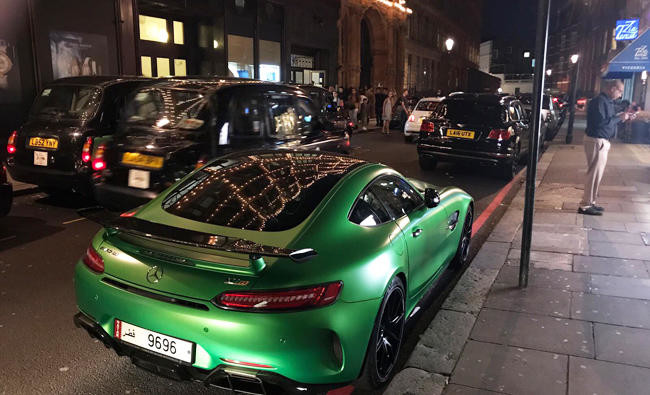
A high-end Mercedes-Benz motor with Qatari plates parked outside the Harrods department store on Thursday evening. (AN photo by Greg Wilcox)
2 / 4
3 / 4
A high-end Mercedes-Benz motor with Qatari plates parked outside the Harrods department store on Thursday evening. (AN photo by Greg Wilcox)
4 / 4
Updated 05 September 2017
Follow

What ‘blockade’? Lavish Qatari spending in London refutes claims of inhuman sanctions

LONDON: A bright green Mercedes with Qatari plates revs up outside Harrods, as shoppers from the Gulf state pour into the iconic department store. It is just another day under what the authorities in Doha are insisting to refer to as a “blockade.”
Indeed, the Qatari spending over the summer holidays, seen most notably in London’s poshest areas is in sharp contrast to the image local media is trying to portray as an inhuman, collective punishment of the Qatari people.
As the Eid Al-Adha holiday got under way, there was no shortage of supercars being paraded in the UK capital’s posh Knightsbridge district, home to the Qatar-owned Harrods department store and numerous upmarket boutiques.
That is despite the June 5 move by the Anti-Terror Quartet — Saudi Arabia, the UAE, Egypt and Bahrain — to impose a series of sanctions on Doha over the latter’s alleged support of terror groups.
The quartet views the move as a “boycott” — although Doha interprets it more harshly, as a “blockade” against it.
Yet there were few visible restrictions on moneyed Qataris in Central London over the past few days — with some supercar owners not even perturbed by the area’s parking regulations.
Despite the boycott, spending by Qataris in the UK is actually on the rise, figures obtained exclusively by Arab News show.
According to payments processing company Worldpay, spending in the UK by people with credit and debit cards registered in Qatar rose sharply after the June 5 boycott against the Gulf state.
Total spending in the UK with Qatar-registered cards rose by 6.4 percent in June compared to the year before, the figures show.
And during the week of the Eid Al-Fitr holiday in late June — another popular time for Gulf Arabs to travel — spending on Qatar-registered cards was up by a whopping 49 percent compared to earlier in the month, the Worldpay figures show. Spending using cards registered in Saudi Arabia rose by just 29.1 percent during the same period.
Worldpay said spending by Middle Eastern tourists was “particularly prolific” during the Eid celebrations at the end of June.
James Frost, an executive from the firm, attributed this partly to the slump in the value of the UK pound, as well as the Eid festivities.
“Sterling’s slump is continuing to attract visitors in their droves, safe in the knowledge that their holiday cash will stretch a little further. Eid provides a useful barometer for foreign spending more broadly. The latest figures from this year’s festival point toward a summer spending frenzy from overseas visitors looking to cash in on the weak pound,” he said in July.
Figures for the more recent Eid holiday are not yet available but — if the fleet of Qatar-owned supercars seen on the streets of Knightsbridge is anything to go by — it looks like it is accelerating.
“There are some ridiculous crazy cars,” one parking attendant in the area, who declined to be named due to company policy, told Arab News.
“You don’t even have to see them to know they are around, the noise they make tell you they are here. It’s always busy around the summer, they come here, have some fun and then go home.
“When I dish them out with parking fines they never complain, they just accept it with a smile, they usually have a load of friends with them and they probably don’t want to cause a fuss in front of them.”
Yet there have been numerous complaints from local residents over the supercar-driving tourists from Qatar and other Gulf Arab states that descend on London each summer.
One Knightsbridge resident, who did not wish to be named, told Arab News: “The racket they make is awful, they drive their cars around here and disturb the peace. It can be very annoying at times.”


Palestinian PM: Gaza reconstruction advancing amid US talks, Saudi support

In an interview with Arab News, Mohammed Mustafa said “Palestinian objective is clear,’ but we need to ‘get Gaza right first.’
Updated 21 January 2026
Follow

Palestinian PM: Gaza reconstruction advancing amid US talks, Saudi support

  • In an interview with Arab News, Mohammed Mustafa said “Palestinian objective is clear,’ but we need to ‘get Gaza right first’
  • Speaking at Davos panel, PM calls Kingdom a key stakeholder in the Palestinian cause

DAVOS: Palestinian Prime Minister Mohammed Mustafa told Arab News that progress is underway in Gaza’s reconstruction talks, with clear dialogue between the Palestinian Authority, US President Donald Trump and Special Envoy Steve Witkoff.

“I think the Palestinian objective is pretty clear, it has been for a long time, which is to establish their own independent state, (achieve) international resolution,” Mustafa said, noting that “we need to get Gaza right first.”

Despite a ceasefire taking hold earlier in 2025, Gaza remains under what the international community describes as an Israeli-enforced blockade. Basic supplies such as food and medicine are still subject to Tel Aviv’s scrutiny, which controls all access in and out of the Strip.

On Sunday, Trump announced that his Gaza plan had entered its second phase, in which Hamas would release all remaining hostages, Israel would free more Palestinian prisoners and fully withdraw its forces — a step international actors say should pave the way from ceasefire to lasting peace.

The formation of a technocratic National Committee for the Administration of Gaza, or NCAG, composed of Palestinian figures, marks the first concrete step toward implementing the plan and restoring Palestinian ownership of the next phase.

A precise timeline for reconstruction remains unclear, with analysts warning that major works hinge on Hamas disarmament — a politically fraught task assigned to the Gaza Peace Board.

“It’s going to take more than two years to fix Gaza, but at least we want to make sure that things are in the right direction,” continued Mustafa, adding that the West Bank remains part of the broader conversation.

He stressed the urgency of reunifying Gaza’s institutions with the West Bank to achieve the PA’s political goal of independence. 

“Our priority is what’s happening to our people in Gaza today. Despite four months passing (after) the ceasefire, people are still dying. Yes, there is a ceasefire but it’s not fully observed due to Israeli military actions,” he said, stressing that “shelter is the biggest challenge” at the moment.

Mustafa revealed he held “very active and useful” talks with US officials on Tuesday, saying both sides “share the same goals” on the matter.

Later in his panel, Mustafa said a Palestinian reform plan is in the works with the help of partners including Saudi Arabia.

In a session at the World Economic Forum in Davos, Mustafa said Saudi Arabia and other partners such as Egypt and Jordan were not just contributors but key stakeholders in the Palestinian cause.

“Saudi Arabia along with France have been working with us on the two state solution and integrating it,” he said.

“We want to work with the board of peace to ensure that they do their part of things to prepare for reconstruction efforts,” he added.

Mustafa said although some view the Oslo treaty as outdated, it still holds its place as an internationally recognized framework.

“According to the Oslo agreement, Israel should have withdrawn from most of the West Bank and Gaza. We want to see Israel respecting this agreement,” he said.

“The Israelis did not respect the economic part of the treaty. We are praying for a heavy price, not only in Gaza and people being killed every day. But also actions on the ground in the West Bank. We said clearly, we want to achieve our goals by peaceful means,” he said.

“Israel today holds $4 billion of our government’s money. They control the borders and collect the tax fines. For the past four months they have sent zero dollars. Our ability to govern has been impacted due to this,” Mustafa said.

In a sideline interview with Arab News, Palestinian Ambassador to Switzerland Ibrahim Mohammad Khraishi said that he met an Egyptian minister who expressed hope that the Rafah crossing could soon reopen on both sides.

“We need the understanding from all,” Khraishi said. “Yes, we have this administrative committee (as part of the Gaza Peace Board), but without the Palestinian Authority, they cannot deliver. Because we have everything. We have the institutions, we have the government,” Khraisi said.

Commenting on recent West Bank developments, including Israeli bulldozers razing the UNRWA compound in occupied East Jerusalem on Tuesday, he warned: “This is the scenario for the Israelis. For them, there is nothing to talk about. It’s total crash and destruction. Now, what they are doing in West Bank is on the way.”