Netanyahu’s wife undergoes ‘humiliating’ polygraph test over graft

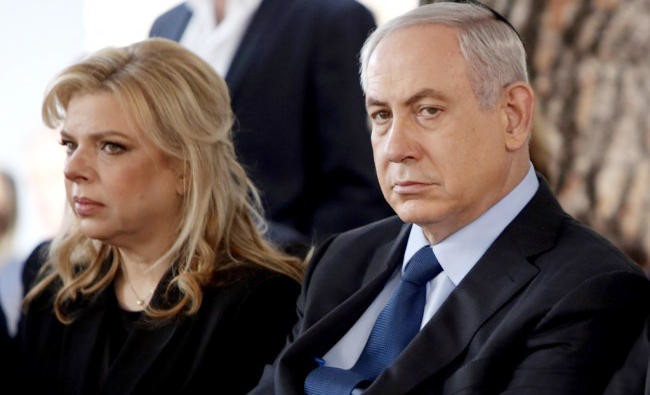
Sara and Benjamin Netanyahu. (AFP)
Updated 03 September 2017
Follow

Netanyahu’s wife undergoes ‘humiliating’ polygraph test over graft

JERUSALEM: Israeli Prime Minister Benjamin Netanyahu’s wife has taken a voluntary lie detector test to try and dispel allegations she misused public funds, her lawyer said on Sunday.
National fraud squad detectives questioned Sara Netanyahu last month on suspicions she routinely claimed state payments for personal housekeeping expenses at the couple’s official and private residences.
Private broadcaster Channel Two reported at the weekend that the attorney general was expected to announce charges against her by Sept. 10.
“She took the test,” Netanyahu family lawyer Yossi Cohen told Israeli public radio. “It’s a very tough test. It’s humiliating and she did it wonderfully.”
He did not give details of the questions she was asked or the test results.
He said the decision to undergo the examination, at a privately operated polygraph facility, was taken “following the horrible mudslinging against her and after we heard that she is going to be put on trial.”
Results of polygraph testing are not admissible as evidence in Israeli criminal trials.
Netanyahu himself is also under investigation on suspicions of corruption, and last month his former chief of staff signed a deal to turn state’s witness in probes involving the premier.
One is based on suspicions Netanyahu unlawfully received gifts from wealthy supporters, including Australian billionaire James Packer and Hollywood producer Arnon Milchan.
Also under investigation is a suspicion that Netanyahu sought a secret deal with the publisher of top-selling daily Yediot Aharonot.
The proposed deal, which is not believed to have been finalized, would have seen Netanyahu receive positive coverage in return for him helping to scale down the operations of Israel Hayom, Yediot’s main competitor.
Netanyahu has been questioned about both cases.
The investigations have stirred Israeli politics and led to speculation over whether Netanyahu will eventually be forced to step down, which he is not formally obliged to do unless convicted.
He denies any wrongdoing.
Submarine graft probe
In another development, Israeli police said they detained six people Sunday for questioning over suspected corruption around a deal to buy submarines for Israel’s navy from Germany’s ThyssenKrupp.
They gave no further details but daily newspaper Haaretz said the roundup included “a former senior official” in the prime minister’s bureau and senior naval officers.
In July, Germany delayed signing a deal with Israel for the sale of three submarines, an Israeli official said, as the corruption probe gained momentum.
That followed the arrest of several people on suspicion of offenses including bribery and money laundering around the deal to buy the Dolphin submarines from the German industrial giant.
David Shimron, a relative of Netanyahu and his family lawyer who also represented ThyssenKrupp in Israel, was among those questioned and then released in July.
Israeli officials said Germany had not backed out of the deal but was waiting to see the outcome of the investigation, daily newspaper Yediot Aharonot reported.
In February, Israel’s Justice Ministry said it had launched an investigation into the affair, stressing that Netanyahu himself was not a suspect.


Israel to partially reopen Gaza’s Rafah crossing

Updated 56 min 31 sec ago
Follow

Israel to partially reopen Gaza’s Rafah crossing

  • Reopening comes amid ongoing violence in the Palestinian territory
  • Gaza’s civil defense agency says dozens killed in Israeli attacks on Saturday

RAFAH, Palestinian Territories: Israel is set to partially reopen the Rafah crossing between the war-devastated Gaza Strip and Egypt on Sunday, following months of urging from humanitarian organizations, though access will be limited to the movement of people.

The reopening comes amid ongoing violence in the Palestinian territory, with Gaza’s civil defense agency reporting dozens killed in Israeli attacks on Saturday, while the Israeli military said it was retaliating against ceasefire violations.

The Rafah crossing is a vital gateway for both civilians and aid, but has remained closed since Israeli forces seized control of it in May 2024 during the war with Hamas, aside from a brief and limited reopening in early 2025.

Israel had previously said it would not reopen the crossing until the remains of Ran Gvili — the last Israeli hostage held in Gaza — were returned.

His remains were recovered days ago and he was laid to rest in Israel on Wednesday.

“The Rafah Crossing will open this coming Sunday (February 1st) in both directions, for limited movement of people only,” COGAT, an Israeli defense ministry body overseeing civil affairs in the occupied Palestinian territories, said on Friday.

Entry and exit “will be permitted in coordination with Egypt, following prior security clearance of individuals by Israel, and under the supervision of the European Union mission,” it added.

However, key details remain unclear, including how many people will be allowed to cross and whether those seeking to return to Gaza will be permitted entry.

A source at the border told AFP that Sunday would be largely devoted to preparations and logistical arrangements.

The crossing is set to open on Sunday on a trial basis to allow the passage of wounded individuals, ahead of a regular reopening scheduled for Monday, three sources at the crossing said.

However, no agreement has yet been reached on the number of Palestinians permitted to enter or exit, the sources added, noting that Egypt plans to admit “all Palestinians whom Israel authorizes to leave” the territory.

“Every day that passes drains my life and worsens my condition,” said Mohammed Shamiya, 33, who suffers from kidney disease and requires dialysis treatment abroad.

“I’m waiting every moment for the opening of the Rafah land crossing.”

Anxious wait

Safa Al-Hawajri, who has received a scholarship to study overseas, is also eagerly awaiting the reopening on Sunday.

“I’m waiting in the hope of fulfilling my ambition, which is tied to the reopening of the crossing,” said Hawajri, 18.

“I hope to be able to travel as soon as it opens.”

Located on Gaza’s southern border with Egypt, Rafah is the only crossing into and out of the territory that does not pass through Israel.

The crossing lies in an area held by Israeli forces following their withdrawal behind the so-called “Yellow Line” under the terms of a US-brokered ceasefire that came into effect on October 10.

Israeli troops still control more than half of Gaza, while the rest remains under Hamas authority.

The ceasefire has now entered its second phase and calls for reopening the crossing following the release or return of all Israeli hostages held by Palestinian militants.

Hamas had called for its full reopening in both directions after the remains of Gvili were brought back to Israel.

The reopening is expected to facilitate the entry of a 15-member Palestinian technocratic body, the National Committee for the Administration of Gaza (NCAG), established to oversee the day-to-day governance of the territory’s 2.2 million residents.

The committee is to operate under the supervision of the so-called “Board of Peace” chaired by US President Donald Trump.

The NCAG, headed by former Palestinian Authority deputy minister Ali Shaath, is expected to enter the Gaza Strip once the Rafah crossing reopens.

Violence continued ahead of the crossing’s reopening.

At least 32 people, including children, were killed on Saturday in Israeli air strikes in Gaza, reported the civil defense agency, which operates as a rescue force under the Hamas authority.

Israel’s military said the strikes were retaliation for an incident on Friday in which eight Palestinian fighters exited a tunnel in the city of Rafah, which it said violated the ceasefire.