TAL AFAR: Iraqi forces backed by local militia and a US-led coalition were poised Sunday to drive the Daesh group from the city of Tal Afar, dealing another blow to the jihadists.
Just a week after authorities announced an offensive to push the jihadists from one of their last major urban strongholds in Iraq, the Joint Operations Command said Iraqi forces held all 29 districts of the city and were pursuing final clearing operations.
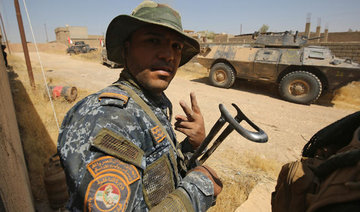
Pro-government fighters could already be seen celebrating, flashing victory signs as their tanks rolled through the streets, waving Iraqi flags and taking down black Daesh banners from buildings and lamp posts.
The offensive comes just weeks after Iraqi forces retook second city Mosul from Daesh, in their biggest victory since the jihadists seized control of large parts of Syria and Iraq in mid-2014.
Much of that territory has since been retaken with support from coalition air strikes and Daesh is also facing a major US-backed offensive against its de facto Syrian capital Raqqa.
The loss of Tal Afar, in northern Iraq between Mosul and the Syrian border, will deprive Daesh of what was once a significant hub for movement between the Syrian and Iraqi components of the self-styled “caliphate” it declared three years ago.
On Saturday, Iraqi forces reached Tal Afar’s Ottoman-era citadel and took control of the city center.
Government troops and units of the Hashed Al-Shaabi paramilitary coalition launched the assault last Sunday after weeks of coalition and Iraqi air strikes.
Progress in Tal Afar has been far more rapid than in Mosul, which fell to Iraqi forces only after a gruelling nine-month battle.
Officials have said they hope to announce victory by Eid Al-Adha, the Muslim holiday set to start in Iraq on September 2.
The next target in the area was the town of Al-Ayadieh 15 kilometers (10 miles) north of Tal Afar and strategically located on the road between the city and the Syrian border.
In the whole Tal Afar region, “1,155 square kilometers (445 square miles) of 1,655 square kilometers (640 square miles), or 70 percent of the area, have been taken” the JOC said late on Saturday.
Pro-government forces faced an obstacle course of roads blocked with earth embankments and strategically parked trucks, as well as sniper fire and mortar shelling during the battle for Tal Afar.
Troops also said they discovered a network of underground tunnels used by Daesh to launch attacks behind lines of already conquered territory, or to escape.
Most of the city’s 200,000-strong population had fled after Daesh seized it. Until its takeover by Daesh, Tal Afar was largely populated by Shiite Turkmen, whose beliefs are considered heretical by the Sunni jihadists of Daesh.
Officials have said the capture of the city would make it even more difficult for the jihadists to transport fighters and weapons between Iraq and Syria.
The jihadist group has lost much of the territory it controlled and thousands of its fighters have been killed since late 2014, when the US-led international coalition was set up to defeat the group.
Once Tal Afar is retaken, Baghdad is expected to launch a new offensive on Hawija, about 300 kilometers (185 miles) north of the Iraqi capital.
The coalition has announced carrying out strikes near Hawija in recent days, including two that killed Daesh fighters and destroyed a command post.
Daesh is also present in the vast western province of Anbar, where it controls several zones along the border with Syria, including the Al-Qaim area.
Despite its losses in Iraq and Syria, Daesh has continued to claim responsibility for attacks carried out by its members or supporters abroad, including this month’s deadly attacks in Spain and knife attacks in Russia and Brussels.


![]()

Iraqi forces poised for victory over Daesh in Tal Afar
Iraqi forces poised for victory over Daesh in Tal Afar


Latest updates


© 2026 SAUDI RESEARCH & PUBLISHING COMPANY, All Rights Reserved And subject to Terms of Use Agreement.