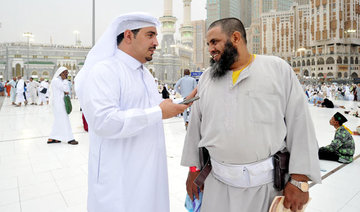
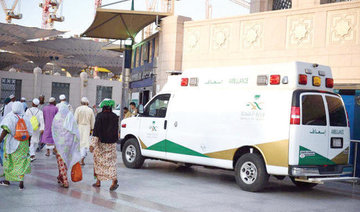
MAKKAH: More than 7,000 men from government and national sectors are volunteering to serve pilgrims once they arrive at King Abdul Aziz International Airport in Jeddah.
The volunteers ensure pilgrims’ comfort and receive them with hospitality and generosity. Golf vehicles are available to transport the elderly. Using the latest technology, the volunteers serve pilgrims with honor and pride.
Meanwhile, the Ministry of Hajj and Umrah has launched the United Hajj e-system, which integrates and connects entities involved in serving pilgrims. Available in seven languages, it is the first system of its kind in the Middle East.
The ministry stressed the importance of expanding the use of technology to serve pilgrims from arrival until departure.
Furthermore, a group of Saudi women and girls have been devoting themselves for eight years to taking care of children who have become lost among the crowds in the holy city during Hajj.
Lina Abu Znadeh, the head of the women’s volunteer scout team for receiving and taking care of lost children during Hajj, confirmed in an interview with Al Arabiya that their teams have an integrated network connected to the Saudi police, hospitals and scouts to help reunite lost children with their loved ones as quickly as possible.
“The volunteers started their work eight years ago, working around the clock during Hajj season,” she said. “We receive lost children and give them all the psychological and moral support. We start by calming them down, because they are usually afraid and panicked. Then we give them a shower and let them change their clothes,” she added.
“The mechanism of reuniting children with their parents or relatives is organized with the relevant authorities operating in the field. First, we report to the state network any details about the lost child, identifying the child by name or by any specific characteristics. Parents come to our center and are reunited with their child, after all the necessary paper work. The child leaves our center with a bracelet containing their name and their parents’ contact numbers in case they get lost again,” said Abu Znadeh.
In the interview, Abu Znadeh revealed some of the obstacles they faced in the early years of their work, such as the difference of languages. However, this helped them become more experienced in finding immediate solutions.
She indicated that the number of lost children has decreased throughout the years due to the increasing awareness among parents. In the center’s first year of operation, 80 lost children were found against 64 children the following year. This number kept decreasing until last year, when there were only 26 lost children.
Abu Znadeh added: “We will start our around-the-clock field work this year Aug. 29 up and finish Sept. 5. Over the years, we had special needs children come to the center (Ex: autistic children), and thus we have now an autism specialist and a therapist on our team.”


![]()

Over 7,000 volunteers serve Hajj pilgrims at Jeddah airport
Over 7,000 volunteers serve Hajj pilgrims at Jeddah airport

Latest updates


Recommended


© 2026 SAUDI RESEARCH & PUBLISHING COMPANY, All Rights Reserved And subject to Terms of Use Agreement.