LONDON: Luxury British carmaker Aston Martin is trying to boost its market share in the United States and Japan to mitigate against any risks from Brexit which could add costs and delays to sales to the European Union.
Around 20 percent of the firm’s top-end cars are currently exported to the United States whilst 15 percent are sold to the European Union, with whom unfettered tariff-free trade is at risk depending on the outcome of Brexit talks.
But Chief Executive Andy Palmer said the firm has plowed resources into boosting demand in the world’s biggest economy since the June 23 Brexit vote last year.
“We decided to invest money in marketing in the US,” he told Reuters during a telephone interview on Friday.
“We are trying to give a push in the US to increase our market share there, increase our volumes there (and) therefore decrease our reliance on Europe,” he told Reuters. “To some extent, that would be true also of Japan.”
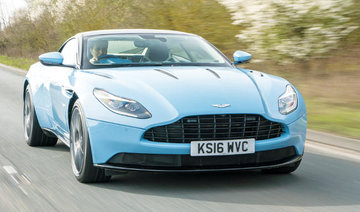
Aston Martin reported its first half-yearly profit in almost a decade on Friday as sales of the new DB11 model put the luxury British carmaker on the road to recovery.
The 104-year old firm posted a record pre-tax profit of £21.1 million in the first six months of the year, compared with a £82.3 million loss last year. It is the first time it has been in profit at this stage of the year since 2008.
Aston, famed for making the sports car driven by fictional secret agent James Bond, has benefited in recent months from surging sales with volumes rising 67 percent to 2,439 vehicles, spurred on by the new DB11 model.
“It’s the big uptick in volume — plus we’re getting much higher specifications on these cars,” said Chief Financial Officer Mark Wilson.
Wilson told Reuters it is “increasingly possible” that the firm will post a full-year pre-tax profit this year, which would be its first since 2010.
The automaker, owned mainly by Kuwaiti and Italian investors, is implementing a turnaround plan which could propel it toward a stock market flotation by the end of the decade.
Demand was strong in Britain, mainland Europe, the Americas and China. The average selling price per model, excluding special editions, rose 25 percent to £149,000 – mainly powered by the DB11.
Aston’s sales were at a low last year as the firm was still selling its range of older models ahead of the release of several new cars designed to boost volumes and its appeal.
The firm suffered a setback earlier this year as it had to recall 1,658 Vantage sports cars and 2,244 DB11 coupe models.
Some Vantage cars are affected by a transmission issue whereby the gears can change outside of the driver’s control, whilst the tire pressure mounting system is incorrectly set in the DB11, according to the Driver and Vehicle Standards Agency.
Wilson said the cost of the Vantage recall is in the “low hundreds of thousands” and changes to the DB11 will be less expensive.


![]()

Aston Martin trying to mitigate Brexit risk with US sales drive
Aston Martin trying to mitigate Brexit risk with US sales drive

Latest updates






© 2026 SAUDI RESEARCH & PUBLISHING COMPANY, All Rights Reserved And subject to Terms of Use Agreement.