Brexit fears slow British growth, hit consumers and businesses

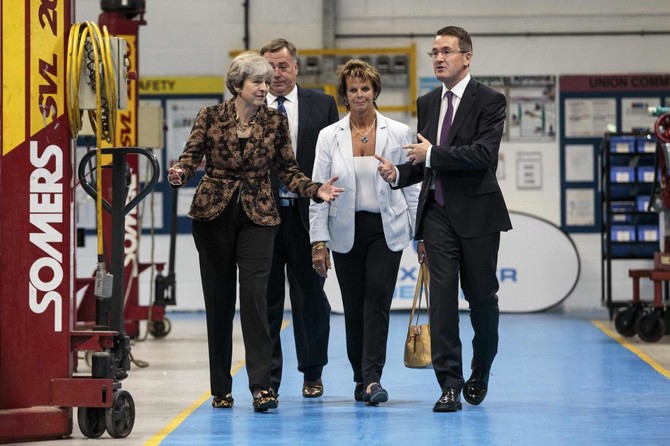
British Prime Minister Theresa May (L) staff as she tours the Alexander Dennis bus and coach manufacturers factory in Guildford, south of London, on August 23, 2017. The company has secured a 44-million GBP government finance deal to sell Britain's famous red double-decker buses to Mexico. A £1.7 billion package of taxpayer-funded support to help businesses make the most of opportunities outside of the European Union has helped 137 firms expand and win overseas contracts over the past year, the prime minister said. (AFP)
Updated 25 August 2017
Follow

Brexit fears slow British growth, hit consumers and businesses

LONDON: Britain’s economy suffered weakness on all fronts in the three months to June, with shoppers pinched by the pound’s tumble, exports failing to fill the gap, and business investment frozen by Brexit uncertainty.
The Office for National Statistics confirmed on Thursday the economy grew 0.3 percent in the second quarter after 0.2 percent in the first — adding up to the slowest growth for any major advanced economy since the start of 2017.
The data showed negligible growth in household spending and flat business investment.
A separate report suggested the malaise will continue. The Confederation of British Industry said retail sales growth slowed in August at the fastest pace in more than a year.
Last year Britain surprised most economists by continuing to grow strongly during the six months after the June vote to leave the European Union.
The growth was powered by robust consumer spending, despite a fall of around 15 percent in the value of the pound after the financial markets downgraded Britain’s long-run prospects following the Brexit vote.
But Thursday’s figures showed household spending is flagging with the weakest quarterly and annual growth since late 2014. Investment and foreign trade failed to compensate, despite a weaker currency and strong global economy.
“Sterling’s depreciation is doing more harm than good,” Samuel Tombs of consultancy Pantheon Macroeconomics said.
Consumer price inflation rose to a four-year high of 2.9 percent in May off the back of the weaker pound, and real-term growth in household spending slid to a quarterly rate of just 0.1 percent in the three months to June, the ONS said.
Flat year-on-year business investment undershot economists’ expectations for a modest 0.5 percent rise, while net trade contributed nothing to quarterly growth and acted as a 0.5 percent drag on Britain’s annual performance.
“The most recent three months growth has been almost entirely reliant on spending by households and government ... which doesn’t feel like the most stable of foundations for a post-Brexit economy,” said Lee Hopley, chief economist for manufacturing trade body EEF.
Barclays said the data was “highlighting just how much businesses are holding back investment in the face of high levels of uncertainty.”
Britain started formal talks to leave the EU in June, but businesses have complained that progress appears slow in light of the fixed deadline to leave in March 2019.
EU negotiators want agreement on membership dues, existing EU immigrants’ rights and Britain’s land border with Ireland before starting more substantive talks on future trade arrangements later this year.


Saudi Fund for Development, Omani Ministry of Finance sign MoU to establish industrial city

Updated 02 February 2026
Follow

Saudi Fund for Development, Omani Ministry of Finance sign MoU to establish industrial city

RIYADH: The CEO of the Saudi Fund for Development, Sultan bin Abdulrahman Al-Murshid, and the Omani Minister of Finance, Sultan bin Salem Al-Habsi, signed a development memorandum of understanding to support the establishment of the Thumrait Industrial City Project in Oman.

The project is funded by Saudi Arabia through the SFD with $40 million.

The signing ceremony was attended by the Saudi Ambassador to Oman, Ibrahim bin Saad bin Bishan, and several officials from both sides.

The MoU aims to develop the industrial, logistical, developmental, and social sectors in the Dhofar Governorate through the establishment of the integrated Thumrait Industrial City, covering an area of ​​approximately 3.94 million sq. meters.

The city will be equipped with all necessary infrastructure services. The project includes the construction and equipping of administrative and service buildings as well as public facilities. It also includes road works and electrical installations, as well as water networks and the construction of two wastewater treatment plants.

Engineering consultancy services will also be provided, reflecting the expected developmental impact in enhancing the industrial and service sectors in the governorate.

The CEO of the SFD affirmed that this MoU reflects the Kingdom’s efforts, through the fund, to support development sectors in Oman and strengthen the close development partnership between the two sides.

This will be achieved through the implementation of high-quality projects that contribute to developing infrastructure and creating an integrated and stimulating environment for industrial and logistical activities, which will positively impact the empowerment of the private sector and enhance economic as well as social development.

For his part, the Omani Minister of Finance emphasized that the signing of this agreement stems from a desire to strengthen developmental, economic, and investment relations and encourage partnerships across various sectors between the two countries.

At a time when the world is getting fragmented due to geopolitical tensions and ongoing wars, Saudi Arabia’s development fund is becoming a beacon of hope, as it continues to provide soft loans and grants for emerging economies.

Established in 1974 and commencing operations in 1975, the Saudi Fund for Development has financed more than 800 development projects in over 100 countries, with a cumulative value exceeding $21 billion.

SFD’s financing spans across multiple sectors, including health, education, and transport, as well as water and energy, with the aim of improving living conditions, enhancing capacity building, and creating job opportunities for millions of people in emerging nations.