Saleh loyalists accuse Houthi allies of ineptitude and corruption

1 / 3
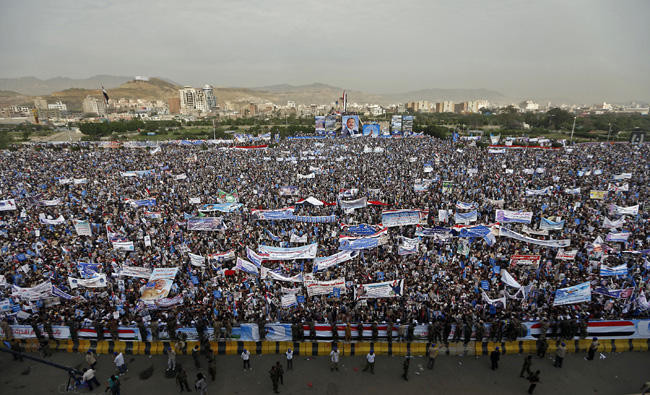
Hundreds of thousands of Yemenis take part in a demonstration in support of Yemen's ex-president Ali Abdullah Saleh, as his political party, the General People's Congress, marks 35 years since its founding, at Sabaeen Square in the capital Sanaa on August 24, 2017. (AFP / Mohammed Huwais)
2 / 3
Supporters of Yemen's former President Ali Abdullah Saleh rally to mark the 35th anniversary of the establishment of the General People's Congress party in Sanaa on Thursday. (REUTERS/Khaled Abdullah)
3 / 3
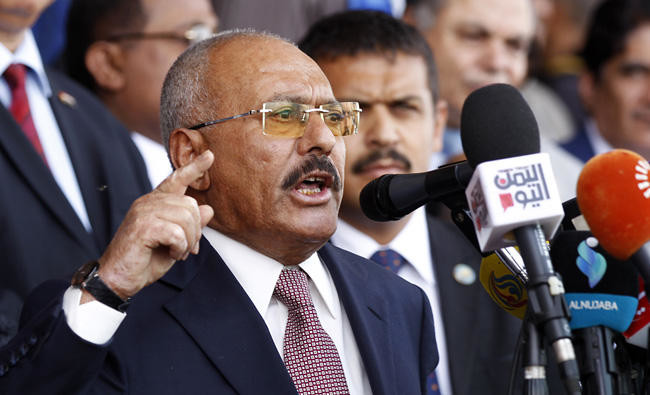
Yemen's ex-president Ali Abdullah Saleh gives a speech addressing his supporters during a rally as his General People's Congress party marks 35 years since its founding at Sabaeen Square in the capital Sanaa on August 24, 2017. (AFP / Mohammed Huwais)
Updated 24 August 2017
Follow

Saleh loyalists accuse Houthi allies of ineptitude and corruption

SANAA: Hundreds of thousands of Yemenis descended on Sanaa Thursday in a major show of force for ex-president Ali Abdullah Saleh, whose alliance with the country’s Shiite Houthi rebels has been shaken by mutual distrust.
Tensions have been rising between Saleh and his one-time foe, rebel chief Abdul Malik Al-Houthi, who in 2014 joined ranks in a shock alliance that drove the government out of the capital and into the southern province of Aden.
The rally marking 35 years since the founding of Saleh’s Arab nationalist General People’s Congress (GPC) sends out a signal that the strongman remains a force to be reckoned with.
“We came today to the square to show our faith in the General People’s Congress and in Ali Abdullah Saleh,” Saeed Al-Obeidi said at the rally.
“Today the GPC proved that it is a national party and that the Houthis are incapable of leading the nation the way a real political party can.”
Chanting “With our souls, with our blood, we serve you, Yemen,” crowds poured into the four-square-kilometer (1.5-square-mile) square and poured into the streets of the capital, waving the blue flag of the GPC and carrying pictures of the 75-year-old Saleh.
Saleh ruled Yemen with an iron fist for more than three decades before stepping down in 2012 after a bloody year-long uprising.
But the strongman retained the loyalty of some of the best-equipped units in the military and later joined forces with the Houthis, after they overran the capital in 2014.
The ensuing civil war between the Saudi-backed government and the Houthi-Saleh alliance has killed thousands and brought the Arabian Peninsula country to the brink of famine.
Saleh’s supporters had traveled to Sanaa from across the impoverished country, camping out in Sabaeen Square overnight ahead of the rally.
An AFP reporter in Sanaa said the Houthis had set up checkpoints at the main entrances to the city.
But they did nothing to stop the demonstrators from reaching the square, where the rebels had also deployed but did not interfere with the rally.
Saleh — who survived the 2011 Arab Spring protests that saw a string of his peers ousted from Egypt to Libya — appeared in person at the rally and gave a brief speech behind bulletproof glass, surrounded by heavily armed guards.
“We are political pioneers with a solid anchor, and we have been facing conspiracies against us since 2011,” he told the cheering crowd, referring to the start of protests in Sanaa that eventually led to his resignation.

Mismanaged by Houthis
Saleh said he was ready to deploy “tens of thousands of fighters to the frontlines,” on condition the rebel-led government train and pay them.
Analysts have said the rally serves in part as public protest against the Iran-backed Houthis, who with Saleh have run the capital since 2014.
The rebels have rapidly risen in a parallel government in Sanaa, and now hold clout in the city’s economy, defense and educational ministries.
Former troops and civil servants in the parallel rebel-run government have not been paid for months.
Saleh’s second-in-command in the GPC, Aref Al-Zouka, on Thursday accused the Houthis of financial mismanagement and corruption, saying the party refused to be “allies for show.”
A war of words between Saleh and Abdul Malik Al-Houthi, whose rebel group have historically clashed with Saleh’s troops, has escalated in the past week.
The two have publicly accused each other of treason, with Saleh hinting his allies were merely “a militia” and the rebels warning the former president he would “bear the consequences” of the insult.
The Houthis reportedly suspect Saleh has been negotiating with a Saudi-led Arab military coalition that supports the Yemeni government.
Saleh was a strong ally of Saudi Arabia from the late 1970s, when he fought the Houthis for control of Yemen, until 2014.
The Saleh camp has meanwhile accused the Houthis of aiming to consolidate their power in Sanaa.
The war between the government of President Abedrabbo Mansour Hadi, backed by the Saudi-led coalition, and the rebel camp has killed more than 8,300 Yemenis since 2015 and pushed the country to the brink of famine.
More than 30 people, including civilians, were killed on Wednesday in air raids on Sanaa, where the coalition has been bombing the Houthis since joining the war in 2015.
A cholera outbreak has independently claimed an estimated 2,000 lives since April in Yemen.
Iranian strikes kill two in UAE, injure eight in Qatar as regional conflict escalates

Updated 01 March 2026
Follow

Iranian strikes kill two in UAE, injure eight in Qatar as regional conflict escalates

  • UAE defense ministry said Iran fired 137 missiles and 209 drones at the territory
  • Qatar intercepted most of the 65 missiles and 12 drones launched by Iran, said officials

ABU DHABI: Explosions rocked cities across the Gulf on Saturday, killing two people in Abu Dhabi, while smoke and flames rose from Dubai landmark The Palm as Iran launched waves of attacks in retaliation for US and Israeli strikes.

The attacks hit airports in Abu Dhabi, Dubai and Kuwait, as well as Gulf military bases and residential areas, raising fears of a wider conflict and rattling a region long seen as a haven of peace and security.

Across the UAE, Iran fired 137 missiles and 209 drones at the territory, the country’s defense ministry said, as projectiles streaked across the skies of every Gulf state but Oman, a mediator in the recent US-Iran talks.

The UAE defense ministry said most of the missiles and drones were intercepted but at Abu Dhabi’s Zayed International Airport officials said at least one person was killed and seven wounded in an “incident.”

Earlier, falling debris killed a Pakistani civilian in Abu Dhabi, the United Arab Emirates’ capital, officials said.

At Dubai International Airport four people were injured according to airport authorities and four others were also hurt at the luxury Palm development.

In Qatar, officials said Iran launched 65 missiles and 12 drones toward the Gulf state, most of which were intercepted, but eight people were injured in the salvos, with one of them in critical condition.

“We are scared of what the future is for us now, and we can’t say how the next few days are going to be,” Maha Manbaz, a nursing student in Doha told AFP.

Terrified’

Smoke poured from US bases in Abu Dhabi and Bahrain’s capital Manama, home of the American navy’s Fifth Fleet, witnesses saw.

A drone struck Kuwait’s international airport and a base housing US personnel was targeted. Three Kuwaiti soldiers and 12 other people were wounded, authorities said.

After Iran’s Revolutionary Guards reported missile strikes, US Central Command (CENTCOM) said on X that no American naval vessels were hit, damage to US facilities was minimal, and no US casualties had been reported.

Residential buildings were also targeted in Manama, with officials saying firefighters and civil defense teams had been dispatched to the scene.

“The sound of the first explosion terrified me,” said a 50-year-old retiree living near the US base in Manama’s Juffair area, where residents were quickly evacuated.

The UAE, Saudi Arabia and Qatar warned they reserved the right to respond to the attacks.

The oil-and-gas-rich Arab monarchies, lying just across the Gulf from Iran, are long-term American allies and host a clutch of US military bases.

“The Gulf states are sandwiched between Iran and Israel, and have to bear the worst inclinations of both,” said Bader Al-Saif, an assistant professor at Kuwait University.

“Iran’s attacks on the Gulf are misplaced. They’ll only alienate its neighbors and invite further distancing from Iran,” he added.

Conflict is unusual in the Gulf, which has traded on its reputation for stability to become the Middle East’s commercial and diplomatic hub.

‘Significant damage’

The unprecedented barrage targeted Qatar’s Al Udeid base, the region’s biggest US military base, as well as Riyadh and eastern Saudi Arabia.

The UAE, Qatar and Kuwait all announced that their airspace was closed.

An AFP journalist in Qatar saw one missile destroyed in a puff of white smoke, while another in Dubai saw a volley of Patriot interceptors taking off.

Iran fired missiles at Al Udeid last June after US strikes targeted Iranian nuclear facilities during a brief war with Israel.

The escalation also saw Saudi Crown Prince Mohammed bin Salman and UAE President Mohamed bin Zayed speak for the first time since a public row in late December.

The Saudi de facto ruler called the Emirati president and the pair discussed Iran’s retaliatory strikes on the Gulf and expressed solidarity and sympathy.

In Kuwait, an Iranian missile attack caused “significant damage” to the runway at an air base hosting Italian air force personnel, Italian Foreign Minister Antonio Tajani was quoted by the ANSA news agency as saying.

Late on Saturday, Kuwaiti officials said a drone targeted a naval base there with air defense forces intercepting the projectile, according to a post by the defense ministry on X.

For many residents in the Gulf, which has drawn a cosmopolitan, largely expat population, the reaction was one of shock.

“I heard the explosions, I don’t know what I felt,” a Lebanese woman living in Riyadh told AFP.

“We came to the Gulf because it’s known to be safer than Lebanon. Now I don’t know what to do or how to think really.”