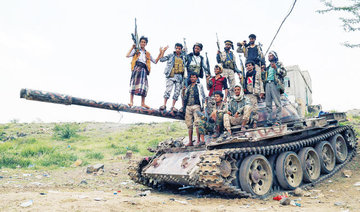
SANAA, Yemen: A long-simmering power struggle between Yemen’s Shiite insurgents and former president Ali Abdullah Saleh has burst into the open, threatening to undermine their alliance against the internationally-recognized government and its Saudi-led Coalition backers.
Armed men suspected of links to the rebels on Sunday tore up poster portraits of Saleh and his son and one-time heir Ahmed in Sanaa, Yemen’s capital.
The vandalism took place in a part of the city where Saleh’s Popular Conference party is due to hold celebrations on Thursday marking the 35th anniversary of its founding. Adding to the tension, an unusually high number of armed men could be seen in Sanaa on Sunday, fueling fears that the two sides may clash on the streets of the capital.
Saleh has complained that the rebels, known as Houthis, have sidelined him and his loyalists, leaving them out of military and political decisions, as well as UN-sponsored negotiations to end Yemen’s civil war.
Rebel leader Abdul-Malik Al-Houthi made thinly-veiled charges against Saleh and his loyalists late Saturday, saying his rebels have been “stabbed in the back while fighting the enemy in good faith.”
Without mentioning Saleh or forces loyal to him by name, he suggested that they were not fighting pro-government forces in earnest.
“Look who is on the front lines? Visit the graves (of fallen fighters) to see who is buried there and where they come from?” he said.
In a recorded address scheduled to be broadcast later on Sunday, Saleh dismissed the charges and complained of what he called the domination of decision-making by the Houthis’ Revolutionary Committees instead of the National Salvation government the two sides have jointly set up.
The rift between the Houthis and Saleh adds another layer to the vexing complexities of Yemen’s ruinous civil war.
Yemen’s civil war began in 2014, when the Houthis and their allies swept down from the country’s north and captured Sanaa. The Saudi-led coalition has waged a blistering air campaign since March 2015, seeking to dislodge the Houthis and restore the internationally recognized government, which has been confined to the southern port city of Aden for the past two years.
The war has killed over 10,000 civilians, displaced 3 million people, and pushed the country to the brink of famine. An outbreak of cholera has killed 2,000 people and infected an estimated 500,000, according to the UN’s World Health Organization.


![]()

Tensions rise within Yemen’s alliance of insurgents
Tensions rise within Yemen’s alliance of insurgents

Latest updates


© 2026 SAUDI RESEARCH & PUBLISHING COMPANY, All Rights Reserved And subject to Terms of Use Agreement.