BAGHDAD: At least 250 US-led airstrikes have pounded the Syrian city of Raqqa and surrounding territory in the past week, the coalition fighting Daesh said on Tuesday.
Coalition spokesman Colonel Ryan Dillon said that the air raids targeted the greater Raqqa area.
Activists and monitoring groups have reported that intensifying coalition bombardment of the city has left scores of civilians dead.
The Britain-based Syrian Observatory for Human Rights said at least 42 civilians had been killed in US-led strikes on Raqa on Monday, taking the civilian toll for the past eight days to 167.
Dillon said that the allegations would be taken seriously and investigated.
Since a US-backed offensive ousted Daesh from Mosul in Iraq in July, the coalition has had more available aircraft to strike Raqqa, he added.
"We have increased our strikes recently especially since the end of the Mosul battle," Dillon said.
Earlier this month, the coalition acknowledged the deaths of 624 civilians in its strikes in Syria and Iraq since 2014, but rights groups say the number is much higher.
The international alliance says it takes all possible measures to prevent unnecessary deaths.
"The avoidance of civilian casualties is our highest priority when conducting strikes against legitimate military targets with precision munitions, unlike the indiscriminate nature of ISIS tactics which result in an enormous number of avoidable civilian deaths," the coalition told AFP in an emailed statement on Tuesday.
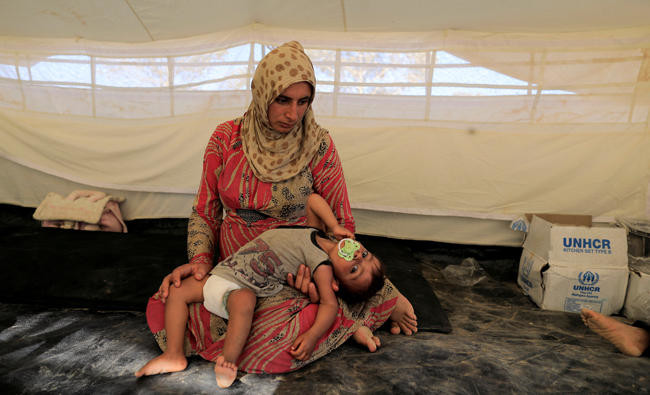
In another development, the International Labour Organization (ILO) said Jordan had opened its first job center inside a refugee camp, unlocking work opportunities across the country for thousands living in the world’s largest Syrian refugee camp.
So far, more than 800 refugees in Zaatari camp in Jordan, which borders Syria and is home to nearly 80,000 people, have registered for work permits at the job center.
“Refugee workers now have a clear address to resort to when searching for jobs and applying for work permits, where they can receive all necessary information and benefit from expert support,” said Maha Kattaa, ILO response coordinator in Jordan, said in a statement.
The Jordanian government says the country is home to 1.4 million Syrians, of whom more than 660,000 are registered with the UN refugee agency UNHCR.
Allowing refugees to work in host countries relieves pressure on social services, boosts the local economy, and gives refugees the financial security to reestablish their lives, the UN refugee agency UNHCR said, which manages work permits and the flows in and out of Zaatari camp.
“I am confident that having an increased number of Syrians entering the labor market will positively impact the local economy and bring stability to refugee families,” said Stefano Severe, a UNHCR spokesman in Jordan.
Earlier this month Jordan became the first Arab country to issue Syrian refugees with a new type of work permit that opens up the growing construction sector.
The center, launched by the Jordanian government, will run job fairs and employment matching services with businesses across the country.
There are also plans to open a second center in a nearby camp in Azraq, ILO said.

US-led airstrikes target greater Raqqa area
Hamas to elect first leader since Sinwar killed by Israel
- Role left vacant since Israel killed Yahya Sinwar in 2024
- Khalil Al-Hayya and Khaled Meshaal are seen as frontrunners
CAIRO: Hamas is expected to elect a new leader this month, two sources in the group told Reuters, filling the role left vacant since Israel killed Yahya Sinwar in 2024 despite concerns that a successor could suffer the same fate.
Khalil Al-Hayya and Khaled Meshaal are seen as frontrunners for the helm at a vital moment for the militant Islamist group, battered by two years of war ignited by its October 7, 2023 attack on Israel and facing international demands to disarm.
Both men reside in Qatar and sit on a five-man council that has run Hamas since Israel killed Sinwar, a mastermind of the October 7 attack. His predecessor, Ismail Haniyeh, was assassinated by Israel while on a visit to Iran in 2024.
The election process has already begun, the sources said. The leader is chosen in a secret ballot by Hamas’ Shoura Council, a 50-member body that includes Hamas members in the Israeli-occupied West Bank, the Gaza Strip, and exile.
A Hamas spokesperson declined to comment.
Tough challenges
The sources said a deputy leader will also be elected to replace Saleh Al-Arouri, who was killed by an Israeli airstrike in Lebanon in 2024.
Sources close to Hamas said it was determined to conclude the vote, though some preferred an extension of collective leadership.
Hamas watchers regard Meshaal as part of a pragmatic wing with good ties to Sunni Muslim countries, and Hayya, the group’s lead negotiator, as part of a camp that deepened its relations with Iran.
Hamas faces some of the toughest challenges since it was founded in 1987. While fighting has largely abated in Gaza since the US-brokered ceasefire in October, Israel still holds almost half the coastal enclave, attacks continue, and conditions for Gaza’s 2 million people remain dire.
Hamas has also drawn criticism within Gaza because of the heavy toll inflicted by the war, with much of the enclave reduced to ruins and more than 71,000 people killed, according to Gaza health authorities.
Hamas-led militants killed some 1,200 people and abducted 251 others in the October 7 cross-border assault on Israel.
US President Donald Trump’s ceasefire plan for Gaza demands Hamas disarm and foresees the enclave being run by a technocratic Palestinian administration overseen by an international body called the Board of Peace.
Targeted by Israel
Hamas has so far refused to disarm, saying the question of armed resistance is a matter for wider debate among Palestinian factions and that it would be ready to surrender its weapons to a future Palestinian state, an outcome Israel has ruled out.
Hamas is designated as a terrorist organization by Western powers including the United States.
Born in Gaza, Hayya was among Hamas leaders targeted by an Israeli airstrike on Qatar in September.
Israeli Prime Minister Benjamin Netanyahu later expressed regret to the emir of Qatar — a US ally — in a three-way call with Trump and affirmed Israel would not conduct such an attack again in the future, the White House said at the time.
Meshaal previously led Hamas for almost two decades. Israeli agents tried to assassinate him in Jordan in 1997 by injecting him with poison.
His relations with Iran were strained in 2012 when he distanced Hamas from Tehran’s Syrian ally, the now-ousted President Bashar Assad, early in the Arab Spring uprisings.
Hamas was founded as the Palestinian branch of the Muslim Brotherhood and is the main rival to the Palestinians’ Fatah national movement led by 90-year-old President Mahmoud Abbas.
Hamas’ founding charter called for the destruction of Israel, although its leaders have at times offered a long-term truce with Israel in return for a viable Palestinian state on all Palestinian territory occupied by Israel in the 1967 war.
Israel regards this approach as a ruse.
Analyst Reham Owda said there were limited differences between Hayya and Meshaal over the conflict with Israel but believed Meshaal had better chances as he could “market (Hamas) internationally and help rebuild its capabilities.”
Khalil Al-Hayya and Khaled Meshaal are seen as frontrunners for the helm at a vital moment for the militant Islamist group, battered by two years of war ignited by its October 7, 2023 attack on Israel and facing international demands to disarm.
Both men reside in Qatar and sit on a five-man council that has run Hamas since Israel killed Sinwar, a mastermind of the October 7 attack. His predecessor, Ismail Haniyeh, was assassinated by Israel while on a visit to Iran in 2024.
The election process has already begun, the sources said. The leader is chosen in a secret ballot by Hamas’ Shoura Council, a 50-member body that includes Hamas members in the Israeli-occupied West Bank, the Gaza Strip, and exile.
A Hamas spokesperson declined to comment.
Tough challenges
The sources said a deputy leader will also be elected to replace Saleh Al-Arouri, who was killed by an Israeli airstrike in Lebanon in 2024.
Sources close to Hamas said it was determined to conclude the vote, though some preferred an extension of collective leadership.
Hamas watchers regard Meshaal as part of a pragmatic wing with good ties to Sunni Muslim countries, and Hayya, the group’s lead negotiator, as part of a camp that deepened its relations with Iran.
Hamas faces some of the toughest challenges since it was founded in 1987. While fighting has largely abated in Gaza since the US-brokered ceasefire in October, Israel still holds almost half the coastal enclave, attacks continue, and conditions for Gaza’s 2 million people remain dire.
Hamas has also drawn criticism within Gaza because of the heavy toll inflicted by the war, with much of the enclave reduced to ruins and more than 71,000 people killed, according to Gaza health authorities.
Hamas-led militants killed some 1,200 people and abducted 251 others in the October 7 cross-border assault on Israel.
US President Donald Trump’s ceasefire plan for Gaza demands Hamas disarm and foresees the enclave being run by a technocratic Palestinian administration overseen by an international body called the Board of Peace.
Targeted by Israel
Hamas has so far refused to disarm, saying the question of armed resistance is a matter for wider debate among Palestinian factions and that it would be ready to surrender its weapons to a future Palestinian state, an outcome Israel has ruled out.
Hamas is designated as a terrorist organization by Western powers including the United States.
Born in Gaza, Hayya was among Hamas leaders targeted by an Israeli airstrike on Qatar in September.
Israeli Prime Minister Benjamin Netanyahu later expressed regret to the emir of Qatar — a US ally — in a three-way call with Trump and affirmed Israel would not conduct such an attack again in the future, the White House said at the time.
Meshaal previously led Hamas for almost two decades. Israeli agents tried to assassinate him in Jordan in 1997 by injecting him with poison.
His relations with Iran were strained in 2012 when he distanced Hamas from Tehran’s Syrian ally, the now-ousted President Bashar Assad, early in the Arab Spring uprisings.
Hamas was founded as the Palestinian branch of the Muslim Brotherhood and is the main rival to the Palestinians’ Fatah national movement led by 90-year-old President Mahmoud Abbas.
Hamas’ founding charter called for the destruction of Israel, although its leaders have at times offered a long-term truce with Israel in return for a viable Palestinian state on all Palestinian territory occupied by Israel in the 1967 war.
Israel regards this approach as a ruse.
Analyst Reham Owda said there were limited differences between Hayya and Meshaal over the conflict with Israel but believed Meshaal had better chances as he could “market (Hamas) internationally and help rebuild its capabilities.”
© 2026 SAUDI RESEARCH & PUBLISHING COMPANY, All Rights Reserved And subject to Terms of Use Agreement.