US-backed Syrian forces close in on Raqqa from south

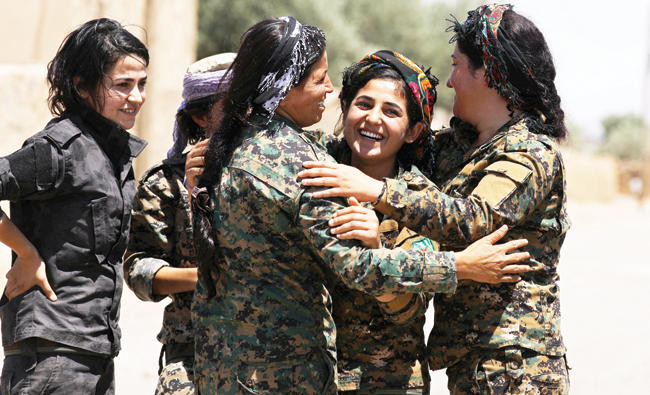
Syrian Democratic Forces fighters greet a field commander, center, near Raqqa city, in this June 7 photo. (Reuters)
Updated 21 June 2017
Follow

US-backed Syrian forces close in on Raqqa from south

BEIRUT: US-backed Syrian militias closed in on Daesh’s Syrian stronghold of Raqqa on Wednesday, taking territory on the south bank of the Euphrates River with the aim of encircling the city, a militia spokesman told Reuters.
The Syrian Democratic Forces (SDF), which includes Arab and Kurdish fighters and are supported with airstrikes by a US-led coalition, began an offensive two weeks ago to seize the northern city from Daesh, which overran it in 2014.
Nouri Mahmoud, spokesman for the Kurdish YPG militia, which is part of the SDF, told Reuters Daesh had been ousted from the suburb of Kasrat Al-Farj as the SDF moved in along the southern riverbank from the west.
When the campaign began the SDF had Raqqa, which sits on the Euphrates’ northern bank, surrounded from the north, west and east. Although Daesh controlled the south bank of the river, coalition airstrikes had destroyed the bridges connecting it to the city.
The SDF is now trying to enact a siege of the city by taking the southern bank. The forces are a couple of kilometers from achieving this aim.
The Syrian Observatory for Human Rights war monitor said on Wednesday SDF forces had moved along the southern riverbank to reach the eastern edge of Kasrat Al-Farj, in the area between the new and old bridges into Raqqa.
Daesh is also facing defeat in its Iraqi stronghold of Mosul and is being forced into retreat across much of Syria, where Deir Al-Zor in eastern Syria is its last major foothold.
After Daesh
Meanwhile, local Syrians who have escaped the battlefield are worried about what comes after the fight.
Dozens of them have volunteered to help rebuild the town once the militants have been defeated.
The aim of organization they have joined, the Raqqa Civil Council (RCC), is to restore order and keep the peace in a place where further violence could fuel the rise of a new set of extremists with global ambitions.
The RCC was established in April by Kurdish and Arab allies of the US-led coalition that began attacking Raqqa this month, to replace militant rule in a part of Syria long beyond President Bashar Assad’s control.
The campaign against Daesh has accelerated since US President Donald Trump took office in January with the militants now facing defeat in both Raqqa and Mosul in Iraq.


Israeli-backed group kills a senior Hamas police officer in Gaza, threatens more attacks

Updated 3 sec ago
Follow

Israeli-backed group kills a senior Hamas police officer in Gaza, threatens more attacks

  • Hussam Al-Astal, leader of an anti-Hamas group based in an area under Israeli control east of Khan Younis, claimed responsibility for the killing
CAIRO: An Israeli-backed Palestinian militia said on Monday it had killed a senior Hamas police officer in the southern Gaza Strip, an incident which Hamas blamed on “Israeli collaborators.”
A statement from the Hamas-run interior ministry said gunmen opened fire from a passing car, ​killing Mahmoud Al-Astal, head of the criminal police unit in Khan Younis, in the south of the enclave. It described the attackers as “collaborators with the occupation.”
Hussam Al-Astal, leader of an anti-Hamas group based in an area under Israeli control east of Khan Younis, claimed responsibility for the killing in a video he posted on his Facebook page. The surname he shares with the dead man, Al-Astal, is common in that part of Gaza.
“To those who work with Hamas, your destiny is to be killed. Death is coming to you,” he ‌said, dressed in ‌a black military-style uniform and clutching an assault rifle.
Reuters could ‌not ⁠independently ​verify ‌the circumstances of the attack. An Israeli military official said the army was not aware of any operations in the area.
The emergence of armed anti-Hamas groups, though still small and localized, has added pressure on the Islamists and could complicate efforts to stabilize and unify a divided Gaza, shattered by two years of war.
These groups remain unpopular among the local population as they operate in areas under Israeli control, although they publicly deny they take Israeli orders. Hamas has held public executions ⁠of people it accuses of collaboration.
Under a ceasefire in place since October, Israel has withdrawn from nearly half of ‌the Gaza Strip, but its troops remain in control of ‍the other half, largely a wasteland ‍where virtually all buildings have been levelled.
Nearly all of the territory’s two million people ‍now live in Hamas-held areas, mostly in makeshift tents or damaged buildings, where the group has been reasserting its grip. Four Hamas sources said it continues to command thousands of fighters despite suffering heavy losses during the war.
Israel has been allowing rivals of Hamas to operate in areas it controls. In ​later phases, US President Donald Trump’s plan for Gaza calls for Israel to withdraw further and for Hamas to yield power to an internationally backed administration, ⁠but there has so far been no progress toward those steps.
Prime Minister Benjamin Netanyahu acknowledged Israeli backing for anti-Hamas groups in June, saying Israel had “activated” clans, but has given few details since then.
The ceasefire has ended major combat in Gaza over the past three months, but both sides have accused the other of regular violations. More than 440 Palestinians and three Israeli soldiers have been killed since the truce took effect.
Gaza health authorities said on Monday Israeli drone fire killed at least three people near the center of Khan Younis.
The Israeli military did not have an immediate comment on the drone incident.
The war erupted on October 7, 2023 when Gazan militants invaded Israel, killing about 1,200 people and taking some 250 hostages, according to ‌Israeli tallies.
Israel’s subsequent military assault on Gaza has killed more than 71,000 Palestinians, according to the enclave’s health ministry, and led to accusations of genocide and war crimes, which Israel denies.