MEMPHIS, USA: Elvis Presley, American icon and King of rock ‘n’ roll, transformed popular culture, sold over a billion records and is idolized as ever on the 40th anniversary of his tragic death.
His Graceland mansion in Memphis, Tennessee — the second most famous home in the United States after the White House — expects more than 50,000 people to descend for the biggest ever annual celebration of his life 40 years after his death aged 42 on August 16, 1977.
Presley is considered the best selling artist of all time, shifting an estimated billion records. In 2016, Forbes ranked him fourth highest earning dead celebrity at $27 million, still moving a million albums.
“He is the only person of modern times who is instantly recognizable throughout the world by his first name,” said British author and artist Ted Harrison, who has written two books about Presley.
“Say ‘Elvis’ in Beijing, Nicaragua, Estonia or Fiji and you get an immediate recognition across language and culture,” he told AFP.
His unique voice and style blended R&B, blues, country, gospel and black music, challenging social and racial barriers at the time, and earning him the nickname “Elvis the Pelvis” for his gyrating moves.
Oozing style, charisma and naked sex appeal, he was the fantasy of millions of women and inspired everyone who came after him, from The Beatles to The Rolling Stones to today’s chart-topper Bruno Mars.
“Hearing him for the first time was like busting out of jail,” Bob Dylan has said.
In the late 1960s, the composer and conductor Leonard Bernstein called him “the greatest cultural force in the 20th century.”
Hits such as “Heartbreak Hotel,” “Hound Dog,” “Jailhouse Rock” and “Are You Lonesome Tonight” are instantly recognizable. His music has been reissued and repackaged countless times since his death.
More than 20 million people have visited Graceland, his home for 20 years, after Priscilla, his ex-wife and mother of his only child Lisa Marie, opened it to the public in 1982.
The estate says it pulls in 600,000 visitors a year and contributes around $150 million a year to the Memphis economy. Neither is it showing any sign of slowing down.
In March, it opened a brand-new $45 million entertainment complex and hotel spread across 40 acres.
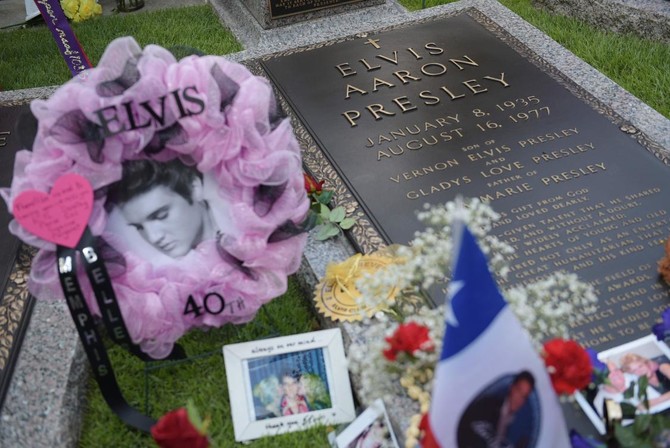
Die-hard fans are often moved to tears at his gravesite at Graceland, where he is interred next to his beloved parents, Gladys and Vernon, and grandmother Minnie Mae, covered in flowers, tributes and mementos.
“It gives you that fire,” said Stephanie Harris, 42, from Michigan who sells life insurance. “His music is transcendent to our generation because there’s nothing like the ‘Hound Dog’ baby.”
In downtown Memphis, home of the blues, you can buy everything Elvis — from Christmas tree decorations to luggage. Cardboard Elvis cutouts greet you outside bars and his music blares out of loudspeakers.
“He’s the celebrity of all celebrities,” said Lisa Bseiso, 36, who set up The Official Elvis Presley Fan Club of Qatar, the Middle Eastern kingdom where she was born and raised.
“Forty years after his death, that’s why he’s a phenomenon. He’s still as powerful, as loving.”
Born to a truck driver father and sewing-machine operator in a two-room house in Tupelo, Mississippi, on January 8, 1935, Presley grew up an only child after his brother was stillborn.
In 1948, he and his parents moved to Memphis, he graduated high school, cut his first record aged 19 and became an almost instant star.
As an early rebel whose hip-swiveling, pulsating leg-tapping had conservatives up in arms, his music also crossed the racial divide in a South where the specter of segregation still loomed large.
“Far more worrying to many white Americans was the way he took African-American music and presented it mainstream,” says Harrison.
Then came a two-year stint in the US Army during the Cold War, he was shipped off to West Germany, promoted to sergeant and after leaving the military turned into a respectable family entertainer.
But if he embodied the American dream — the poor boy made good who doted on his parents and liked to buy Cadillacs for strangers off the street on a whim — he also personified American excess.
He became a total recluse, abusing a dizzying array of prescription pills, overate, becoming a bloated shadow of his once lithe self in declining health and plagued by poor management.
His last live performance was on June 25, 1977, in Indianapolis and on August 16, 1977, the day before his next scheduled concert, he was found dead in his bathroom.


Elvis: 40 years since the death of ‘the King’
Elvis: 40 years since the death of ‘the King’


As an uncertain 2026 begins, virtual journeys back to 2016 become a trend
- Over the past few weeks, millions have been sharing throwback photos to that time on social media, kicking off one of the first viral trends of the year
LONDON: The year is 2016. Somehow it feels carefree, driven by Internet culture. Everyone is wearing over-the-top makeup.
At least, that’s how Maren Nævdal, 27, remembers it — and has seen it on her social feeds in recent days.
For Njeri Allen, also 27, the year was defined by the artists topping the charts that year, from Beyonce to Drake to Rihanna’s last music releases. She also remembers the Snapchat stories and an unforgettable summer with her loved ones. “Everything felt new, different, interesting and fun,” Allen says.
Many people, particularly those in their 20s and 30s, are thinking about 2016 these days. Over the past few weeks, millions have been sharing throwback photos to that time on social media, kicking off one of the first viral trends of the year — the year 2026, that is.
With it have come the memes about how various factors — the sepia hues over Instagram photos, the dog filters on Snapchat and the music — made even 2016’s worst day feel like the best of times.
Part of the look-back trend’s popularity has come from the realization that 2016 was already a decade ago – a time when Nævdal says she felt like people were doing “fun, unserious things” before having to grow up.
But experts point to 2016 as a year when the world was on the edge of the social, political and technological developments that make up our lives today. Those same advances — such as developments under US President Donald Trump and the rise of AI — have increased a yearning for even the recent past, and made it easier to get there.
2016 marked a year of transition
Nostalgia is often driven by a generation coming of age — and its members realizing they miss what childhood and adolescence felt like. That’s certainly true here. But some of those indulging in the online journeys through time say something more is at play as well.
It has to do with the state of the world — then and now.
By the end of 2016, people would be looking ahead to moments like Trump’s first presidential term and repercussions of the United Kingdom leaving the EU after the Brexit referendum. A few years after that, the COVID-19 pandemic would send most of the world into lockdown and upend life for nearly two years.
Janelle Wilson, a professor of sociology at the University of Minnesota-Duluth, says the world was “on the cusp of things, but not fully thrown into the dark days that were to come.”
“The nostalgia being expressed now, for 2016, is due in large part to what has transpired since then,” she says, also referencing the rise of populism and increased polarization. “For there to be nostalgia for 2016 in the present,” she added, “I still think those kinds of transitions are significant.”
For Nævdal, 2016 “was before a lot of the things we’re dealing with now.” She loved seeing “how embarrassing everyone was, not just me,” in the photos people have shared.
“It felt more authentic in some ways,” she says. Today, Nævdal says, “the world is going downhill.”
Nina van Volkinburg, a professor of strategic fashion marketing at University of the Arts, London, says 2016 marked the beginning of “a new world order” and of “fractured trust in institutions and the establishment.” She says it also represented a time of possibility — and, on social media, “the maximalism of it all.”
This was represented in the bohemian fashion popularized in Coachella that year, the “cut crease” makeup Nævdal loved and the dance music Allen remembers.
“People were new to platforms and online trends, so were having fun with their identity,” van Volkinburg says. “There was authenticity around that.”
And 2016 was also the year of the “boss babe” and the popularity of millennial pink, van Volkinburg says, indications of young people coming into adulthood in a year that felt hopeful.
Allen remembers that as the summer she and her friends came of age as high school graduates. She says they all knew then that they would remember 2016 forever.
Ten years on, having moved again to Taiwan, she said “unprecedented things are happening” in the world. “Both of my homes are not safe,” she said of the US and Taiwan, “it’s easier to go back to a time that’s more comfortable and that you felt safe in.”
Feelings of nostalgia are speeding up
In the last few days, Nævdal decided to hide the social media apps on her phone. AI was a big part of that decision. “It freaks me out that you can’t tell what’s real anymore,” she said.
“When I’ve come off of social media, I feel that at least now I know the things I’m seeing are real,” she added, “which is quite terrifying.”
The revival of vinyl record collections, letter writing and a fresh focus on the aesthetics of yesterday point to nostalgia continuing to dominate trends and culture. Wilson says the feeling has increased as technology makes nostalgia more accessible.
“We can so readily access the past or, at least, versions of it,” she said. “We’re to the point where we can say, ‘Remember last week when we were doing XYZ? That was such a good time!’”
Both Nævdal and Allen described themselves as nostalgic people. Nævdal said she enjoys looking back to old photos – especially when they show up as “On This Day” updates on her phone, She sends them to friends and family when their photos come up.
Allen wished that she documented more of her 2016 and younger years overall, to reflect on how much she has evolved and experienced since.
“I didn’t know what life could be,” she said of that time. “I would love to be able to capture my thought process and my feelings, just to know how much I have grown.”


