China lung cancer on rise, smog suspected — China Daily

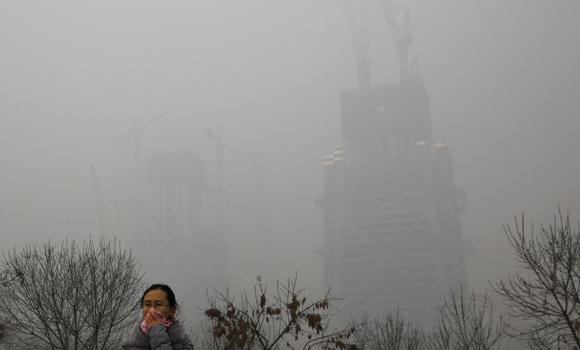
A woman covers her face from pollutants as she walks past a construction building on a heavily polluted day in Beijing on Nov. 30, 2015. China's health officials have seen a sharp rise in the incidence of lung cancer in the past 10-15 years, with long-term exposure to air pollution a possible culprit, the official China Daily reported on Friday. (AP Photo/Andy Wong)
Updated 11 August 2017
Follow

China lung cancer on rise, smog suspected — China Daily

SHANGHAI, China: Health officials have seen a sharp rise in the incidence of lung cancer in the past 10-15 years, with long-term exposure to air pollution a possible culprit, the official China Daily reported on Friday.
Experts with the China Academy of Medical Sciences said lung cancer was rising rapidly in groups not normally susceptible to the disease, including women and non-smokers, suggesting that smoking was not responsible for the increase, China Daily said.
An estimated 300 million Chinese people are smokers, but the paper said there had been a rapid increase in a form of lung cancer that develops deep in the lung and is not associated with tobacco use.
China has been waging a battle against hazardous air pollution, with concentrations of small, breathable particles known as PM2.5 frequently exceeding 300 micrograms per cubic meter in industrialized northern regions.
Last year’s national average stood at 47 micrograms, with only a quarter of cities meeting the country’s official air quality guideline of 35 micrograms. The World Health Organization recommends levels of no more than 10 micrograms.
A study published earlier this year by the British Medical Journal said China could prevent three million premature deaths a year if it raised air quality to meet WHO guidelines.
The Chinese government acknowledged in a three-year campaign to tackle cancer launched in 2015 that environmental pollution had contributed to a surge of cancer cases in the country.
According to the latest figures, there were nearly 4.3 million new cancer patients in China in 2015, including 730,000 cases of lung cancer, accounting for 36 percent of the world’s total. Cancer is responsible for around a quarter of Chinese deaths, and has become a massive burden on the country’s medical system.
Several local studies have also established links between cancer and air pollution. Research published last year by the Hebei Medical University showed that lung cancer mortality rates in the province — known as China’s most polluted — nearly trebled from 1973-75 to 2010-2011.
Water pollution and the excessive use of chemical fertilizers and pesticides has also been blamed for an increase in rural cancer rates. (Reporting by David Stanway)


Fourth pair of Filipino twins set to fly to Riyadh next week for separation surgery

Updated 4 sec ago
Follow

Fourth pair of Filipino twins set to fly to Riyadh next week for separation surgery

  • Born in April 2024, Olivia and Gianna Manuel are joined from the chest to the abdomen
  • Their mother learned about Saudi Conjoined Twins Program from social media updates

MANILA: As they prepare to travel to Riyadh next week for separation surgery, the parents of Olivia and Gianna Manuel have renewed hopes that their children will grow up like others, as they have become the fourth pair of Filipino twins to be taken care of by the Saudi Conjoined Twins Program.

The girls from the town of Talavera in the central Philippine province of Nueva Ecija were born in April 2024.

They are joined from the chest to the abdomen, a condition known as omphalopagus.

“They can’t eat properly. It’s really difficult for them. When one is lying down, the other often gets pinned down because the bigger one is very hyper. The smaller one is usually underneath,” the children’s mother, Ginalyn Manuel, told Arab News.

“When they’re lying down or sleeping, even if one still wants to sleep, she’s forced to wake up because the other keeps moving.”

She first learned about the Saudi Conjoined Twins Program when she followed social media updates on Akhizah and Ayeesha Yusoph, the second pair of Filipino twins to undergo separation surgery in Saudi Arabia.

At that time, she was still in the hospital with the girls, closely monitored by doctors for three months after they were born. She then reached out to the King Salman Humanitarian Aid and Relief Center, which runs the conjoined twins program, and in July last year, a hospital in Riyadh got in touch with her.

After various steps of medical qualification, the Saudi Embassy in Manila announced the girls would soon travel to the Kingdom with their parents to undergo the separation procedure.

They are scheduled to fly to Riyadh on Jan. 26.

“Out of so many people, we were given the chance for our twins to be separated. If it were just us, we really couldn’t afford it. The help from the Saudi government is truly enormous,” Manuel said.

“I imagine them playing here, already apart, walking on their own. It feels so good just thinking about it. That’s what I always include in my prayers — that their separation surgery will be successful.”

Saudi Arabia is known as a pioneer in the field of separation surgery. KSrelief was established by King Salman in 2015 and is headed by Dr. Abdullah Al-Rabeeah, one of the world’s most renowned pediatric surgeons.

Since 1990, he and his team have separated more than 140 children from 27 countries who were born sharing internal organs with their twins.

The first pair of Filipino conjoined twins, Ann and Mae Manzo, were separated under the program in March 2004. They were joined at the abdomen, pelvis and perineum.

They were followed by the Yusoph twins, who were joined at the lower chest and abdomen and shared one liver. Their successful separation procedure was in September 2024.

The third pair of Filipino conjoined twins, Maurice Ann and Klea Misa, who are joined at the head, flew to Riyadh in May and are currently being prepared for their surgery.