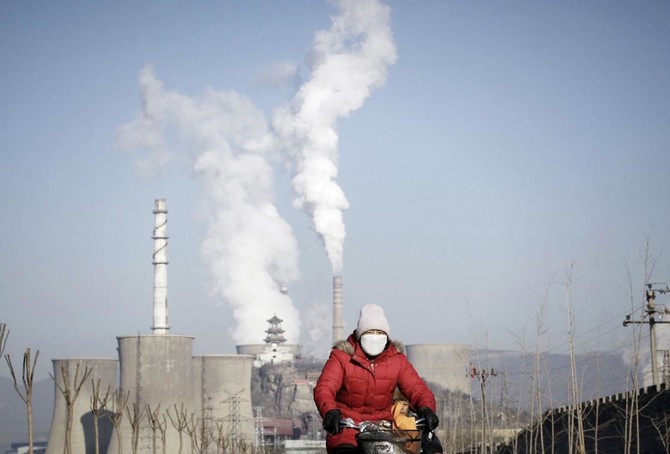
SHANGHAI: China and the Asia Development Bank (ADB) have launched a green financing platform to support efforts by small- and medium-sized enterprises (SMEs) to cut pollution in the smog-hit Beijing-Tianjin-Hebei region, ADB said on Friday.
The area, home to six of China’s 10 smoggiest cities in the first quarter of this year, has promised to upgrade or shut vast swathes of polluting industry as it tries to meet 2017 air quality targets.
But financing the transition to cleaner energy has proved one of its biggest challenges, especially in poorer rural regions of Hebei, where the switch from coal to natural gas is expected to cost at least 300 billion yuan ($44.04 billion) over the period between 2016 and 2020.
The financing platform was launched by the ADB and the China National Investment and Guaranty Corporation (I&G), the State Development and Investment Corporation (SDIC), as well as China’s Finance Ministry and National Development and Reform Commission (NDRC).
The bank late last year approved a loan of €458 million ($510.58 million) for the platform, which it said will leverage €3.6 billion in domestic commercial financing.
According to Hebei delegates attending an annual session of the Parliament in March, the government is only expected to provide around 10-15 percent of the 3-4 trillion yuan of green investment China needs every year over the next five years.
China began to develop green financing in 2007 and more than 8 trillion yuan in “green credit,” used to finance clean projects, has been issued. However, environmental financing mechanisms remain inadequate, especially when it comes to tackling widespread soil and water pollution, and SMEs have also struggled to get funding.
“The reality is, even though SMEs realize the need to invest in cleaner production facilities, they often do not have access to finance,” said Ayumi Konishi, director-general of ADB’s East Asia Department, at a ceremony held in Beijing on Friday.
China selected five regions this week to take part in pilot government green financing schemes, the Cabinet said on Wednesday.
It promised to back financial institutions in their efforts to set up green financing businesses, encourage small loans and provide support to venture capital and private equity funds participating in green investment programs.
It also said it would explore new green credit mechanisms, including the granting of loans that accept emission trading earnings as collateral.

China, ADB launch green financing platform to fight pollution
Gulf oil exports could stop within weeks, warns Qatar energy minister as Iran war continues
RIYADH: Gulf oil producers could halt exports within weeks due to the ongoing Middle East war, sending crude prices to $150 a barrel, according to Qatar’s energy minister.
In an interview published on Friday, Saad Al-Kaabi warned oil could hit the figure in two to three weeks if ships and tankers were unable to pass through the Strait of Hormuz, which is the world's most vital oil export route as it connects the biggest Gulf oil producers with the Gulf of Oman and the Arabian Sea.
Hostilities between US-Israeli forces and Iran, which began with strikes on Iran on Feb. 28, has continued to cause widespread disruption across the region, and led to the virtual closure of the Strait of Hormuz and the shutdown of multiple national airspaces.
Speaking to the Financial Times, Al-Kaabi said that “everybody that has not called for force majeure we expect will do so in the next few days that this continues. All exporters in the Gulf region will have to call force majeure.”
As well as the $150-a-barrel oil price warning, the minister also expects gas prices to rise to $40 per million British thermal units.
He added that if the war continues for a few weeks, “GDP growth around the world” will be impacted.
“Everybody's energy price is going to go higher. There will be shortages of some products and there will be a chain reaction of factories that cannot supply,” Kaabi said.
Qatar halted its liquefied natural gas production on March 2, as Iranian retaliation for US and Israeli strikes continued to target Gulf countries. The halt takes a major facility offline that accounts for roughly 20 percent of global supply, a key resource that balances demand in both Asian and European markets.
Al-Kaabi said even if the war ended immediately it would take Qatar “weeks to months” to return to a normal cycle of deliveries.
Oil continues to rise
Oil prices rose again on Friday, with Brent crude up 2.77 percent to $87.78 a barrel and West Texas Intermediate up 4.41 percent to $84.36 at 11:47 a.m. GMT
The price surge followed the start of the war on Feb. 28, which halted tanker movements through the Strait of Hormuz, a waterway that typically carries approximately one-fifth of the world’s daily oil supply, or about 20 million barrels per day.
The conflict has since spread across the key Middle East energy-producing region, causing disruptions to oil output and the shutdown of refineries and liquefied natural gas plants.
The US Treasury Department indicated it would announce measures to combat rising energy prices from the Iran conflict, including potential action involving the oil futures market, a move that would mark an unusual attempt by Washington to influence energy prices through financial markets rather than physical oil supplies.
The Treasury also granted waivers for companies to start buying sanctioned Russian oil stored on tankers to ease supply constraints that have pushed Asian refineries to reduce fuel processing.
“To enable oil to keep flowing into the global market, the Treasury Department is issuing a temporary 30-day waiver to allow Indian refiners to purchase Russian oil. This deliberately short-term measure will not provide significant financial benefit to the Russian government as it only authorizes transactions involving oil already stranded at sea,” Treasury Secretary Scott Bessent said on X.
He emphasized that India is an “essential partner” and expressed anticipation that New Delhi will ramp up purchases of US oil. “This stop-gap measure will alleviate pressure caused by Iran’s attempt to take global energy hostage.”
Imad Salamey, professor of political science and international affairs at the Lebanese American University, told Arab News that such measures “may work as short-term shock absorbers by calming markets and preventing immediate price spikes.”
However, he warned that financial engineering cannot permanently compensate for disrupted physical supply.
“If the Strait of Hormuz remains impaired, markets will eventually adjust to the reality of reduced flows. Relying too heavily on financial tools risks creating distortions where prices no longer reflect actual supply conditions,” Salamey explained.
If the war drags on and global economic costs continue to rise daily, Salamey added, the impact will spread far beyond the region. “Substituting Gulf oil with supplies from Russia or Venezuela could severely damage Gulf economies and shift long-term market dynamics,” he warned.
In an interview with Arab News, economist and Lebanese University professor Jassem Ajaka noted that “US President Donald Trump would not allow an internal uprising to undermine him before the midterm elections, suggesting he would make strategic reserves available if needed.”
He added that the US also has the capacity to ramp up shale oil production, as higher prices make extraction more economically viable. Trump said on March 4 that the US Navy may escort tankers through the Strait of Hormuz.
Aramco pricing reflects return of geopolitical risk premium
Saudi Aramco’s crude oil differentials for April 2026, reflect the severe fragmentation of the regional energy market. The OSPs showed significant premiums for light crude grades across North America, Northwest Europe, Asia, and the Mediterranean.
In the Asian market versus Oman/Dubai, Super Light crude commanded a premium of $4.15 in April, up from $2.15 in March, a change of plus $2. Extra Light crude in Asia rose to $3 from $1, while Light crude reached $2.50 from zero. Medium and Heavy grades in Asia saw smaller increases but remained in positive territory for April.
Ajaka said: “Saudi oil giant Aramco has demonstrated its ability to deliver oil through alternative routes, specifically via pipelines to the Red Sea, despite supply disruptions caused by the ongoing war.”
This, he explained, highlights how Saudi Arabia is leveraging its position as a “reliable supplier” in a region where many other producers are either sanctioned, directly targeted, or logistically constrained.
Salamey said Iran aims to widen the conflict to make it globally costly: “By threatening Gulf infrastructure and shipping, Tehran hopes GCC (Gulf Cooperation Council) states will pressure Washington to negotiate and end the war.”
According to the expert, Tehran seeks sustained disruption of energy markets rather than a full blockade, since a total closure would “almost certainly” trigger a major military response. The strategy risks backfiring if direct harm to Gulf states pushes them to join the war.
Airlines grapple with airspace closures
The region’s aviation sector has faced its most severe test since the COVID-19 pandemic, with carriers across the Middle East announcing mass cancelations and emergency schedule adjustments.
Etihad Airways said it would resume a limited commercial flight schedule from March 6, operating between Abu Dhabi and a number of key destinations, while Emirates Airline anticipates a return to 100% of its network within the coming days, subject to airspace availability and the fulfilment of all operational requirements.
Qatar Airways announced that its scheduled flight operations remain temporarily suspended due to the closure of Qatari airspace, and it would provide a further update on March 7.
Saudi low-cost carrier Flynas confirmed it is operating limited exceptional flights between Saudi Arabia and Dubai starting from March 6.
Saudia Airlines, however, canceled flights to and from Amman, Kuwait, Dubai, Abu Dhabi, Doha, and Bahrain, effective until March 6 at 23:59 GMT.
In Beirut, Middle East Airlines’ spokesperson Rima Makkaoui told Arab News that the carrier is “operating flights to all destinations normally, except those that have their airspace closed such as Iraq and Kuwait.”
MEA announced a strict new No-Show policy, imposing a $300 fee for economy class and $500 for business class passengers who fail to cancel bookings within the specified timeframe.
The move comes in response to passengers and travel agents booking multiple seats simultaneously, then failing to show up without cancelation, depriving other travelers of seats during this critical period.
Royal Jordanian continued operating flights to Beirut as scheduled, while flights to Doha and Dubai remained canceled according to the Queen Alia International Airport website.