China should stay neutral if North Korea attacks first, says state-run paper

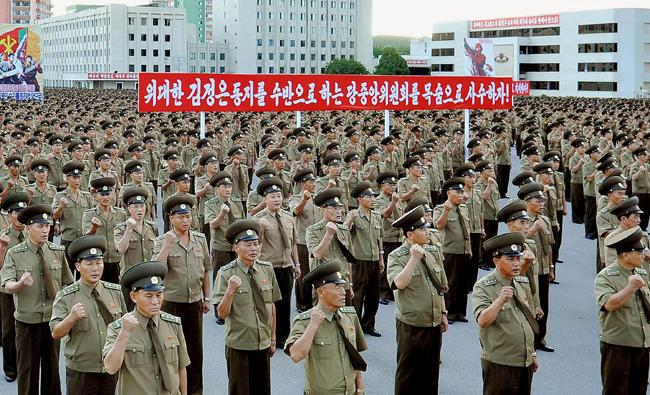
This picture taken on August 10, 2017 and released by North Korea's official shows service personnel of the Ministry of People's Security at a rally in Pyongyang in support of North Korea's stance against the US. (Korean Central News Agency via AFP)
Updated 11 August 2017
Follow

China should stay neutral if North Korea attacks first, says state-run paper

BEIJING: If North Korea launches an attack that threatens the United States then China should stay neutral, but if the United States attacks first and tries to overthrow North Korea’s government China will stop then, a Chinese state-run newspaper said on Friday.
President Donald Trump ratcheted up his rhetoric toward North Korea and its leader on Thursday, warning Pyongyang against attacking Guam or US allies after it disclosed plans to fire missiles over Japan to land near the US Pacific territory.
China, North Korea’s most important ally and trading partner, has reiterated calls for calm during the current crisis. It has expressed frustration with both Pyongyang’s repeated nuclear and missile tests and with behavior from South Korea and the United States that it sees as escalating tensions.
The widely-read state-run Global Times, published by the ruling Communist Party’s official People’s Daily, wrote in an editorial that Beijing is not able to persuade either Washington or Pyongyang to back down.
“It needs to make clear its stance to all sides and make them understand that when their actions jeopardize China’s interests, China will respond with a firm hand,” said the paper, which does not represent government policy.
“China should also make clear that if North Korea launches missiles that threaten US soil first and the US retaliates, China will stay neutral,” it added.
“If the US and South Korea carry out strikes and try to overthrow the North Korean regime and change the political pattern of the Korean Peninsula, China will prevent them from doing so.”
China has long worried that any conflict on the Korean peninsula, or a repeat of the 1950-53 Korean war, could unleash a wave of destabilizing refugees into its northeast, and could end up with a reunified county allied with the United States.
North Korea is a useful buffer state for China between it and US forces based in South Korea, and also across the sea in Japan.
The Global Times said China will “firmly resist any side which wants to change the status quo of the areas where China’s interests are concerned.”
“The Korean Peninsula is where the strategic interests of all sides converge, and no side should try to be the absolute dominator of the region.”


WHO appeals for $1 bn for world’s worst health crises in 2026

Updated 58 min 6 sec ago
Follow

WHO appeals for $1 bn for world’s worst health crises in 2026

  • The UN health agency estimated 239 million people would need urgent humanitarian assistance this year and the money would keep essential health services going

GENEVA: The World Health Organization on Tuesday appealed for $1 billion to tackle health crises this year across the world’s 36 most severe emergencies, including in Gaza, Sudan, Haiti and the Democratic Republic of Congo.
The UN health agency estimated 239 million people would need urgent humanitarian assistance this year and the money would keep essential health services going.
WHO health emergencies chief Chikwe Ihekweazu told reporters in Geneva: “A quarter of a billion people are living through humanitarian crises that strip away the most basic protections: safety, shelter and access to health care.
“In these settings, health needs are surging, whether due to injuries, disease outbreaks, malnutrition or untreated chronic diseases,” he warned.
“Yet access to care is shrinking.”
The agency’s emergency request was significantly lower than in recent years, given the global funding crunch for aid operations.
Washington, traditionally the UN health agency’s biggest donor, has slashed foreign aid spending under President Donald Trump, who on his first day back in office in January 2025 handed the WHO his country’s one-year withdrawal notice.
Last year, WHO had appealed for $1.5 billion but Ihekweazu said that only $900 million was ultimately made available.
Unfortunately, he said, the agency had been “recognizing ... that the appetite for resource mobilization is much smaller than it was in previous years.”
“That’s one of the reasons that we’ve calibrated our ask a little bit more toward what is available realistically, understanding the situation around the world, the constraints that many countries have,” he said.
The WHO said in 2026 it was “hyper-prioritising the highest-impact services and scaling back lower?impact activities to maximize lives saved.”
Last year, global funding cuts forced 6,700 health facilities across 22 humanitarian settings to either close or reduce services, “cutting 53 million people off from health care.” Ihekweazu said.
“Families living on the edge face impossible decisions, such as whether to buy food or medicine,” he added, stressing that “people should never have to make these choices.”
“This is why today we are appealing to the better sense of countries, and of people, and asking them to invest in a healthier, safer world.”