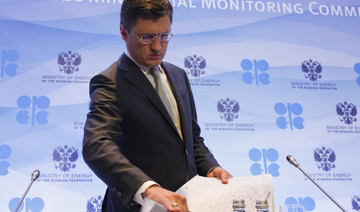
OPEC sees higher oil demand in 2018; July output up by 173,000 bpd

OPEC said that oil stocks in developed economies declined in June and would fall further in the US. (Reuters)
Updated 10 August 2017
Follow

OPEC sees higher oil demand in 2018; July output up by 173,000 bpd

LONDON: OPEC forecast higher demand for its oil in 2018 due to rising global consumption and slower supply growth from rivals, although another jump in the group’s output suggested the market will remain in surplus despite efforts to rein in production.
In a monthly report on Thursday, the Organization of the Petroleum Exporting Countries said the world would need 32.42 million barrels per day (bpd) of its crude next year, up 220,000 bpd from the previous forecast.
The group was also upbeat about 2018 economic growth and said oil stocks in developed economies declined in June and would fall further in the US, a sign the OPEC-led supply cut is working.
“With the ongoing growth momentum and an expected continued dynamic in second-half 2017, there is still some room to the upside,” OPEC said in the report.
“Further declines in US crude stocks are likely, given the record rates at which US refineries are running.”
But the 14-country producer group also said its oil output in July came in above the demand forecast, led by gains in Libya and Nigeria, two members exempt from the cuts aimed at eliminating excess supply.
In the report, OPEC said its oil output rose by 173,000 bpd in July to 32.87 million bpd, led by the exempt producers plus top exporter Saudi Arabia.
The figures mean OPEC has complied 86 percent with its output-cutting pledge, according to a Reuters calculation, down from 96 percent initially reported for June but still high by OPEC standards.


Oman’s trade surplus narrows to $12bn as exports decline 

Updated 6 sec ago
Follow

Oman’s trade surplus narrows to $12bn as exports decline 

RIYADH: Oman’s trade surplus narrowed to 4.69 billion rials ($11.9 billion) by the end of October as weaker oil and gas shipments weighed on exports, even as imports rose, according to official data.

The surplus compares with 7.31 billion rials in the same period of 2024, the Oman News Agency reported, citing preliminary figures from the National Centre for Statistics and Information. Total merchandise exports fell 8 percent year on year to 19.3 billion rials, while imports increased 6.8 percent to 14.6 billion rials.

This comes as Fitch Ratings last month upgraded Oman to investment-grade status, raising its long-term foreign-currency rating from BB+ to BBB-, citing stronger public finances, an improved external position, and a continued commitment to prudent fiscal management. 

The agency noted that Oman has successfully strengthened fiscal discipline, reducing government debt to around 36 percent of gross domestic product in 2025, down from about 68 percent in 2020.   

“The decline in the value of Oman’s merchandise exports is primarily attributed to a decrease in the value of oil and gas exports, which reached 12.1 billion rials by the end of October 2025, a 16.3 percent decrease compared to 14.4 billion rials at the end of October 2024,” the ONA report stated.   

It added: “Conversely, the value of Oman’s non-oil merchandise exports increased by 9.9 percent, reaching 5.61 billion rials by the end of October 2025, compared to 5.1 billion rials during the same period in 2024.”  

The value of re-exports also increased, reaching 1.6 billion rials by the end of October, up 11.6 percent year on year. 

The UAE was the leading destination for Oman’s non-oil exports, with shipments valued at 1.07 billion rials, marking a 27.6 percent increase compared to the same period in 2024. 

The UAE also topped the list for re-exports, at 532 million rials, and for exports to Oman, at 3.49 billion rials. 

Saudi Arabia ranked second among destinations for Oman’s non-oil exports, with a value of 920 million rials, followed by India at 597 million rials. 

In re-exports, Iran ranked second with 324 million rials, followed by the UK with 179 million rials. 

On the import side, China ranked second, with imports valued at 1.55 billion rials, followed by Kuwait at 1.25 billion rials.