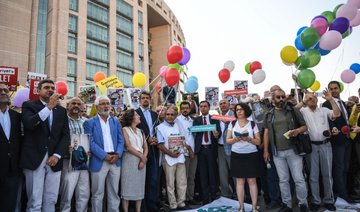
ISTANBUL: Turkish authorities on Thursday issued arrest warrants for 35 employees of media groups on suspicion of links to the alleged mastermind of the failed 2016 coup Fethullah Gulen, the state-run news agency said.
Nine people have been detained so far, Anadolu news agency said, adding that the suspects were accused of using a messaging app allegedly used by Gulen to mobilize followers in Turkey and of belonging to a “terror” group.
Thousands of people have already been arrested in Turkey for using the Bylock messaging app, which the authorities say was used by Gulen supporters to coordinate actions ahead of the plot.
The latest arrests come amid growing alarm over press freedom in Turkey under President Recep Tayyip Erdogan, in particular under the state of emergency imposed in the wake of the failed July 2016 coup and which remains in place.
Gulen, an Islamic preacher who lives in the US state of Pennsylvania, denies any link to the botched putsch.
Those detained include a former columnist for the Turkiye daily Ahmet Sagirli and the current website editor at the leftist opposition Birgun daily Burak Ekici.
Turkey ranks 155 on the latest Reporters Sans Frontieres (Reporters Without Borders) world press freedom index, below Belarus and the Democratic Republic of Congo.
According to the latest figures from the P24 press freedom website, there are 164 journalists behind bars in Turkey, most of whom were detained under the state of emergency.
In one of the highest profile cases, 17 staff from the Cumhuriyet daily — one of the few voices in the media in Turkey to oppose Erdogan — last month went on trial for aiding “terror” groups.
While most of the suspects in that case have been released from pre-trial detention, four Cumhuriyet journalists, most of whom have been held for eight months, remain behind bars.
The crackdown has also affected foreign reporters and freelance French journalist Loup Bureau was detained last month on charges of links to a Kurdish militia Ankara regards as a terror group.

Turkey seeks arrest of 35 media workers over alleged Gulen links
Lebanese finance minister denies any plans for a Kushner-run economic zone in the south
- Proposal was made by US Envoy Morgan Ortagus but was ‘killed on the spot’
- Priority is to regain control of state in all aspects, Yassine Jaber tells Arab News
DAVOS: Lebanon’s finance minister dismissed any plans of turning Lebanon’s battered southern region into an economic zone, telling Arab News on the sidelines of the World Economic Forum’s meeting in Davos that the proposal had died “on the spot.”
Yassine Jaber explained that US Envoy to Lebanon Morgan Ortagus had proposed the idea for the region, which has faced daily airstrikes by Israel, and it was immediately dismissed.
Jaber’s comments, made to Arab News on the sidelines of the World Economic Forum in Davos, were in response to reports which appeared in Lebanese media in December which suggested that parts of southern Lebanon would be turned into an economic zone, managed by a plan proposed by Jared Kushner, US President Donald Trump’s son in law.
Meanwhile, Jaber also dismissed information which had surfaced in Davos over the past two days of a bilateral meeting between Lebanese ministers, US Middle East Envoy Steve Witkoff and Kushner.
Jaber said that the meeting on Tuesday was a gathering of “all Arab ministers of finance and foreign affairs, where they (Witkoff and Kushner) came in for a small while, and explained to the audience the idea about deciding the board of peace for Gaza.”
He stressed that it did not develop beyond that.
When asked about attracting investment and boosting the economy, Jaber said: “The reality now is that we need to reach the situation where there is stability that will allow the Lebanese army, so the (Israeli) aggression has to stop.”
Over the past few years, Lebanon has witnessed one catastrophe after another: one of the world’s worst economic meltdowns, the largest non-nuclear explosion in its capital’s port, a paralyzed parliament and a war with Israel.
A formal mechanism was put in place between Lebanon and Israel to maintain a ceasefire and the plan to disarm Hezbollah in areas below the Litani river.
But, the minister said, Israel’s next step is not always so predictable.
“They’re actually putting pressure on the whole region. So, a lot of effort is being put on that issue,” he added.
“There are still attacks in the south of the country also, so stability is a top necessity that will really succeed in pushing the economy forward and making the reforms beneficial,” he said.
Lawmakers had also enacted reforms to overhaul the banking sector, curb the cash economy and abolish bank secrecy, alongside a bank resolution framework.
Jaber also stressed that the government had recently passed a “gap law” intended to help depositors recover funds and restore the banking system’s functionality.
“One of the priorities we have is really to deal with all the losses of the war, basically reconstruction … and we have started to get loans for reconstructing the destroyed infrastructure in the attacked areas.”
As Hezbollah was battered during the war, Lebanon had a political breakthrough as the army’s general, Joseph Aoun, was inaugurated as president. His chosen prime minister was the former president of the International Court of Justice, Nawaf Salam.
This year marks the first time a solid delegation from the country makes its way to Davos, with Salam being joined by Jaber, Economy and Trade Minister Amr Bisat, and Telecoms Minister Charles Al-Hage.
“Our priority is to really regain the role of the state in all aspects, and specifically in rebuilding the institutions,” Jaber said.