ISTANBUL: Seven staff from the Turkish opposition newspaper Cumhuriyet were provisionally freed on Saturday after nine months in jail, as calls intensified for the release of four journalists still behind bars.
An Istanbul court Friday ordered that the seven be released under judicial control, meaning they remain charged and will have to report to the authorities, although it is rare in Turkey for defendants in such cases to be sent back to jail.
A total of 17 staff from the newspaper — one of the few voices in the media in Turkey to oppose President Recep Tayyip Erdogan — had been on trial for aiding “terror” groups, accusations denounced as absurd by supporters.
But despite growing pressure from abroad but also within Turkey for the release of all the defendants, the most prominent journalists from the newspaper were ordered by the court Friday to remain in jail.
The seven freed — including respected cartoonist Musa Kart, books supplement editor Turhan Gunay and the paper’s legal executives — left Silviri jail on the outskirts of Istanbul to cheers and embraces from supporters.
They had been held for 271 days.
“We were taken away from the people we love, our relatives, our work,” said Kart after his release.
But he added: “Believe me, during this period in jail we have felt no hatred, no rancour, we could not live with such thoughts.”
The staff are charged with supporting in their coverage three entities that Turkey considers terror groups — the Kurdistan Workers’ Party (PKK), the ultra-left Revolutionary People’s Liberation Party-Front (DHKP-C), and the movement of Fethullah Gulen, the US-based preacher who Ankara accuses of ordering last year’s coup attempt.
The four remaining in custody include some of the biggest names in Turkish journalism: the commentator Kadri Gursel, investigative journalist Ahmet Sik, the paper’s editor-in-chief Murat Sabuncu and chief executive Akin Atalay.
Eight other suspects are also charged but not in jail.
Kart said: “The image of journalists in jail is not flattering for our country and I hope our four friends will come out as soon as possible.”
The Cartoonists Rights Network International (CRNI), which has pushed for Kart’s release, said the news was “better than could have been expected” but added there was “little comfort” for the families of those returning to jail.
“Deficient justice,” headlined Cumhuriyet, saying the trial had proved to the world that the accusations were “baseless.”
There has been intense international alarm over the case, seen as a test for press freedom under Erdogan’s rule amid the crackdown that followed the failed coup.
The US State Department on Thursday called for the release of all the suspects, saying they were being held “arbitrarily.”
The New York-based Committee to Protect Journalists (CPJ) described the release of the seven as a “small step in the right direction” but said they should never have been jailed.
“Authorities should put an end to this farcical trial by immediately dropping the transparently retaliatory charges,” said CPJ Europe and Central Asia Program Coordinator Nina Ognianova.
There have also been signs of growing unease even among supporters of Erdogan’s ruling party over the lengthy detention of the journalists, who have yet to be convicted of any crime.
In a rare public intervention, former president Abdullah Gul, who Erdogan succeeded as head of state in 2014, said Friday that the journalists should be set free.
Meanwhile influential conservative journalist Abdulkadir Selvi — a staunch supporter of Erdogan — said all those on trial should be released “as these are people who are doing journalism.”
He told CNN-Turk there was “no need to invent” ties between Cumhuriyet and Gulen, calling on the authorities to focus on trying genuine members of the movement.
The next hearing is set for September 11. If convicted, they face varying terms of up to 43 years in jail.
Prosecutors meanwhile said they would file new accusations against Sik over an incendiary defense statement he made on Wednesday where he slammed the ruling party’s past cooperation with Gulen.


![]()
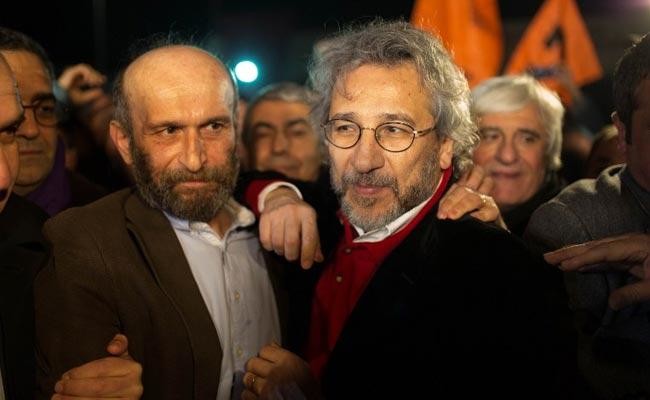
Turkey newspaper staff provisionally freed as pressure grows for journalists
Turkey newspaper staff provisionally freed as pressure grows for journalists
Latest updates


© 2026 SAUDI RESEARCH & PUBLISHING COMPANY, All Rights Reserved And subject to Terms of Use Agreement.