

DP World, Egypt set up joint venture company for Suez Canal development

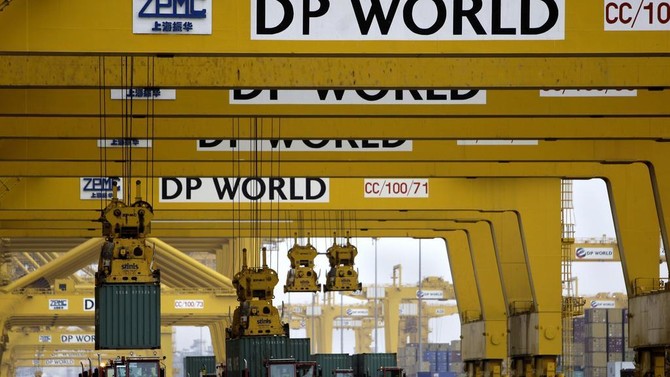
DP World plans to establish a dedicated industrial and trade logistics district within the free zone with the Suez Canal free zone. (AP)
Updated 10 August 2017
Follow

DP World, Egypt set up joint venture company for Suez Canal development

DUBAI: DP World has entered into a joint venture with the General Authority for the Suez Canal Economic Zone in Egypt to develop projects in the free zone and trade hub of the newly-expanded canal.
DP World plans to establish a dedicated industrial and trade logistics district within the free zone, and will incorporate services and facilities alongside spaces for residence and entertainment.
The joint venture announcement came after Egyptian President Abdel Fattah El-Sisi and Mohab Mamish, the Chairman of the Suez Canal Authority, met with Sultan Ahmed bin Sulayem, the DP World Chairman and chief executive, on Wednesday.
During the meeting, El-Sisi approved the plans for the joint development company and also affirmed Egypt’s support for the immediate start of DP World’s plans for the industrial and trade logistics district.

The world’s fourth largest terminal operator already has a presence in Egypt through the Ain Al Sokhna Port, which is one of the 78 terminals it operates in 40 countries.
DP World last month signed an agreement with the Indonesian government to provide advice on the development of the Kuala Tanjung greenfield port and logistics zone and the Belawan port located in North Sumatra.
The Dubai port operator will review Belawan port operations to help shore up efficiencies while looking for ways to reduce costs in building the new Kuala Tanjung port and logistics zone, DP World said.


Egypt defies African FDI trend with inflows of $11bn in 2025: UNCTAD 

Updated 4 sec ago
Follow

Egypt defies African FDI trend with inflows of $11bn in 2025: UNCTAD 

RIYADH: Egypt emerged as Africa’s top destination for foreign direct investment in 2025, attracting an estimated $11 billion in inflows in a year marked by declining investment across the continent. 

According to UNCTAD’s latest Global Investment Trends Monitor, the North African country ranked ahead of other major African economies despite a sharp regional slowdown. 

The performance underscores Egypt’s relative resilience at a time when foreign investment into Africa has normalized following an unusually strong 2024, which UNCTAD said was inflated by a single large project. As a result, the 2025 data reflects a return to more typical investment levels across the continent. 

“Among African economies, inflows to Angola reached an estimated $3 billion, marking a return to positive values after nine consecutive years of net divestments,” the report stated. 

It added: “Egypt, with inflows of $11 billion, remained the largest FDI host country in Africa.”  

While Egypt solidified its position as Africa’s leading FDI host, other notable movements on the continent included Mozambique, where inflows surged 80 percent to $6 billion, driven by renewed activity in major liquified natural gas projects.  

Angola also saw a positive shift, recording an estimated $3 billion in FDI after nine consecutive years of net divestments. 

UNCTAD noted that Egypt’s strength extended beyond headline inflows, with the country also contributing to an increase in greenfield investment activity across Africa. While the number of greenfield projects fell globally and across most lower-income economies, Africa recorded a 5 percent increase in project numbers in 2025, supported in part by growth in Egypt and Côte d’Ivoire. 

Globally, FDI flows rose by 14 percent in 2025 to approximately $1.6 trillion, though growth was heavily concentrated in developed economies, which saw a 43 percent increase.  

In contrast, flows to developing economies declined by 2 percent, with the least developed countries particularly affected; three-quarters experienced stagnant or falling investment. 

The report highlighted that new project announcements remained weak globally amid elevated policy uncertainty, with international project finance declining for the fourth consecutive year.  

Looking ahead, UNCTAD warned that geopolitical tensions, regional conflicts, and economic fragmentation could continue to suppress real investment activity in 2026, even as financing conditions are expected to ease.  

For Africa, sustaining FDI inflows will require navigating persistent challenges such as financing constraints, risk perceptions, and structural vulnerabilities.