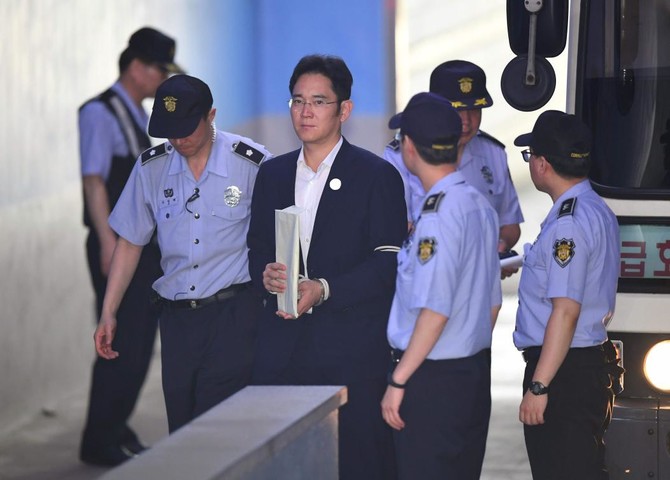
SEOUL: South Korean prosecutors on Monday demanded the heir to the Samsung empire be jailed for 12 years over his role in the corruption scandal that brought down the country’s last president.
At the final hearing in the trial of Lee Jae-Yong, the vice chairman of Samsung Electronics, prosecutors called him the “ultimate beneficiary” of crimes committed in the scandal, which culminated in the impeachment and dismissal of president Park Geun-Hye.
If the judges convict him and agree with the sentence recommendation it will be among the harshest penalties ever passed on a top executive of a chaebol, the business groups that dominate Asia’s fourth-largest economy.
Lee and four other executives of Samsung — the world’s biggest smartphone maker and the country’s largest firm — are accused of bribing Park’s powerful confidante with millions of dollars to win presidential favors and ease a controversial 2015 merger deal.
“The defendants were closely tied to power and sought personal gains,” the prosecutors said.
They sought a 12-year sentence for Lee, who is also charged with embezzlement and hiding assets overseas among other offenses, 10-year terms for three of his co-accused, and seven years for the last of the defendants in the trial.
Lee denied any wrongdoing.
“I once again deeply regret and apologize for causing a huge disappointment,” he told the court in his final statement, choking up and pausing at one point for a sip of water.
Lee has been in custody for the past six months, and said that during his time in detention he realized he had “many shortcomings” and there were some things he “failed to oversee” as a business leader.
But he insisted: “I never sought favors from the president for personal gain.”
Lee, 49, has effectively been at the helm of Samsung, which has revenues equivalent to about a fifth of the country’s GDP, since his father was left bedridden by a heart attack in 2014.
Taking the stand for the first time in his defense last week, he claimed he had no role in decision-making at the wider Samsung group and “mostly listened to other executives.”
His lawyers say the allegations were unjustified and the defendants never sought anything in return for the money that was donated.
The verdicts will be given on August 25.
A Samsung Group spokeswoman said it had no comment on the prosecutors’ request.
Despite the arrest of its de facto leader and a humiliating recall fiasco of its flagship smartphone last year, Samsung Electronics shares have risen strongly in recent months on soaring profits, driven by strong demand for its memory chips.
They closed down 0.25 percent on Seoul’s stock market on Monday.
One of the favors Lee allegedly sought from Park was state approval for a controversial merger of two Samsung units in 2015, seen as a key step to ensuring a smooth power transfer to him.
The deal was opposed by shareholders who said it wilfully undervalued shares of one of the firms. But it eventually went through after the national pension fund — a major Samsung shareholder — approved it.
“The special prosecutors failed to give any evidence for the existence of such a succession operation,” Lee’s lawyers argued at Monday’s hearing.
Choi Gee-Sung, a former Samsung Electronics vice chairman and a co-defendant, reiterated his claims of responsibility, saying the allegations were the result of his own decision to “protect the company” from Park’s confidante Choi Soon-Sil.
He was head of Samsung Group’s Future Strategy Office — which oversaw the vast group’s major business decisions — until he stepped down in February, and is accused of approving a payment of millions of euros to finance the confidante’s daughter.
“I feel heavy responsibility as the FSO chief who oversaw all business dealings,” Choi told the court.
If Lee is found guilty it will be a blow for Park, who is on trial separately on 18 charges including bribery, coercion and abuse of power following her dismissal from office in March.
Park was formally impeached after public uproar over her questionable ties with confidante Choi Soon-Sil sparked mass nationwide protests for months.
Choi Soon-Sil is also on trial for using her presidential ties to force top South Korean firms including Samsung to “donate” nearly $70 million to non-profit foundations which she controlled.


![]()
S. Korea prosecutors seek 12 years’ jail for Samsung heir
S. Korea prosecutors seek 12 years’ jail for Samsung heir
Latest updates


Recommended


© 2026 SAUDI RESEARCH & PUBLISHING COMPANY, All Rights Reserved And subject to Terms of Use Agreement.