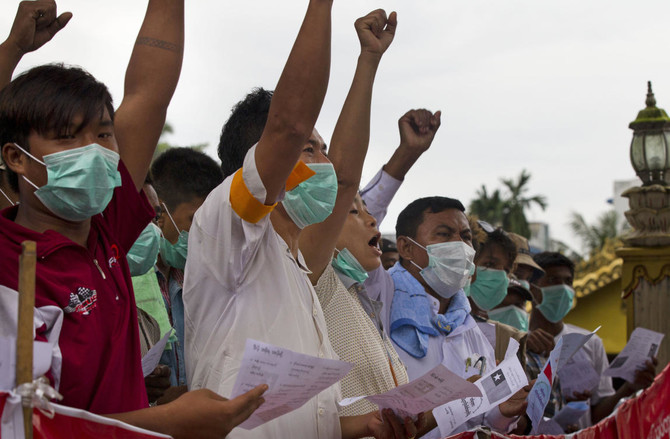
MYANMAR: Security forces in Myanmar fired warning shots to disperse Muslim villagers while they were arresting four suspected insurgents in a western region where government troops have been accused of human rights violations against Rohingya minority, officials said Saturday.
About 600 villagers surrounded troops in Rathedaung township in Rakhine state on Friday while they were searching for six men suspected of financing a “terrorist” group, said police officer Zaw Win Aung.
He said the villagers carried slingshots, sticks and machetes as they approached the troops, who responded by firing 40-50 warning shots. They managed to arrest four suspects, he said.
On Thursday, the government said that six Buddhists were killed and two other villagers are missing in Kaigyi village in Maungdaw township, also in Rakhine state.
It wasn’t clear who was responsible, but Maj. Zayar of the border guard police headquarters in Maungdaw said they were searching for culprits.
The government has shut down northern Rakhine to independent journalists, rights experts and humanitarian workers for almost nine months except for organized media trips.
The military has launched operations in the northern part of Rakhine since last October, when suspected Rohingya militants killed nine police officers along the border with Bangladesh.
Rights groups said that during the crackdown, more than 1,000 houses have been burned down, an unknown number of civilians killed and hundreds of Rohingya men and boys arrested. The government said that the operation had ended in February.
Last month, the UN human rights envoy to Myanmar, Yanghee Lee, expressed disappointment over a lack of government effort to tackle problems behind the violence between Buddhists and Muslims. She said she saw little improvement in the situation for Rohingya and that the government prevented her from visiting several areas there.

Myanmar troops arrest Rohingya suspects; 6 Buddhists killed
South Korea calls for resuming dialogue with North
- President Lee Jae Myung has sought to mend ties with the nuclear-armed North since taking office in June
- North Korean leader Kim Jong Un last week dashed hopes of a diplomatic thaw with Seoul
SEOUL: South Korean President Lee Jae Myung called on Sunday for dialogue with North Korea to resume, after Pyongyang last week shunned the prospect of diplomacy with its neighbor.
Since taking office in June, a dovish Lee has sought to mend ties with the nuclear-armed North, which reaffirmed its anti-Seoul approach during a party meeting last week.
“As my administration has repeatedly made clear, we respect the North’s system and will neither engage in any type of hostile acts, nor pursue any form of unification by absorption,” Lee said in a speech marking the anniversary of a historical campaign against Japan’s colonial rule.
“We will also continue our efforts to resume dialogue with the North,” he said.
North Korean leader Kim Jong Un last week dashed hopes of a diplomatic thaw with Seoul, describing its overtures as “clumsy, deceptive farce and a poor work.”
Speaking at the party congress in Pyongyang, Kim said North Korea has “absolutely no business dealing with South Korea, its most hostile entity, and will permanently exclude South Korea from the category of compatriots.”
But he also said the North could “get along well” with the United States if Washington acknowledges its nuclear status.
Speculation has mounted over whether US President Donald Trump will seek a meeting with Kim during planned travels to China.
Last year, Trump said he was “100 percent” open to a meeting.
Previous Trump-Kim summits during the US president’s first term fell apart after the pair failed to agree over sanctions relief — and what nuclear concessions North Korea might make in return.
Since taking office in June, a dovish Lee has sought to mend ties with the nuclear-armed North, which reaffirmed its anti-Seoul approach during a party meeting last week.
“As my administration has repeatedly made clear, we respect the North’s system and will neither engage in any type of hostile acts, nor pursue any form of unification by absorption,” Lee said in a speech marking the anniversary of a historical campaign against Japan’s colonial rule.
“We will also continue our efforts to resume dialogue with the North,” he said.
North Korean leader Kim Jong Un last week dashed hopes of a diplomatic thaw with Seoul, describing its overtures as “clumsy, deceptive farce and a poor work.”
Speaking at the party congress in Pyongyang, Kim said North Korea has “absolutely no business dealing with South Korea, its most hostile entity, and will permanently exclude South Korea from the category of compatriots.”
But he also said the North could “get along well” with the United States if Washington acknowledges its nuclear status.
Speculation has mounted over whether US President Donald Trump will seek a meeting with Kim during planned travels to China.
Last year, Trump said he was “100 percent” open to a meeting.
Previous Trump-Kim summits during the US president’s first term fell apart after the pair failed to agree over sanctions relief — and what nuclear concessions North Korea might make in return.
© 2026 SAUDI RESEARCH & PUBLISHING COMPANY, All Rights Reserved And subject to Terms of Use Agreement.