MAUNG HNA MA, Myanmar: In the middle of the night on July 4, more than a dozen masked men, dressed head-to-toe in black, surrounded Abdu Sulwon’s home in northwestern Myanmar. His widow said that was the last time she saw him alive.
“I saw a trail of blood where they dragged him away,” said Haleda, 40, showing bruises on her body where she says the men beat her with sticks. Her husband’s body was found in a ravine near their village, Maung Hna Ma, on Saturday.
She gave her account to reporters during a government-organized trip to the troubled north of Myanmar’s Rakhine State, where most people belong to the stateless Rohingya Muslim minority.
Officials say Rohingya insurgents are behind this and a slew of killings in the area that has been racked by violence in recent months, with security forces accused of committing atrocities against civilians.
“It is clear that Muslim militants are taking out Muslim villagers who are perceived to be collaborating with the government,” Thaung Tun, national security adviser to Myanmar’s de facto leader Aung San Suu Kyi, told diplomats in Yangon.
At least 44 civilians have been killed and 27 have been kidnapped or gone missing in northern Rakhine in the past nine months, Thaung Tun said.
It was not possible to independently verify those figures or establish who was behind any of the killings described to journalists. Insurgents have denied targeting civilians.
But in two cases, including that of Abdu Sulwon, relatives of the victims broadly supported the official version.
If militants were to blame for at least some of the killings, it would add to evidence the insurgency that flared in October has not been fully rooted out, despite the government announcing the end of its security operation in February.
‘Back to grassroots’
A group known as Harakah Al-Yaqin (HaY) attacked Myanmar Border Guard Police (BGP) posts on Oct. 9, killing nine policemen and igniting the biggest crisis yet to face Nobel laureate Suu Kyi’s fledgling administration.
About 75,000 Rohingya fled to Bangladesh during the ensuing military crackdown, which was beset by allegations of rape, torture and extrajudicial killings by security forces.
Suu Kyi’s government has denied most of the allegations and is refusing access to a UN panel of experts, saying its mission will aggravate the situation on the ground in Rakhine.
Rohingya villagers and Myanmar security sources told Reuters earlier this year how HaY, or Faith Movement, began as a small group of leaders who recruited hundreds of young men in the run-up to the October attacks.
HaY says it is fighting for the rights of 1.1 million Rohingya who are denied citizenship and face restrictions on their movement in Buddhist-majority Myanmar.
Militants have rarely confronted security forces in recent months, but troops checking a report of a militant hideout in Tin May village on July 9 clashed with armed men, killing two and arresting two.
Anthony Davis, a security analyst with Jane’s at IHS-Markit, said the militants appeared to be regrouping.
“The pattern of events we’ve seen this year appears to reflect a strategy of going back to grassroots and working politically in villages,” said Davis.
“It appears they are attempting to eliminate potential intelligence liabilities and to a degree intimidate waverers among the population.”
A social media account that claims to speak for HaY, also known as the Arakan Rohingya Salvation Army, said in May the group had “never attacked or killed ‘any civilian’ as it is claimed in numerous false, fabricated and fake news.”
Fear and reprisals
Brig. Gen. Thura San Lwin, BGP commander, said information garnered from interrogations and the discovery of militant training camps indicated that at least some of the recent killings were committed by insurgents.
Other killings could be down to local disputes, he said.
Mohammad Tason, 28, was found dead with knife wounds across his neck and torso in Yinma Kyaung Taung village.
“My husband was on friendly terms with the military; I think that’s why they killed him,” said his wife Hawdiza, 23.
Like Haleda, Hawdiza was brought to meet reporters by administrators in Buthidaung township during a media visit conducted under the close watch of Border Guard Police.
Following Sulwon’s killing, security forces raided Maung Hna Ma village, torching at least one home, arresting several men and sending others into hiding, according to accounts given by women there who beckoned reporters from a river bank to tell of their missing husbands and sons.
“My son has nothing to do with terrorism,” said Marmuda Hatu, 48, whose son Saad Ullah, 24, was arrested. “They don’t have any evidence.”
Chris Lewa from monitoring group Arakan Project said the region was seeing “vicious cycles of violence” with security forces launching nighttime raids in response to killings.
Police Major Tun Hlaing said around 20 people had been arrested in Maung Hna Ma this week in the investigation into Abdu Sulwon’s killing. Most had been released, he said, but four suspected of working with the insurgents were being questioned.


![]()
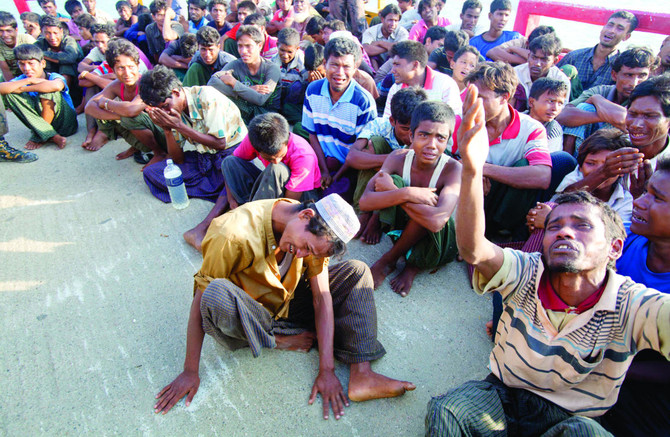
Myanmar sees insurgents behind Rohingya killings in northwest
Myanmar sees insurgents behind Rohingya killings in northwest
Latest updates


© 2026 SAUDI RESEARCH & PUBLISHING COMPANY, All Rights Reserved And subject to Terms of Use Agreement.