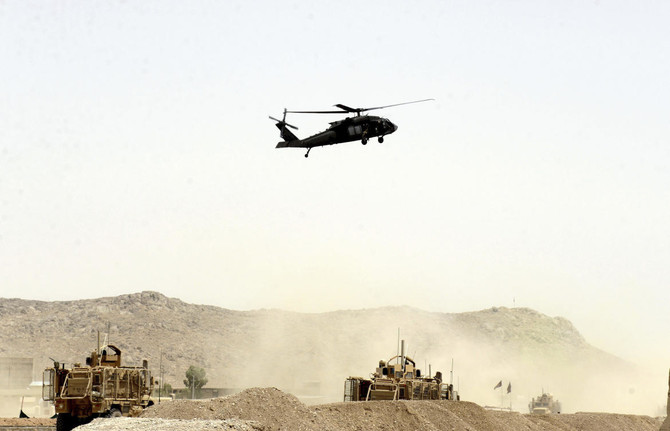
KABUL: An Afghan official says the suicide bomber who hit a NATO patrol, killing one service member and two Afghan civilians, had hid behind the all-enveloping women’s garment known as a burqa.
Abdul Sami Sharifi, governor of the district of Qarabagh, located north of the Afghan capital, said on Friday that the attacker was riding a motorcycle.
He says the bomber rammed his motorcycle into a NATO patrol late the previous night.
The US military in Afghanistan reported the death of the coalition member but not identify the soldier’s nationality. The statement said another five service members and their Afghan translator were hurt in the attack, but were in stable condition.
The Taliban have claimed responsibility for the attack in a telephone call to The Associated Press.

Afghan official says bomber who hit NATO wore woman’s burqa
Archbishop of York says he was ‘intimidated’ by Israeli militias during West Bank visit
- “We were … intimidated by Israeli militias who told us that we couldn’t visit Palestinian families in the occupied West Bank,” the archbishop said
LONDON: The Archbishop of York has revealed that he felt “intimidated” by Israeli militias during a visit to the Holy Land this year.
“We were stopped at various checkpoints and intimidated by Israeli militias who told us that we couldn’t visit Palestinian families in the occupied West Bank,” the Rev. Stephen Cottrell told his Christmas Day congregation at York Minster.
The archbishop added: “We have become — and really, I can think of no other way of putting it — we have become fearful of each other, and especially fearful of strangers, or just people who aren’t quite like us.
“We don’t seem to be able to see ourselves in them, and therefore we spurn our common humanity.”
He recounted how YMCA charity representatives in Bethlehem, who work with persecuted Palestinian communities in the West Bank, gave him an olive wood Nativity scene carving.
The carving depicted a “large gray wall” blocking the three kings from getting to the stable to see Mary, Joseph and Jesus, he said.
He said it was sobering for him to see the wall in real life during his visit.
He continued: “But this Christmas morning here in York, as well as thinking about the walls that divide and separate the Holy Land, I’m also thinking of all the walls and barriers we erect across the whole of the world and, perhaps most alarming, the ones we build around ourselves, the ones we construct in our hearts and minds, and of how our fearful shielding of ourselves from strangers — the strangers we encounter in the homeless on our streets, refugees seeking asylum, young people starved of opportunity and growing up without hope for the future — means that we are in danger of failing to welcome Christ when he comes.”