

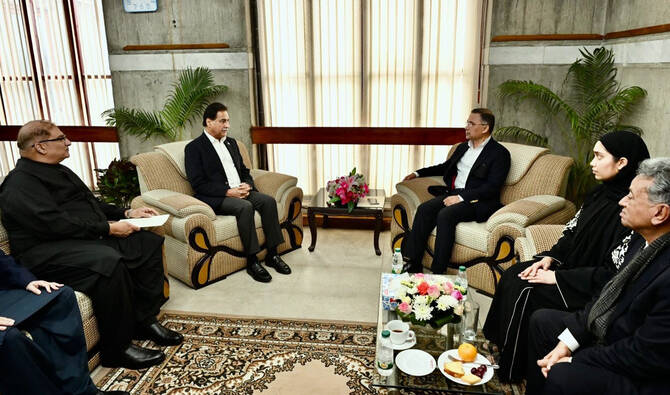
Pakistan’s National Assembly speaker attends Khaleda Zia’s funeral in Dhaka

Pakistan’s National Assembly Speaker Sardar Ayaz Sadiq (second left) meets Tarique Rahman (center), the acting chairperson of the BNP party, to convey condolences over his mother and Bangladesh’s former prime minister Khaleda Zia’s demise in Dhaka, Bangladesh, on December 31, 2025. (X/@PakinBangladesh)
Short Url
Updated 31 December 2025
Follow

Pakistan’s National Assembly speaker attends Khaleda Zia’s funeral in Dhaka

  • Ayaz Sadiq meets Zia’s son to convey Pakistani people, government’s condolences
  • Visit comes amid warming ties between Islamabad and Dhaka after years of strain

ISLAMABAD: Pakistan’s National Assembly Speaker Sardar Ayaz Sadiq attended the funeral of Bangladesh’s former prime minister Khaleda Zia in Dhaka amid a recent thaw in relations between the two South Asian countries after decades of unease.

Zia, Bangladesh’s first female prime minister and a key political figure for decades, died on Tuesday at the age of 80 after a prolonged illness, her Bangladesh Nationalist Party (BNP) said. Her death prompted messages of condolence from leaders across the region, including Pakistan’s prime minister.

Dignitaries from several countries, including India’s External Affairs Minister Subrahmanyam Jaishankar, Sadiq and Bhutan’s Foreign Minister Lyonpo D.N. Dhungyel were among those who attended the funeral, as per international media reports. The state funeral in Dhaka drew vast crowds of people outside Bangladesh’s parliament at Manik Mia Avenue. 

Sadiq later met Zia’s son Tarique Rahman, the acting chairperson of the BNP, to convey condolences over his mother’s demise from the people and government of Pakistan, the Pakistan High Commission in Bangladesh said. 

“During the meeting, he recalled Begum Zia’s remarkable political leadership and noted her pivotal role in promoting historical affinities, mutual respect and cooperation between our two nations,” the high commission wrote on social media platform X. 

Sadiq is expected to meet senior officials of Bangladesh’s interim government, according to an earlier statement issued by his office.

Prime Minister Shehbaz Sharif had described Zia as a “committed friend of Pakistan” on Tuesday, praising her role in Bangladesh’s political life and expressing solidarity with the Bangladeshi people during what he called a difficult moment.

Zia, who served three terms as prime minister, led the BNP and remained a central figure in Bangladeshi politics despite years of ill health and imprisonment under the government of her longtime rival, Sheikh Hasina. She was released last year following Hasina’s ouster after a violent uprising.

Pakistan and Bangladesh were part of the same country until Bangladesh’s secession following a bloody civil war in 1971, an event that has long cast a shadow over bilateral ties. Relations remained largely strained for decades, shaped by historical grievances and political mistrust.

However, Islamabad enjoyed comparatively warmer ties with Dhaka during Zia’s tenure than under Hasina.

Engagement between Islamabad and Dhaka has increased since Hasina’s removal and the formation of an interim administration, with both sides signaling interest in improving political, diplomatic, economic and security ties.


Security forces kill four militants in Pakistan’s volatile southwest, military says

Updated 13 January 2026
Follow

Security forces kill four militants in Pakistan’s volatile southwest, military says

  • Balochistan, Pakistan’s largest province by land area bordering Iran and Afghanistan, has long been the site of a low-level insurgency
  • The Balochistan government has recently established a threat assessment center to strengthen early warning, prevent ‘terrorism’ incidents

ISLAMABAD: Pakistani security forces gunned down four militants in an intelligence-based operation in the southwestern Balochistan province, the military said on Tuesday.

The operation was conducted in Balochistan’s Kalat district on reports about the presence of militants, according to the Inter-Services Public Relations (ISPR), the Pakistani military’s media wing.

The “Indian-sponsored militants” were killed in an exchange of fire during the operation, while weapons and ammunition were also recovered from the deceased, who remained actively involved in numerous militant activities.

“Sanitization operations are being conducted to eliminate any other Indian-sponsored terrorist found in the area,” the ISPR said in a statement.

There was no immediate response from New Delhi to the statement.

Balochistan, Pakistan’s largest province by land area bordering Iran and Afghanistan, has long been the site of a low-level insurgency involving Baloch separatist groups, including the Balochistan Liberation Army (BLA) and the Balochistan Liberation Front (BLF).

Pakistan accuses India of supporting these separatist militant groups and describes them as “Fitna Al-Hindustan.” New Delhi denies the allegation.

The government in Balochistan has also established a state-of-the-art threat assessment center to strengthen early warning and prevention against “terrorism” incidents, a senior official said this week.

“Information that was once scattered is now shared and acted upon in time, allowing the state to move from reacting after incidents to preventing them before they occur,” Balochistan Additional Chief Secretary Hamza Shafqaat wrote on X.

The development follows a steep rise in militancy-related deaths in Pakistan in 2025. According to statistics released by the Pakistan Institute for Conflict and Security Studies (PICSS) last month, combat-related deaths in 2025 rose 73 percent to 3,387.

These included 2,115 militants, 664 security forces personnel, 580 civilians and 28 members of pro-government peace committees, the think tank said.