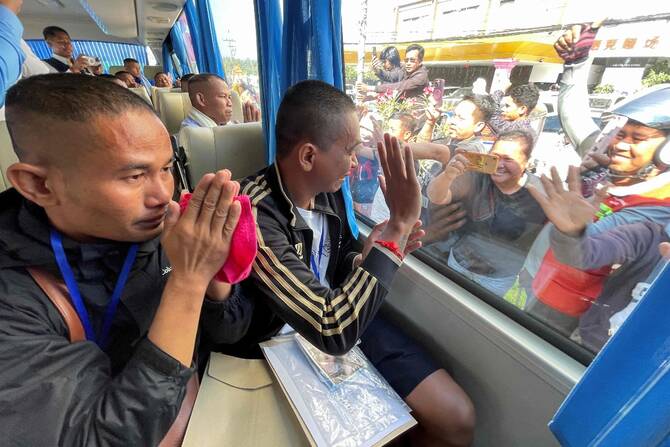
BANGKOK/PHNOM PENH: Thailand on Wednesday released 18 Cambodian soldiers it had detained since July under the renewed ceasefire the two countries agreed on the weekend to end a border conflict, Cambodian and Thai authorities said.
The Southeast Asian neighbors agreed on a ceasefire that took effect at noon (0500 GMT) on Saturday, halting 20 days of fighting that killed at least 101 people and displaced more than half a million on both sides, and included fighter-jet sorties, exchanges of rocket fire and artillery barrages.
The soldiers were due to be returned on Tuesday, but Thailand over alleged breaches of the ceasefire deal, which Cambodia denied.
Cambodian Defense Ministry spokesperson Maly Socheata said the soldiers were handed over at a border checkpoint at 10 a.m. (0300 GMT) on Wednesday after 155 days in Thai custody.
Thailand’s Foreign Ministry said the soldiers had been treated “in
The border clashes reignited early this month, following the breakdown in a
ceasefire deal
that US President
Donald Trump and Malaysian Prime Minister Anwar Ibrahim helped broker to halt a previous round of conflict in July.

Thailand frees 18 Cambodian soldiers as ceasefire holds
https://arab.news/wvauw
Thailand frees 18 Cambodian soldiers as ceasefire holds
- The Southeast Asian neighbors agreed on a ceasefire that took effect on Saturday, halting 20 days of fighting that killed at least 101 people and displaced more than half a million
NASA’s new moon rocket heads to the pad ahead of astronaut launch as early as February
- The 98-meter rocket began its 1.6 kph creep from Kennedy Space Center’s Vehicle Assembly Building at daybreak
- The six-kilometer trek could take until nightfall
CAPE CANAVERAL, USA: NASA’s giant new moon rocket headed to the launch pad Saturday in preparation for astronauts’ first lunar fly-around in more than half a century.
The out-and-back trip could blast off as early as February.
The 322-foot (98-meter) rocket began its 1 mph (1.6 kph) creep from Kennedy Space Center’s Vehicle Assembly Building at daybreak. The four-mile (six-kilometer) trek could take until nightfall.
Thousands of space center workers and their families gathered in the predawn chill to witness the long-awaited event, delayed for years. They huddled together ahead of the Space Launch System rocket’s exit from the building, built in the 1960s to accommodate the Saturn V rockets that sent 24 astronauts to the moon during the Apollo program. The cheering crowd was led by NASA’s new administrator Jared Isaacman and all four astronauts assigned to the mission.
Weighing in at 11 million pounds (5 million kilograms), the Space Launch System rocket and Orion crew capsule on top made the move aboard a massive transporter that was used during the Apollo and shuttle eras. It was upgraded for the SLS rocket’s extra heft.
The first and only other SLS launch — which sent an empty Orion capsule into orbit around the moon — took place back in November 2022.
“This one feels a lot different, putting crew on the rocket and taking the crew around the moon,” NASA’s John Honeycutt said on the eve of the rocket’s rollout.
Heat shield damage and other capsule problems during the initial test flight required extensive analyzes and tests, pushing back this first crew moonshot until now. The astronauts won’t orbit the moon or even land on it. That giant leap will take come on the third flight in the Artemis lineup a few years from now.
Commander Reid Wiseman, pilot Victor Glover and Christina Koch — longtime NASA astronauts with spaceflight experience — will be joined on the 10-day mission by Canadian astronaut Jeremy Hansen, a former fighter pilot awaiting his first rocket ride.
They will be the first people to fly to the moon since Apollo 17’s Gene Cernan and Harrison Schmitt closed out the triumphant lunar-landing program in 1972. Twelve astronauts strolled the lunar surface, beginning with Neil Armstrong and Buzz Aldrin in 1969.
NASA is waiting to conduct a fueling test of the SLS rocket on the pad in early February before confirming a launch date. Depending on how the demo goes, “that will ultimately lay out our path toward launch,” launch director Charlie Blackwell-Thompson said on Friday.
The space agency has only five days to launch in the first half of February before bumping into March.


