INDIA: Indian soldiers fired at worshippers outside a mosque in disputed Kashmir on Friday, killing one man and wounding another after some threw rocks, police and residents said.
Police said soldiers on patrol were pelted with rocks near the main mosque in Beerwah town, where worshippers had gathered to offer Friday prayers. A firecracker was hurled toward the soldiers, who mistook the loud noise for a grenade and retaliated, police said in a statement.
Residents, however, said only a few rocks were thrown and none hit any soldier. Witnesses said the soldiers fired indiscriminately after some rocks hit the iron shutters of shops that were closed because of a general strike against Indian rule in Kashmir.
The slain man, a tailor in his mid-20s, was hit by multiple bullets and died on the way to a hospital. The wounded man was reported to be in stable condition.
The killing triggered anger and widespread protests in the town. Police fired tear gas, fearing the funeral procession would turn into larger protests in the area as thousands carried the man’s body to a graveyard for burial while chanting slogans against Indian rule.
Some threw rocks at police, who fired shotgun pellets to quell the protest. No one was reported injured.
Shops, businesses and schools were closed in most parts of the region because of the general strike, called by separatists who challenge India’s sovereignty over Kashmir. The separatists also called for a march to the United Nations office in Srinagar, the region’s main city.
Authorities imposed a tight curfew in downtown Srinagar and areas near the UN office in anticipation of the march and anti-India protests. Armed police and paramilitary soldiers in riot gear patrolled streets and blocked roads with razor wire and steel barricades.
Later Friday, scores of people led by a top separatist leader, Mohammed Yasin Malik, defied the security lockdown and tried to hold a protest march in Srinagar. However, police detained Malik and several other activists.
Nuclear-armed rivals India and Pakistan each administer part of Kashmir, but both claim the Himalayan territory in its entirety. Rebel groups have been fighting since 1989 for the Indian-administered portion to become independent or merge with Pakistan. Nearly 70,000 people have been killed in the uprising and the ensuing Indian military crackdown.
Anti-India sentiment runs deep in Kashmir’s mostly Muslim population and most people support the rebels’ cause against Indian rule.
India has accused Pakistan of arming and training the rebels, which Pakistan denies.
Rebel groups have largely been suppressed by Indian forces in recent years and public opposition to Indian rule is now principally expressed through street protests.


![]()
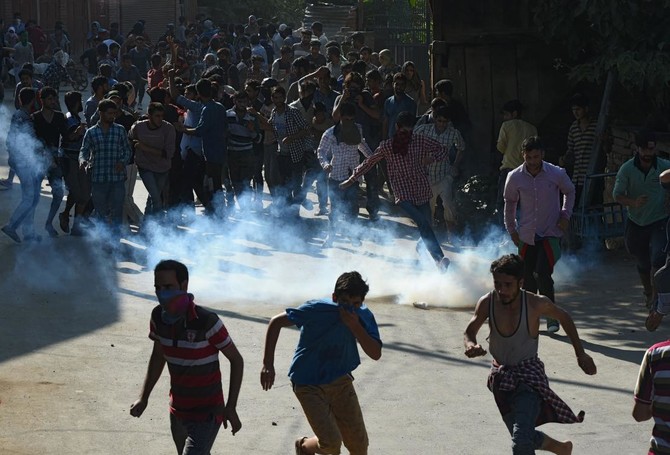
One dead as Indian troops open fire on Kashmiri protesters
One dead as Indian troops open fire on Kashmiri protesters
Latest updates




© 2026 SAUDI RESEARCH & PUBLISHING COMPANY, All Rights Reserved And subject to Terms of Use Agreement.