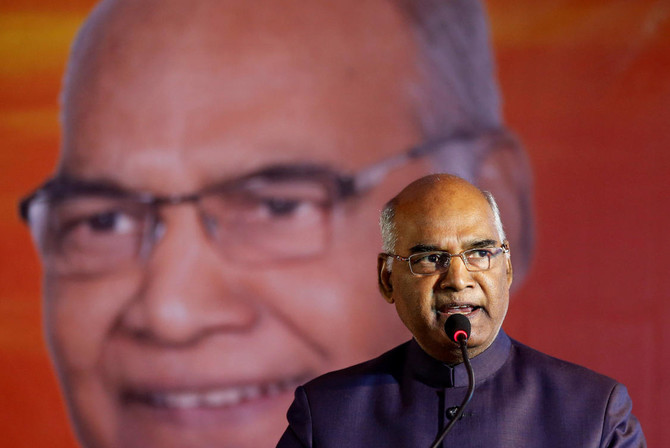
NEW DELHI: India’s parliament began voting on Monday for a new president in an election likely to be won by a candidate backed by the ruling Bharatiya Janata Party (BJP), tightening its grip over top political positions.
Ram Nath Kovind’s ascent to the highest public office would be the first by a leader who started out with the Rashtriya Swayamsevak Sangh, or National Volunteers’ Association, a Hindu nationalist mentor of the BJP and its affiliates.
The president’s role is largely ceremonial but as the custodian of the constitution, the president has played an important role in times of uncertainty, such as when a general election is inconclusive and a decision has to be made about which party is best placed to form a government.
Kovind, 72, who is from the low-caste Dalit community, is facing Meira Kumar, a former parliament speaker and a fellow-Dalit backed by the opposition Congress party.
Prime Minister Narendra Modi, among the first to cast his vote in parliament, said he looked forward to working with Kovind.
“My government will offer full cooperation to him,” he told members of parliament from the ruling coalition.
Members of both houses of parliament and state assemblies will vote on Monday and ballots will be counted on Thursday. The BJP commands the most votes in parliament and in the states.
Some presidents, such as outgoing President Pranab Mukherjee, have tried to act as conscience-keepers, using their constitutional authority as the head of state to defend India’s founding principles as a secular, diverse democracy.
Modi’s rivals say minority Muslims have feared for their wellbeing and have been targeted by fringe Hindu groups since he took office in 2014.
Sonia Gandhi, the head of the Congress party, appealed to members of parliament to vote for Kumar to protect India’s secular values.
“We cannot and must not let India be hostage to those who wish to impose upon it a narrow-minded, divisive and communal vision,” she said.

India parliament elects president, BJP-backed candidate favorite
Filipinos celebrate Christmas on a budget amid soaring costs
- Filipinos are choosing modest Christmas gifts, scaling down year-end festivities
- Millions look to content creators for tips on how to spend less for Christmas dinner
MANILA: As the predominantly Catholic Philippines celebrates one of its most important annual holidays on Thursday, many Filipinos have been forced to rethink their traditional Christmas celebrations amid soaring prices.
This year, street food vendor Gemma Gracia is among those who will keep her business open during the holidays.
“As a vendor, I’ve felt the prices go up since I also still buy at the market for our needs and for our selling needs,” she told Arab News.
But as celebrating Christmas was important for her family, the 39-year-old has allocated 1,000 Philippine pesos ($17) for a family meal out at Jollibee, the Philippines’ biggest fast-food chain restaurant.
“When you don’t have food to share on the table on this holiday, it’s a sad day. That’s why we make sure that we always have something on the table each year,” she said.
For many Filipinos, the time-honored traditions of Noche Buena, or Christmas Eve, is the most awaited part of this holiday season, when dinner tables across the country are filled with a hearty selection of traditional dishes.
Noche Buena, which is Spanish for “the good night,” is the dinner that follows the last evening mass of the season, known as misa de gallo or simbang gabi.
In the Philippines, such festive staples include meaty Filipino-style spaghetti and hamonado, the local version of a Christmas ham that usually serves as the centerpiece of Christmas dinner tables.
But the pinch from rising prices has affected Filipino shoppers in recent years, forcing them to adjust according to their budget.
Although the country’s central bank said inflation had eased to 1.5 percent in November, many say the statistics do not reflect on-the-ground realities, where people reel from rising retail prices, shrinking portions and diminishing purchasing power of the peso.
Allan Manansala, a 48-year-old construction worker in Manila, told Arab News that he is expecting to spend 5,000 pesos for his family of five in 2025, nearly a third of his monthly wage and about a fifth higher than what he spent in previous years.
“I might have to skip giving my children gifts this year because of the costs,” he said.
To get around the high costs, Manansala is skipping the Noche Buena festivities altogether and has instead decided to splurge on New Year’s Eve dinner, which is also a significant occasion in the Philippines.
Others, like Allan Melenio, look for different ways to save up.
“Our relative owns a meat shop, so we’re able to save on that since the prices are quite low,” he told Arab News. “But everywhere else, a piece of meat can cost so much.”
While the economy has forced Filipinos to make smarter choices and get creative, content creators are among those offering ideas to address consumers’ woes, teaching people how to stretch their meager budgets for the holidays.
One such tip came from Ninong Ry, a food content creator who challenged himself to prepare an eight-dish Noche Buena dinner with a budget of 1,500 pesos. Posted about two weeks before Christmas, his one-hour YouTube video has since garnered more than 1.4 million views.
The video was also a response to comments from Philippine Trade Secretary Cristina Aldeguer-Roque, who suggested last month that 500 pesos was enough for a family of four to host a modest Christmas Eve dinner, sparking anger among Filipinos who said she was out of touch with reality.
Jelmark Toqueb, who works as a plumber in Manila, said that the 500-peso budget was unrealistic.
“It is clearly not enough. (Five hundred pesos) is not even enough for you to cook spaghetti with meat. Maybe just the noodles and the sauce,” he told Arab News.
For 32-year-old Toqueb and his wife, who works as a public school teacher, the holiday season remains a cherished occasion to spend quality time with the family. As their Christmas tradition involves gift-giving, he chose more modest presents this year to circumvent the high costs.
“The prices now are different even from last year, (when they were) already high,” Toqueb said. “Even if the gift is simple, it’s fine. It’s the thought that counts.”