JEDDAH: US Secretary of State Rex Tillerson held talks Wednesday with four Arab states calling for combating terror, as part of a round of intense shuttle diplomacy aimed at resolving the Qatar crisis.
Tillerson’s trip from Kuwait to Jeddah followed discussions the previous day with Qatari Emir Sheikh Tamim bin Hamad Al-Thani, which ended with the signing of a counterterrorism pact.
Saudi Arabia, the UAE, Egypt and Bahrain severed relations with Qatar and cut air, sea and land routes with it over a month ago, accusing Doha of supporting extremist groups. Qatar denies the allegations.
Any resolution of the impasse must address all the key issues for Saudi Arabia, the UAE, Bahrain and Egypt, including Doha’s undermining of regional stability, a senior Emirati official said ahead of the talks in Saudi Arabia.
The Anti-Terror Quartet (ATQ) has given no indication it is willing to back off from its stance. Just hours before Tillerson’s arrival in Jeddah, it said the counterterrorism deal that Qatar signed with him Tuesday was “not enough” to ease their concerns.
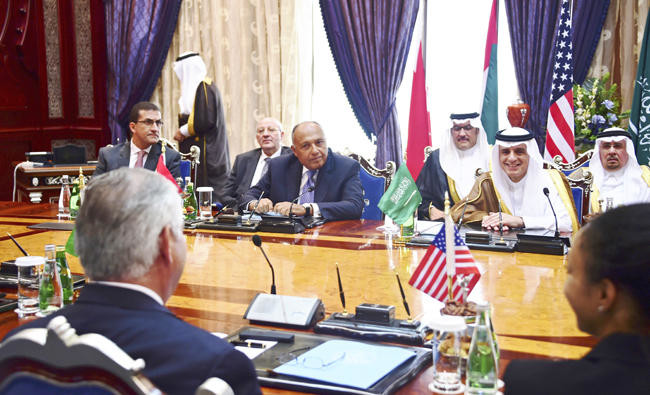
Tillerson’s visit to Saudi Arabia included talks with King Salman and Crown Prince Mohammed bin Salman. He also met with the foreign ministers of the ATQ.
“We’re happy to see this continuous cooperation between us and (to) even strengthen it and increase it further without limits,” the Saudi crown prince said while welcoming Tillerson.
Tillerson later left Jeddah for Kuwait after his meetings. He is expected to travel back to Qatar on Thursday for more talks.
UAE Foreign Minister Sheikh Abdullah bin Zayed Al-Nahyan told reporters during a visit to Slovakia that Tillerson’s visit to Qatar was unlikely to resolve the row. “I think it will ease tensions but it’s just postponing the problem, which will grow in the future,” he said.
Tillerson underscored the shared mutual interests between the US and Saudi Arabia, notably in the areas of “security, stability... and economic prosperity.” He stressed the two countries shared a “strong partnership.”
The deal struck between Washington and Doha falls far short of the sweeping demands made by the ATQ for Qatar to change its policy of supporting extremists in the region.
The ATQ took partial credit for the US counterterrorism deal with Qatar, saying that it was the result of “repeated pressures and demands” by the four countries and others, but that it did not go far enough.
While welcoming US-led efforts to dry up terrorist funding, the ATQ said Doha must meet its list of “fair and legitimate demands.”
The quartet added in a statement that it “affirms that the measures they have taken were motivated by the continuous and diversified activities of the Qatari authorities in supporting, funding and harboring terrorism and terrorists, as well as promoting hateful and extremist rhetoric and interfering in the internal affairs of states.”
Saudi commentators criticized the result of Tillerson’s visit to Qatar. “What makes Wednesday’s meeting in Jeddah difficult is that Tillerson has, since the beginning of the crisis, appeared to be taking the Qatari side,” Abdulrahman Al-Rashed wrote in a column published in the pan-Arab Asharq Al-Awsat newspaper.
“He has to realize that he will be further complicating an already complex matter and prolonging the crisis,” he added, emphasizing that the goal of the ATQ is to change Qatar’s “agenda.”
Commitments made by Doha “cannot be trusted,” said a joint statement published by the Saudi Press Agency (SPA).
France said its foreign minister would visit the Gulf, including Qatar and Saudi Arabia, on July 15-16 as part of its own efforts to overcome the rift.
The US worries the crisis could affect its military and counterterrorism operations and increase the regional influence of Iran, which has been supporting Qatar by allowing it to use air and sea links through its territory.
Qatar hosts Al-Udeid air base, the largest US military facility in the Middle East, from which US-led coalition aircraft stage sorties against Daesh in Syria and Iraq.