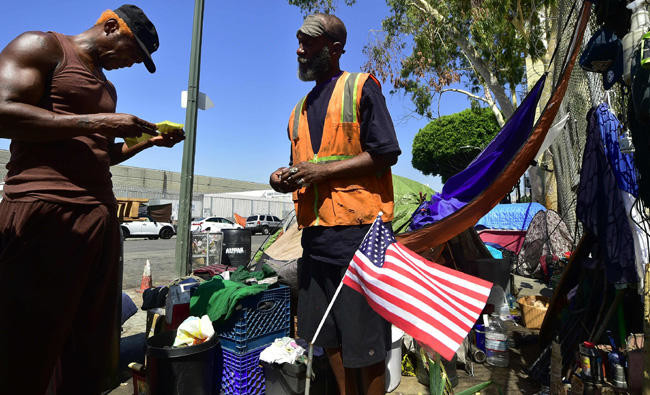
LOS ANGELES: Kendrick Bailey is standing outside the tent he has pitched on a filthy sidewalk in downtown Los Angeles and points to the American flag he served proudly during the Vietnam War.
“I didn’t have education back then,” says Bailey, recalling his time in combat. “So most of us shot guns. Sometimes you could see people get shot by guns. It was horrible.”
Bailey, who is in his sixties, is among an ever-growing population of veterans in Los Angeles who face challenges readjusting to civilian life and eventually become homeless.
“I never had a job,” he says, standing in the searing California sun on a recent day and struggling to explain his predicament.
Though friends initially would offer their couch, he said he quickly overstayed his welcome and got sucked into the same vicious circle facing many veterans who struggle with PTSD, unemployment, alcoholism, family issues, and end up on the street.
Many have also served prison time.
The infamous Skid Row neighborhood of Los Angeles that Bailey now calls home has the largest concentration of homeless people in America, many of them veterans with mental issues and battling addiction.
Their plight has been at the center of debate for decades in an America that loves to glorify its “heroes,” with successive administrations vowing to tackle the problem and pledging millions of dollars in assistance, including for housing.
But despite some 3,500 veterans finding housing last year in the Los Angeles area, recently released statistics serve as a sobering reminder of the scale of the problem.
According to a new count released in May, the number of homeless people in the Los Angeles area jumped by 23 percent in the last year to reach nearly 58,000. Of those, some 5,000 are veterans, the highest number of homeless veterans of any city in the country and a near 60 percent increase over the previous year.
Wrong direction
“There is little doubt that veteran homelessness is now moving in the wrong direction,” said Gary Blasi, a law professor at the University of California Los Angeles who has studied the issue.
“We do not house veterans as quickly as veterans are becoming newly homeless,” he added. “The result is entirely predictable, tragic, and — in the larger context of this country’s wealth and military expenditures — outrageous.”
Blasi said one of the key obstacles to getting veterans off the streets is the lack of affordable housing in a city where rents are skyrocketing. Many landlords in addition are hesitant to rent to a veteran trying to get out of homelessness even though the state usually acts as a guarantor.
Veterans’ advocates also denounce a drop in the number of case workers at the Veterans Affairs office in Los Angeles, which has led to delays in the processing of case files, despite hundreds of thousands of dollars in pledges to tackle the issue.
Several associations have meanwhile been engaged in a lengthy legal battle with Veterans Affairs, a government body, to force it to implement a plan to refurbish a run-down campus in Los Angeles for the purpose of housing veterans.
“The question everybody is asking is where is the money?” said General Dogon, an activist with the Los Angeles Community Action Network (LACAN).
Dogon, whose given name is Steve Richardson, lashed out at city officials, saying they were making empty promises that only look good on paper.
Alex Comisar, a spokesman for Los Angeles mayor Eric Garcetti, counters that he “has invested hundreds of millions of dollars in housing and services for homeless Angelenos” and led a campaign to secure “more than a billion dollars in new funding to do even more.”
Numerous obstacles
Activists also accuse officials of getting rid of buildings with affordable rents in favor of multi-million dollar high rises that are transforming the skyline of downtown Los Angeles.
Added to that, they say, are the numerous obstacles facing homeless veterans, many of whom are handicapped and don’t know how to navigate the system to seek assistance.
“I don’t have money on my credit card to get my birth certificate in San Antonio, Texas, so I can’t get an ID,” said Joseph Shokrian, 33, a US Army veteran who has been homeless for 14 months. “And because I don’t have an address I’m having trouble getting identification, and without my ID it’s very difficult to go to the VA and prove that I was part of the military.”
As for Bailey, he says he has been accumulating citations — to the tune of $1,200 — for pitching his tent and few belongings on a sidewalk.
“These people have fought for this country and they come back and they have to camp out on the ground like they are still in Vietnam,” said Dogon. “Now they don’t combat in uniform, they fight the police who want to move them because they’re bad for business.”


Ranks of homeless war veterans keep swelling in Los Angeles
Ranks of homeless war veterans keep swelling in Los Angeles

Zelensky says meeting with Trump to happen ‘in the near future’
- Zelensky’s announcement came after he said Thursday he had a “good conversation” with US special envoy Steve Witkoff and Trump’s son-in-law Jared Kushner
KYIV: A meeting with US President Donald Trump will happen “in the near future,” Ukrainian President Volodymyr Zelensky said Friday, signaling progress in talks to end the nearly four-year war between Russia and Ukraine.
“We are not losing a single day. We have agreed on a meeting at the highest level – with President Trump in the near future,” Zelensky wrote on X.
“A lot can be decided before the New Year,” he added.
Zelensky’s announcement came after he said Thursday he had a “good conversation” with US special envoy Steve Witkoff and Trump’s son-in-law Jared Kushner.
Trump has unleashed an extensive diplomatic push to end the war, but his efforts have run into sharply conflicting demands by Moscow and Kyiv.
Zelensky said Tuesday he would be willing to withdraw troops from the country’s eastern industrial heartland as part of a plan to end the war, if Moscow also pulls back and the area becomes a demilitarized zone monitored by international forces.
Though Russian Foreign Ministry spokeswoman Maria Zakharova said Thursday that there had been “slow but steady progress” in the peace talks, Russia has given no indication that it will agree to any kind of withdrawal from land it has seized.
In fact, Moscow has insisted that Ukraine relinquish the remaining territory it still holds in the Donbas — an ultimatum that Ukraine has rejected. Russia has captured most of Luhansk and about 70 percent of Donetsk — the two areas that make up the Donbas.
On the ground, Russian drone attacks on the city of Mykolaiv and its suburbs overnight into Friday left part of the city without power.
Meanwhile, Ukraine said it struck a major Russian oil refinery Thursday using British-supplied Storm Shadow missiles.
Ukraine’s General Staff said its forces hit the Novoshakhtinsk refinery in Russia’s Rostov region. “Multiple explosions were recorded. The target was hit,” it wrote on Telegram.
Rostov regional Gov. Yuri Slyusar said a firefighter was wounded when extinguishing the fire.
Ukraine’s long-range drone strikes on Russian refineries aim to deprive Moscow of the oil export revenue it needs to pursue its full-scale invasion. Russia wants to cripple the Ukrainian power grid, seeking to deny civilians access to heat, light and running water in what Kyiv officials say is an attempt to “weaponize winter.”