WASHINGTON: Washington's special envoy to Afghanistan and Pakistan stepped down on Friday, just as the United States is preparing to send thousands more troops to the region.
A senior State Department official told AFP that acting special representative Laurel Miller left the post without a replacement being named.
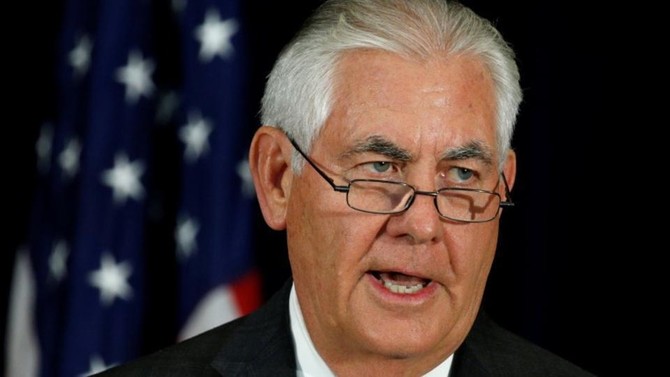
State Department spokeswoman Heather Nauert said Miller is returning to a position at the Rand Corporation and that Secretary of State Rex Tillerson has not yet decided what to do with post.
The office was created when US officials decided that the conflicts in Afghanistan and Pakistan are inextricably linked and ought to be dealt with together.
President Donald Trump came to office planning to slash diplomatic spending and Tillerson plans to cut several special envoy roles.
Miller's responsibilities will now fall under the department's South and Central Asian Affairs Bureau, which has a much bigger footprint that includes India.
But this bureau is itself leaderless, with no assistant secretary appointed to lead it and no one nominated by the new administration for Senate approval.
When news site Politico broke the news that the envoy post had gone, it cited diplomats complaining of a rushed process and a dangerous leadership vacuum.
But, also speaking on condition of anonymity, a senior official told AFP the decision was part of a broader policy review.
Tillerson thinks the issue is best handled at a regional level, the official said, arguing that it made sense to consider India part of the equation.
Trump has given the Pentagon and US commanders wide latitude to decide on the future of Washington's longest ever war -- the 16-year slog in Afghanistan.
Defense Secretary Jim Mattis is reportedly planning to deploy up to 5,000 extra troops to bolster efforts to train Afghan forces to repel a resurgent Taliban insurgency.

US ends role of special envoy to Afghanistan and Pakistan
Kremlin says Putin is mediating in Iran to normalize situation
- Putin had then been briefed by Pezeshkian in a separate call on what the Kremlin called Tehran’s “sustained efforts” to normalize the situation inside Iran
MOSCOW: President Vladimir Putin is mediating in the Iran situation to quickly de-escalate tensions, the Kremlin said on Friday, after the Russian leader spoke with Israeli Prime Minister Benjamin Netanyahu and Iranian President Masoud Pezeshkian.
Moscow has condemned US threats of new military strikes after Iran acted against protests that broke out late last month.
Putin in his call with Netanyahu expressed Russia’s willingness to “continue its mediation efforts and to promote constructive dialogue with the participation of all interested states,” the Kremlin said, adding he had set out his ideas for boosting stability in the Middle East.
No further details were given on Putin’s mediation attempt.
Putin had then been briefed by Pezeshkian in a separate call on what the Kremlin called Tehran’s “sustained efforts” to normalize the situation inside Iran.
“It was noted that Russia and Iran unanimously and consistently support de-escalating
the tensions — both surrounding Iran and in the region as a whole — as soon as possible
and resolving any emerging issues through exclusively political and diplomatic means,” the Kremlin said.
Putin and Pezeshkian had confirmed their commitment to their countries’ strategic partnership and to implementing joint economic projects, the Kremlin added.
Separately, the Shanghai Cooperation Organization, which includes Russia, China, India, and Iran, among others, said it opposed external interference in Iran and blamed Western sanctions for creating conditions for unrest.
“Unilateral sanctions have had a significant negative impact on the economic stability of the state, led to a deterioration in people’s living conditions, and objectively limited the ability of the Government of the Islamic Republic of Iran to implement measures to ensure the country’s socio-economic development,” the SCO said in a statement.
Protests erupted on Dec. 28 over soaring inflation in Iran, whose economy has been crippled by sanctions.
Asked what support Russia could provide to Iran, Kremlin spokesman Dmitry Peskov said: “Russia is already providing assistance not only to Iran but also to the entire region, and to the cause of regional stability and peace. This is partly thanks to the president’s efforts to help de-escalate tensions.”
The US Treasury on Thursday announced new sanctions targeting Iranian officials, including Ali Larijani, secretary of Iran’s Supreme Council for National Security.