US Navy probes destroyer crash that killed seven in Japan

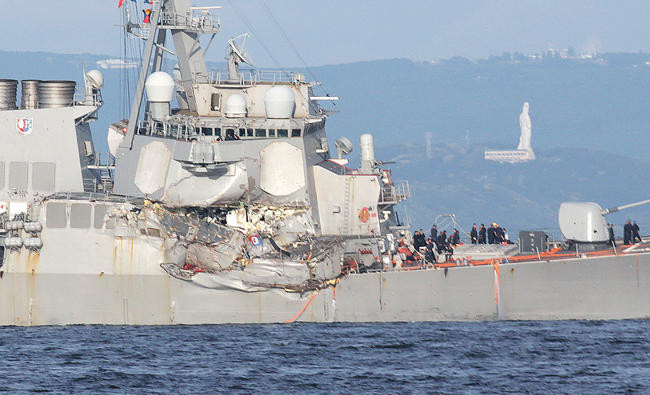
The damaged USS Fitzgerald is seen near the US Naval base in Yokosuka, southwest of Tokyo. (AP)
Updated 19 June 2017
Follow

US Navy probes destroyer crash that killed seven in Japan

TOKYO: A probe into the crash between a US navy destroyer and a Philippine-flagged cargo ship was under way Monday, as the names of seven American sailors who died were made public.
Investigators were looking at how the USS Fitzgerald came to be holed in the smash in a busy shipping lane near its home port.
The container ship, the 222-meter Philippine-flagged ACX Crystal, made a 180 degree turn shortly before the accident, according to data from the Marine Traffic website. It was not immediately clear what prompted the sharp turn.
The US Navy and Japan’s coast guard are conducting separate inquiries, but will likely be co-operating, a spokesman for Japan’s transport safety board said.
Japanese coast guard investigators will be interviewing the Filipino crew of the Japanese-owned container ship, although the US has primary jurisdiction in investigating accidents involving military.
Citing local investigators, Japan’s top-selling Yomiuri newspaper said Monday that the damage on both ships suggests they were traveling in the same direction when the crash occurred, 56 nautical miles southwest of Yokosuka.
The impact tore a huge gash in the Fitzgerald, sending gallons of water flooding into the berths where the crew were sleeping.
The bodies of the sailors, who were aged between 19 and 37, were recovered by navy divers after their 154-meter vessel limped into port.
The huge commercial vessel came into Yokosuka with large scrapes on its bow, but none of its 20 crew were injured.
Japan’s coast guard is also investigating why it took nearly an hour before the Philippine ship reported the collision, a coast guard spokesman said.
“We had first announced that the collision occurred at 2:20 am, based on the initial report from the Philippine ship, but we have now changed it to 1:30 am after directly hearing from the crew,” the spokesman said.
“We are checking what happened during the time and why the report was delayed,” he added.
There have been around 30 boat crashes over the past decade in the area, including a 2013 incident when six Japanese crew died after their cargo ship crashed with another vessel in the early morning hours, a coast guard spokesman said.
“That’s considered a lot of accidents,” he said, adding that many ships pass through the channel in the middle of the night to be on time for morning cargo pick-ups.
“There are all kinds of ships navigating those waters.”
Under maritime law, the container ship had an obligation to avoid a collision if it was trying to overtake the destroyer from behind.
But if the container vessel was approaching from the US ship’s right side, the destroyer had the obligation to give way, another Japanese coast guard spokesman said.
“Generally speaking, if a ship sees another vessel on its right hand side it has the obligation to avoid” a collision, he added.
Investigators are sure to put the vessels’ trackable movements under a microscope to figure out what set the deadly crash in motion, said Shoji Fujimoto, a maritime safety expert at Japan’s Kobe University.
“Probably the bulbous bow of the container ship, which is below the waterline, crashed into the hull of the naval ship,” he added, referring to a protuberance at the front of some ships designed to reduce wave resistance.
“Modern-day destroyers’ hulls are made from very thin steel sheets...so they’re vulnerable in a crash.”
On Sunday, US 7th Fleet commander Vice Admiral Joseph Aucoin said the crew would have had little chance of escaping the “tremendous” amount of water that gushed into the ship after the accident tore open its side.
“A significant part of the crew was sleeping,” he told reporters. “There wasn’t a lot of time in spaces that were open to the sea.”
“So, it was traumatic. As to how much warning they had — I don’t know.”
Several other US crewmembers were injured in the accident and had to be evacuated by air to hospital, including the vessel’s commanding officer Bryce Benson.
He and a couple of other crewmembers have since been released from hospital.


Youth voters take center stage in Bangladesh election after student-led regime change

Updated 4 sec ago
Follow

Youth voters take center stage in Bangladesh election after student-led regime change

  • About 45% of Bangladeshis eligible to vote in Thursday’s election are aged 18-33
  • Election follows 18 months of reforms after the end of Sheikh Hasina’s 15-year rule

DHAKA: When he goes to the polls on Thursday, Atikur Rahman Toha will vote for the first time, believing that this election can bring democratic change to Bangladesh.

A philosophy student at Dhaka University, Toha was already eligible to vote in the 2024 poll but, like many others, he opted out.

“I didn’t feel motivated to even go to vote,” he said. “That was a truly one-sided election. The election system was fully corrupted. That’s why I felt demotivated. But this time I am truly excited to exercise my voting rights for the first time.”

The January 2024 vote was widely criticized by both domestic and international observers and marred by a crackdown on the opposition and allegations of voter fraud.

But the victory of the Awami League of ex-Prime Minister Sheikh Hasina was short-lived, as a few months later the government was ousted by a student-led uprising, which ended the 15-year rule of Bangladesh’s longest-serving leader.

The interim administration, led by Nobel laureate Muhammad Yunus, took control in August 2024 and prepared a series of reforms to restructure the country’s political and institutional framework and organize the upcoming vote.

About 127.7 million Bangladeshis are eligible to cast their ballots, according to Election Commission data, with nearly a third of them, or 40.4 million, aged 18-29. Another 16.9 million are 30-33, making it a youth–dominated poll, with the voters hopeful the outcome will help continue the momentum of the 2024 student-led uprising.

“We haven’t yet fully transitioned into a democratic process. And there is no fully stable situation in the country,” Toha said. “After the election we truly hope that the situation will change.”

For Rawnak Jahan Rakamoni, also a Dhaka University student, who is graduating in information science, voting this time meant that her voice would count.

“We are feeling that we are heard, we will be heard, our opinion will matter,” she said.

“I think it is a very important moment for our country, because after many years of controversial elections, people are finally getting a chance to exercise their voting rights and people are hoping that this election will be more meaningful and credible. This should be a fair election.”

But despite the much wider representation than before, the upcoming vote will not be entirely inclusive in the absence of the Awami League, which still retains a significant foothold.

The Election Commission last year barred Hasina’s party from contesting the next national elections, after the government banned Awami League’s activities citing national security threats and a war crimes investigation against the party’s top leadership.

The UN Human Rights Office has estimated that between July 15 and Aug. 5, 2024 the former government and its security and intelligence apparatus, together with “violent elements” linked to the Awami League, “engaged systematically in serious human rights violations and abuses in a coordinated effort to suppress the protest movement.”

It estimated that at least 1,400 people were killed during the protests, with the majority shot dead from military rifles.

Rezwan Ahmed Rifat, a law student, wanted the new government to “ensure justice for the victims of the July (uprising), enforced disappearances, and other forms of torture” carried out by the previous regime.

The two main parties out of the 51 contesting Thursday’s vote are the Bangladesh Nationalist Party and Jamaat-e-Islami. Jamaat, which in 2013 was banned from political participation by Hasina’s government, heads an 11-party alliance, including the National Citizen Party formed by student leaders from the 2024 movement.

“I see this election as a turning point of our country’s democratic journey … It’s not just a normal election,” said Falguni Ahmed, a psychology student who will head to the polls convinced that no matter who wins, it will result in the “democratic accountability” of the next government.

Ahmed added: “People are not voting only for their leaders; they are also voting for the restoration of democratic credibility. That’s why this election is very different.”