Petition launched to reunite family of Syrian Londoner who died in Grenfell Tower fire

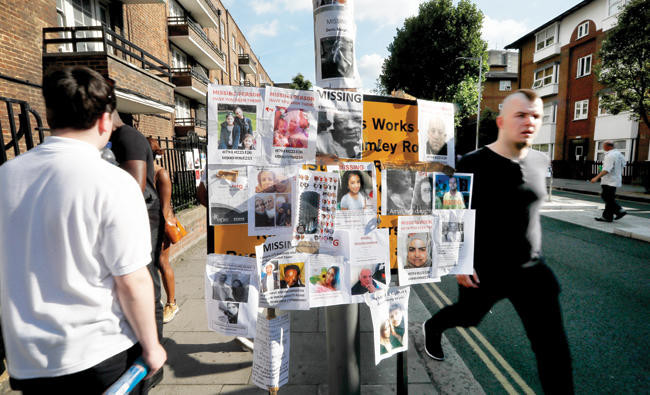
Posters of missing people are stuck to a lamppost after the Grenfell Tower fire in London on Saturday. (AP)
Updated 19 June 2017
Follow

Petition launched to reunite family of Syrian Londoner who died in Grenfell Tower fire

JEDDAH: A petition that was started by a Syrian Londoner calling to reunite parents of a Syrian refugee, who was a victim of the recent Grenfell Tower inferno in London, attracted over 93,000 signatures (at the time of this filing).
Mohammed Al-Haj Ali, 23, fled the war in Syria only to die in the fire that engulfed the 24-story tower block in west London.
The Home Office announced on Sunday that they would assist the parents of Al-Haj Ali to come to the UK to attend their son Mohammed’s funeral and visit their children Omar, who was admitted to a hospital, and Hesham, after five years of separation.
London-based Mirna Ayoubi, a friend of Al-Haj Ali family, launched the petition on Change.Org. She posted on Sunday saying: “We managed to make a difference in the world and hopefully reunite Omar and Hesham Al-Haj Ali with their family in Syria.”
According to the petition, the brothers had not seen their family in five years and were “forced to limit communication to ensure their safety amid the crackdown against the opposition.”
Mohammed, and his two brothers, Omar, 25, and Hesham, 20, came to London seeking a better future away from the conflict in their home in Daraa, in the south of Syria.
Mohammed’s last words to his brother Omar were reportedly: “The smoke is getting in … we are going to die.”
The Home Office on Sunday said that it would offer advice on issuing emergency visas to those who are directly affected by Grenfell Tower fire.
A visa help line is now available as the Home Office published information on its website urging people directly affected by the fire at Grenfell Tower, who are seeking guidance on UK passports, visa or immigration, to call the advice hotline (+443002220000).


‘Not Winston Churchill’: Trump steps up criticism of UK’s Starmer

Updated 10 sec ago
Follow

‘Not Winston Churchill’: Trump steps up criticism of UK’s Starmer

  • Trump criticized Starmer’s decision to cede sovereignty of the Chagos Islands, home to the Diego Garcia air base, ‌saying that they have ‘been very, very uncooperative with with that stupid island’
  • Donald Trump: ‘France has been great. They’ve all been great. The UK has been much different from others’
LONDON/WASHINGTON: President Donald Trump intensified his criticism of Prime Minister Keir Starmer on Tuesday, ​saying his lack of immediate support for US strikes on Iran showed “this is not Winston Churchill we’re dealing with.” Trump has lashed out at Starmer three times this week after he said neither the British military, or its air bases, were involved in the initial US and Israeli strikes on Tehran that killed Iranian Supreme Leader Ayatollah Ali Khamenei. Starmer told parliament that the government had learnt from its mistakes in backing the US in the 2003 Iraq war, and said any military action must have a “viable, thought-through plan.” He also said he did not believe in “regime change from the skies.” But ‌Starmer has since ‌allowed the US to use UK bases to launch what he ​called ‌limited ⁠and defensive ​strikes ⁠to weaken Tehran’s capabilities, after Iran hit US allies in the region with drones and missiles. On Monday, a British base in Cyprus was hit by a drone that Cypriot officials said was likely launched by Iran-backed Lebanese group Hezbollah, prompting London to send a destroyer and more helicopters with counter-drone technology to the region.
Trump told reporters during a meeting in the Oval Office with German Chancellor Friedrich Merz that he was very disappointed with Britain.
“This is not Winston Churchill that we’re dealing with,” he said, comparing Starmer with Britain’s revered ⁠wartime leader.
Trump also criticized Starmer’s decision to cede sovereignty of the Chagos ‌Archipelago, home to the US-UK air base of Diego Garcia, ‌saying they have “been very, very uncooperative with that stupid island.”

Starmer has ‌been criticized from all sides at home for his decision, with opponents on the left calling ‌for him to condemn the military action while on the right, opposition leaders Kemi Badenoch and Nigel Farage attacked Starmer for failing to back Britain’s key security and intelligence ally.
Britain has long prided itself on its relationship with the US, aided by British leaders such as Churchill, Margaret Thatcher and Tony Blair cultivating strong relationships with their counterparts, ‌Franklin D. Roosevelt, Ronald Reagan and George W. Bush.
Starmer, a center-left former lawyer, surprised his critics when he too struck up a solid relationship ⁠with Trump, but that has ⁠been tested in the last year as the US leader became more combative on a number of fronts. Trump earlier told the Sun newspaper he never thought he would see Britain become a reluctant partner, instead heaping praise on France and Germany.
“This was the most solid relationship of all,” he said. “And now we have very strong relationships with other countries in Europe.”
“France has been great. They’ve all been great. The UK has been much different from others.”
Britain, France and Germany released a joint statement in response to Iranian attacks on Saturday, saying they were in close contact with the US, Israel and partners in the region, and were calling for a resumption of negotiations.
Starmer has defended his response, telling parliament on Monday he had to judge what was in Britain’s national interest. “That is what ​I have done, and I stand by ​it,” he said.
Polling published by YouGov on Tuesday showed people in Britain were opposed to the US strikes on Iran by 49 percent to 28 percent.