Strong earthquake shakes Indonesia’s Sulawesi island

1 / 2
A woman and children stand in the doorway of a house during an earthquake in Palu, central Sulawesi, Indonesia, on Monday in this photo taken by Antara Foto. (Antara Foto/Mohamad Hamzah/via Reuters)
2 / 2
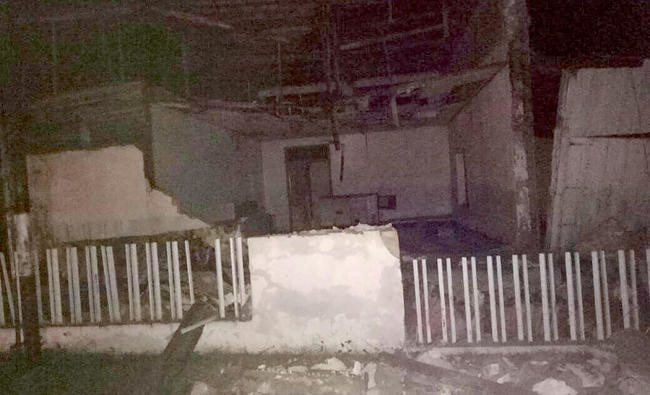
This handout picture taken and released on Monday by the Indonesian National Board of Disaster Management shows damaged buildings in Poso after a shallow, 6.6-magnitude earthquake hit inland on the central Indonesian island of Sulawesi. (Indonesian National Board Of Disaster Management / Handout via AFP)
Updated 29 May 2017
Follow

Strong earthquake shakes Indonesia’s Sulawesi island

JAKARTA, Indonesia: A strong, shallow earthquake rocked Indonesia’s central Sulawesi province Monday evening. There were no immediate reports of serious damage or casualties, and no tsunami warning.
The US Geological Survey said the quake had a magnitude of 6.8 and was centered 79 kilometers (49 miles) southeast of the provincial capital, Palu, at a depth of 9.4 kilometers (6 miles).
Imam Faturrachman, a scientist with Indonesia’s Meteorology and Geophysics Agency, said the land-based quake did not have the potential to cause a tsunami.
The National Disaster Mitigation Agency posted photos on Twitter of what it said was a collapsed building in Poso, a city to the southeast of the epicenter. It said it had no reports of casualties.
El Shinta radio reported that residents ran from their homes in panic.
The first quake was followed by magnitude 5.0 and 4.9 aftershocks, also at a shallow depth.
Shallow earthquakes tend to cause more damage on the Earth’s surface.
Indonesia is prone to earthquakes and volcanic eruptions due to its location along the Pacific “Ring of Fire.” A powerful Indian Ocean quake and tsunami in 2004 killed a total of 230,000 people in a dozen countries, most of them in Indonesia.


In Ethiopia, Tigrayans fear return to ‘full-scale war’

Updated 02 February 2026
Follow

In Ethiopia, Tigrayans fear return to ‘full-scale war’

  • Flights have been suspended into Tigray since Thursday and local authorities reported drone strikes on goods lorries
  • The international community fears the fighting could turn into an international conflict between Ethiopia and Eritrea

ADDIS ABABA: Tigrayans in northern Ethiopia fear a return to all-out war amid reports that clashes were continuing between local and federal forces on Monday, barely three years after the last devastating conflict in the region.
The civil war of 2020-2022 between the Ethiopian government and Tigray forces killed more than 600,000 people and a peace deal known as the Pretoria Agreement has never fully resolved the tensions.
Fighting broke out again last week in a disputed area of western Tigray called Tselemt and the Afar region to the east of Tigray.
Abel, 38, a teacher in Tigray’s second city Adigrat, said he still hadn’t recovered from the trauma of the last war and had now “entered into another round of high anxiety.”
“If war breaks out now... it could lead to an endless conflict that can even be dangerous to the larger east African region,” added Abel, whose name has been changed along with other interviewees to protect their identity.
Flights have been suspended into Tigray since Thursday and local authorities reported drone strikes on goods lorries on Saturday that killed at least one driver.
In Afar, a humanitarian worker, speaking to AFP on condition of anonymity, said there had been air strikes on Tigrayan forces and that clashes were ongoing on Monday, with tens of thousands of people displaced.
AFP could not independently verify the claims and the government has yet to give any comment on the clashes.
In the regional capital Mekele, Nahom, 35, said many people were booking bus tickets this weekend to leave, fearing that land transport would also be restricted soon.
“My greatest fear is the latest clashes turning into full-scale war and complete siege like what happened before,” he told AFP by phone, adding that he, too, would leave if he could afford it.
Gebremedhin, a 40-year-old civil servant in the city of Axum, said banks had stopped distributing cash and there were shortages in grocery stores.
“This isn’t only a problem of lack of supplies but also hoarding by traders who fear return of conflict and siege,” he said.
The region was placed under a strict lockdown during the last war, with flights suspended, and banking and communications cut off.
The international community fears the fighting could turn into an international conflict between Ethiopia and Eritrea, whose relations have been increasingly tense in recent months.
The Ethiopian government accuses the Tigrayan authorities and Eritrea of forging closer ties.
United Nations Secretary-General Antonio Guterres is “deeply concerned about... the risk of a return to a wider conflict in a region still working to rebuild and recover,” his spokesman said.
The EU said that an “immediate de-escalation is imperative to prevent a renewed conflict.”