JEDDAH: Iran’s statement on Monday accusing the US of “Iranophobia” came in for a sharp rebuke from experts who described Tehran as a state sponsor of terrorism.
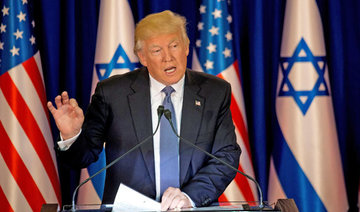
Referring to US President Donald Trump’s recent visit to Saudi Arabia, Iranian Foreign Ministry spokesman Bahram Qassemi said: “Once again, by his repetitive and baseless claims about Iran, the American president... tried to encourage the countries of the region to purchase more arms by spreading Iranophobia.”
That accusation was instantly shot down by former US diplomat and political analyst Ali Khedery.
“It’s not Iranophobia, it’s strategic clarity from Trump and our regional allies,” Khedery told Arab News, adding that Iran has plenty of blood on its hands.
“Since the Islamic revolution in 1979, Iran has killed and wounded thousands of our American soldiers and civilians,” Khedery said. “It started with the US Embassy Tehran hostage crisis, during which our diplomats were held for 444 days. Then Iran participated in the bombing of our embassy in Beirut in 1982, then the Marine barracks in 1983. Iran had a role in the Khobar Towers bombing in Saudi Arabia in 1996, and the terrorist attack against Jewish targets in Argentina in the late 1990s.”
Iran had had dealings with Osama bin Laden and Al-Qaeda for decades, Khedery said, adding: “Iran has also maintained ties with the Taliban, and has facilitated various terrorist activities in Afghanistan that have resulted in the killing and wounding of our soldiers and Afghan civilians. They’ve done the same in Iraq since 2003, killing and wounding thousands of our soldiers, primarily through their Shiite militias. They also participated in the killing and wounding of thousands of Iraqi civilians.”
Iran, Hezbollah and Russia have been Syrian President Bashar Assad’s chief backers “as he committed a modern-day holocaust, killing some half a million Syrians, wounding a million more and displacing some 11 million,” Khedery said.
He expressed relief that “an American president has come along who recognized this fact and is finally willing to do something about it.”
Oubai Shahbandar, a Syrian-American analyst and fellow at the New America Foundation’s International Security Program, said Tehran seems to go to great lengths to complain when the US and the Arab Coalition take it to task “for its very real and dangerous malign activity.”
It is incumbent upon Iran’s recently re-elected President Hassan Rouhani to show he can rein in the Islamic Revolutionary Guard Corps (IRGC) and the Shiite militant forces they arm and fund to destabilize the region, Shahbandar added.
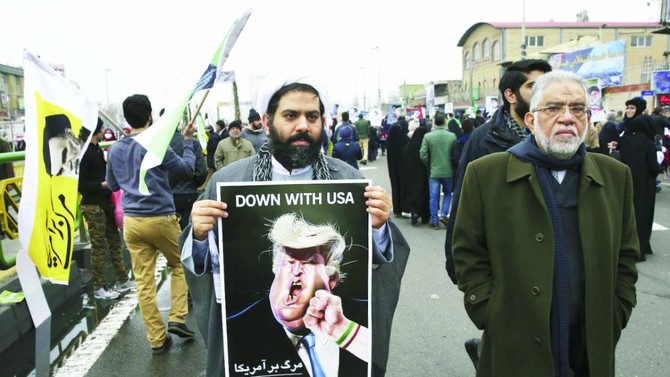
“This isn’t Iranophobia, it’s common sense,” he told Arab News. “It’s how normal states that seek normal relations with their neighbors are supposed to act. When ‘Death to America’ and a drive to spread extremism throughout the Muslim and Arab worlds are purged from Iran’s government policy and rhetoric, then and only then can it realistically hope to mend ties with America and Arab allies. Sadly, the Iranian regime to this day does a great disservice to its people by showing no signs that it’s willing or capable of moving past the extremist fervor of its 1979 revolutionary ethos.”
Harvard scholar and Iranian affairs expert Majid Rafizadeh called it Iranian double standard to accuse the US or other nations of Iranophobia.
“Militarily, strategically, ideologically and geopolitically, some of the core pillars of Iran’s political establishment — for almost four decades since the establishment of the Islamic Republic in 1979 — have been anti-Americanism, damaging US national interests, inciting hatred toward the US, chanting ‘Death to America’ and ‘The Great Satan,’ and scuttling the foreign policy objectives of the US and its allies,” Rafizadeh told Arab News.
“This revolutionary value… is the raison d’etre of the political establishment, particularly the top gilded circle of Iranian leaders. Whatever any nation attempts to do, whatever policy any government pursues, and whatever any US administration tries to do in order to moderate Iran, rationalize it or make peace, one can’t change this underlying ideological and revolutionary pillar,” he added.