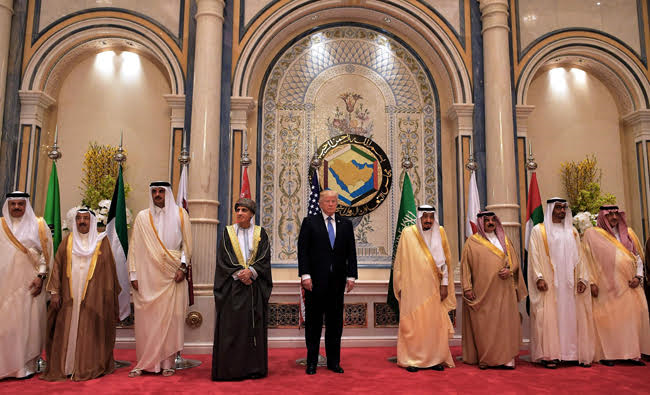
President Donald Trump meets with GCC leaders

US President Donald Trump joins GCC leaders for a summit in Riyadh. (AFP)
Updated 21 May 2017
Follow

President Donald Trump meets with GCC leaders

RIYADH:  The much-anticipated US-GCC Summit has kicked off as US President Donald Trump sat down with Gulf leaders and officials at the King Abdulaziz Conference Center in Riyadh.

Minutes before the commencement of the meeting, US Secretary of State Rex Tillerson exchanged a Memorandum of Understanding on countering the financing of terrorism with Saudi Crown Prince Mohammed bin Naif bin Abdulaziz Al Saud.

Gulf leaders and officials from Saudi Arabia, the UAE, Bahrain, Qatar, Oman and Kuwait are meeting with Trump to discuss threats to regional security and stability, Iranian influence in the region and Yemen. They will also discuss the building of stronger commercial ties between the US and the Gulf. 

The American president first held bilateral meetings with Bahrain’s King Sheikh Hamad bin Isa Al Khalifa and also met with Egyptian President Abdel Fattah El Sisi.

Trump said that Washington's relations with Bahrain were set to improve and also said that he would accept an invitation made by the Egyptian president to visit Egypt. Trump said the visit would happen before long.

Of Bahrain, Trump said: "Our countries have a wonderful relationship together, but there has been a little strain, but there won't be strain with this administration," Trump said during a photo session with Sheikh Hamad bin Issa Al Khalifa.
"We're going to have a very, very long-term relationship. I look forward to it very much — many of the same things in common."
The day of meetings will be followed by the Arab-Islamic-American Summit during which Trump is set to give a much-awaited speech on Islam.
Also today, King Salman and President Trump are set to inaugurate the Global Center for Combating Extremist Ideology (GCCEI), which will counter and prevent the spread of extremist ideology through promoting moderation, compassion and supporting the dissemination of positive dialogue.Yesterday, Saudi Arabia and the US agreed a “Joint Strategic Vision Declaration” covering aspects like diplomacy, trade, security and the fight against terror.
It was co-signed by King Salman and d Trump at the Al-Yamamah Palace in Riyadh.
The White House said in a statement that the declaration reflects the two countries’ efforts to boost “their strategic partnership for the 21st century” and to chart “a renewed path toward a peaceful Middle East where economic development, trade and diplomacy are hallmarks of regional and global engagement.”
The two nations plan to form a Strategic Joint Consultative Group, hosted by the US president and Saudi king, or their appropriate representatives, to chart the course of this strategic partnership. It will meet at least once a year, alternating between the two countries.
“Our two great countries share a desire to address the threats to our shared security interests. Thus, the United States of America and the Kingdom of Saudi Arabia seek to embark on new initiatives to counter violent extremist messaging, disrupt financing of terrorism, and advance defense cooperation,” the White House statement said.


SDAIA Academy opens registration for quantum computing boot camp

Updated 05 January 2026
Follow

SDAIA Academy opens registration for quantum computing boot camp

  • 5 hours of daily training offered, from Jan. 11-15

RIYADH: The SDAIA Academy has opened registration for a five-day quantum computing boot camp aimed at building national capabilities in one of the world’s most advanced and complex computing fields.

The boot camp will run from Jan. 11 to 15, offering five hours of daily training, according to the Saudi Press Agency.

It is organized by the Saudi Data and AI Authority, in collaboration with the King Fahd University of Petroleum and Minerals, and targets professionals and specialists in computer science and related disciplines.

According to the SDAIA, the program is designed to equip participants with a foundational understanding of quantum computing and its potential applications, as Saudi Arabia steps up investments in advanced and emerging technologies, aligned with Vision 2030.

Quantum computing differs fundamentally from classical computing by relying on quantum mechanics rather than binary logic.

While still an emerging field, it is widely expected to reshape areas such as cybersecurity, optimization, advanced simulation and data-intensive research.

The boot camp will introduce participants to the physical and mathematical principles that underpin quantum computing, including the behavior of qubits, quantum superposition and entanglement.

It will also examine how quantum systems differ from traditional computing architectures and where quantum approaches may offer advantages.

In addition to theory, the program places a strong emphasis on applied training.

Participants will receive hands-on exposure to designing and running quantum algorithms using industry-recognized tools and platforms, including Qiskit and CUDA-Q.

These tools are currently used in research and early-stage development environments worldwide.

Organizers say the practical component aims to prepare participants to engage with real-world quantum computing workflows rather than limiting training to conceptual knowledge.

The goal is to build early-stage technical readiness among Saudi professionals, as global interest in quantum technologies accelerates.

The collaboration with King Fahd University of Petroleum and Minerals reflects a broader push to link national digital initiatives with academic and research expertise.

KFUPM has played a central role in developing technical talent in engineering, computing and applied sciences, fields closely connected to quantum research.

The SDAIA has increasingly focused on capability-building programs that support Saudi Arabia’s long-term digital and data strategy.

Training initiatives in artificial intelligence, advanced analytics and emerging technologies are viewed as essential in reducing reliance on external expertise and strengthening local innovation ecosystems.

Officials say the quantum computing boot camp forms part of this wider effort to develop specialized skills that may not yet be widespread in the local labor market but are expected to become strategically important in the coming decade.

The program also aligns with the objectives of Vision 2030 related to human capital development and the transition toward a knowledge-based economy, particularly in high-value technology sectors.

Registration for the boot camp is open until Jan. 6. Applicants can register through the SDAIA’s official training platform.