

Tunisia seeks UNESCO status for Jewish pilgrimage isle

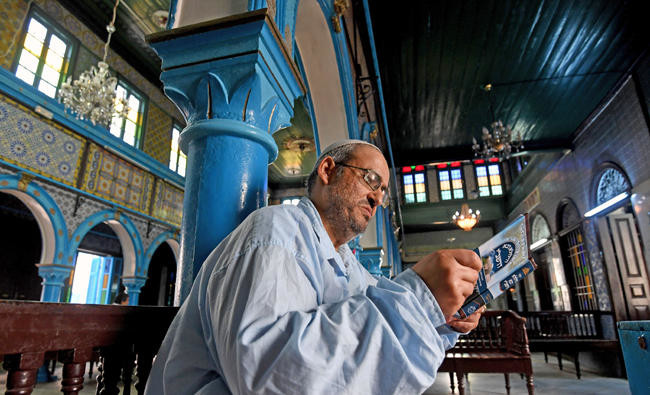
Tunisian Rabbi Daoud reads the torah at the Ghriba Synagogue on the Tunisian resort island of Djerba on May 14, 2017 during the second day of the annual Jewish pilgrimage to the synagogue thought to be Africa's oldest. (AFP / FETHI BELAID)
Updated 15 May 2017
Follow

Tunisia seeks UNESCO status for Jewish pilgrimage isle

DJERBA, Tunisia: Tunisia plans to seek UNESCO World Heritage status for the island of Djerba, site of Africa’s oldest synagogue and an annual Jewish pilgrimage, its culture minister said on Sunday.
Speaking on the last day of the pilgrimage to the Ghriba synagogue, Mohamed Zine El-Abidine said the island was important for its “cultural and religious uniqueness.”
He said the application to add Djerba to the World Heritage List would highlight the rich religious heritage of the island, which is home to centuries-old mosques, churches and synagogues.
He did not give a specific time frame for the application.
The cultural agency of the United Nations already lists eight sites in the North African country, including the old cities of Tunis and Sousse and the city of Carthage, once the capital of the Mediterranean-wide Phoenician empire.
Some 3,000 pilgrims attended this year’s Jewish pilgrimage to the island, which ended Sunday under tight security following a string of jihadist attacks in Tunisia.
“There has been a real increase compared to the past two years,” Tourism Minister Selma Elloumi said.
“It is an important sign for the start of the tourist season,” she added.
The number of pilgrims visiting the synagogue has fallen sharply since a suicide bombing claimed by Al-Qaeda struck Ghriba just before the 2002 pilgrimage, killing 21 people.
Before then the event attracted as many as 8,000 pilgrims a year.
Believed to have been founded in 586 BC by Jews fleeing the destruction of the Temple of Solomon in Jerusalem, the Ghriba synagogue has long been a destination for pilgrims, especially for Jews of Tunisian descent.

Around 1,500 Jews live in Tunisia today, down from an estimated 100,000 before the country won independence from France in 1956.
Many of today’s pilgrims came from Europe, the United States and Israel.
Prime Minister Youssef Chahed was in Ghriba on Sunday to deliver what he called “a double message.”
“Firstly... Tunisia is a country several thousand years old, with a deep-rooted history of openness to all religions,” he told AFP.
Secondly, he said, “security has come back to Tunisia.”
Rocked by instability since the fall in 2011 of longtime dictator Zine El Abidine Ben Ali, Tunisia was hit by a series of jihadist attacks in 2015 and 2016 that left dozens dead, including 59 tourists.
The country’s key tourism sector, devastated by the attacks, has since registered a rise in visitor numbers.
According to Elloumi, there has been a 34 percent rise in tourist arrivals from Europe over the past year.


Lebanon’s government approves a deal to transfer Syrian prisoners back to Syria

Updated 30 January 2026
Follow

Lebanon’s government approves a deal to transfer Syrian prisoners back to Syria

  • Lebanon and Syria have a complicated history with grievances on both sides
  • A key obstacle to warming relations has been the fate of about 2,000 Syrians in Lebanese prisons

BEIRUT: Lebanon’s Cabinet on Friday approved an agreement to transfer Syrian prisoners serving their sentences in Lebanon back to their home country.
The issue of prisoners has been a sore point as the neighboring countries seek to recalibrate their relations following the ouster of former Syrian President Bashar Assad in a lightning offensive by Islamist-led insurgents in December 2024. Former insurgent leader Ahmad Al-Sharaa is now Syria’s interim president.
Lebanon and Syria have a complicated history with grievances on both sides. Many Lebanese resent the decades-long occupation of their country by Syrian forces that ended in 2005. Many Syrians resent the role played by the Lebanese militant group Hezbollah when it entered Syria’s civil war in defense of Assad’s government.
A key obstacle to warming relations has been the fate of about 2,000 Syrians in Lebanese prisons, including some 800 held over attacks and shootings, many without trial. Damascus had asked Beirut to hand them over to continue their prison terms in Syria, but Lebanese judicial officials said Beirut would not release any attackers and that each must be studied and resolved separately.
The deal approved Friday appeared to resolve that tension. Lebanese Information Minister Paul Morcos said other issues remain to be resolved between the two countries, including the fate of Lebanese believed to have been disappeared into Syrian prisons during Assad’s rule and the demarcation of the border between the two countries.
Lebanon’s Deputy Prime Minister Tarek Mitri told reporters after the Cabinet meeting that about 300 prisoners would be transferred as a result of the agreement.
Protesters gathered in a square below the government palace in downtown Beirut ahead of the Cabinet vote to call for amnesty for Lebanese prisoners, including some who joined militant groups fighting against Assad in Syria. Some of the protesters called for the release of Sunni cleric Ahmad Al-Assir, imprisoned for his role in 2013 clashes that killed 18 Lebanese army soldiers.
“The state found solutions for the Syrian youth who are heroes and belong to the Syrian revolution who have been imprisoned for 12 years,” said protester Khaled Al- Bobbo. “But in the same files there are also Lebanese detainees. ... We demand that just as they found solutions for the Syrians, they must also find solutions for the people of this country.”