

Trump throws his hat into Mideast peace process ring

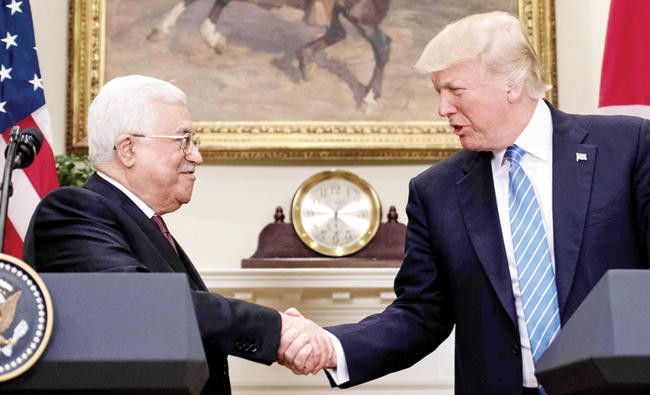
US President Donald Trump and Palestinian President Mahmoud Abbas at the White House Wednesday. (AFP)
Updated 04 May 2017
Follow

Trump throws his hat into Mideast peace process ring

WASHINGTON DC: Walking in the footsteps of many of his predecessors who delved into Israeli-Palestinian peacemaking — but ultimately failed — US President Donald Trump launched Wednesday his own “process which hopefully will lead to peace.”
Trump, striking an optimistic note during his meeting with Palestinian President Mahmoud Abbas, pledged that “we will get this done.”
The Trump-Abbas meeting concluded a series of consultations the new US president held with regional leaders since assuming office. He hopes to resume Israeli-Palestinian negotiations that have been stalled since March 2014.
An analyst, however, pointed to an ever widening gap between the two sides, lowering the chance of any final agreement in the short term.
In statements from the Roosevelt room at the White House flanked by both the American and the Palestinian flags, Trump gave a much-needed boost to Abbas ahead of a working lunch with the delegation. “I want to support you in being the Palestinian leader who signs his name to the final and most important peace agreement that brings safety, stability, and prosperity to both peoples and to the region,” Trump said.
Abbas has been marginalized following the breakdown of talks three years ago. His meeting with Trump, according to former White House official and peace envoy Dennis Ross, gives him “relevance and a boost” on both the Palestinian front and the regional arena.
Ross, a fellow at the Washington Institute for Near East Policy, told reporters that “the gap between the parties has probably never been greater” but not impossible for Trump to overcome with a gradual trust-building approach.
Trump, while sounding hopeful about a peace deal, warned that “any agreement cannot be imposed by the United States... Palestinians and Israelis must work together to reach an agreement.”

The former real estate mogul promised to “do whatever is necessary to facilitate the agreement — to mediate, to arbitrate anything they’d like to do.”
Trump even extended another possible invite to Abbas in “welcoming him back as a great marker of progress and, ultimately, toward the signing of a document with the Israelis and with Israel toward peace.”
Abbas lavished Trump with praise for his leadership on the issue. “I believe that we are capable under your leadership and your stewardship — your courageous stewardship and your wisdom, as well as your great negotiating ability — that we can be partners, true partners, to you to bring about a historic peace treaty,” Abbas said.
Abbas who has been in office since 2005 and was part of two failed US attempts to negotiate peace under George W. Bush and Barack Obama, reiterated the Palestinian principles for peace.
“Our strategic option, our strategic choice is to bring about peace based on the vision of the two-state — a Palestinian state with its capital of East Jerusalem that lives in peace and stability with the state of Israel based on the borders of 1967,” Abbas said.
US Vice President Mike Pence contended ahead of the meeting that the White House is “seriously considering” moving the US Embassy in Israel from Tel Aviv to Jerusalem.
Abbas decried the Israeli occupation, saying “it’s about time for Israel to end its occupation of our people and of our land after 50 years.”
Both leaders avoided mentioning any specifics on the way forward beyond a US push to counter incitement and hate rhetoric from the Palestinian side. Trump concluded his statement challenging the naysayers, and said “let’s see if we can prove them wrong.”
Cuba’s president says no current talks with the US following Trump’s threats

Updated 11 sec ago
Follow

Cuba’s president says no current talks with the US following Trump’s threats

  • Cuba was receiving an estimated 35,000 barrels a day from Venezuela before the US attacked, along with some 5,500 barrels daily from Mexico and roughly 7,500 from Russia, according to Jorge Piñón of the Energy Institute

HAVANA: Cuban President Miguel Díaz-Canel said Monday that his administration is not in talks with the US government, a day after President Donald Trump threatened the Caribbean island in the wake of the US attack on Venezuela.
Díaz-Canel posted a flurry of brief statements on X after Trump suggested that Cuba “make a deal, BEFORE IT IS TOO LATE.” He did not say what kind of deal.
Díaz-Canel wrote that for “relations between the US and Cuba to progress, they must be based on international law rather than hostility, threats, and economic coercion.”
He added: “We have always been willing to hold a serious and responsible dialogue with the various US governments, including the current one, on the basis of sovereign equality, mutual respect, principles of International Law, and mutual benefit without interference in internal affairs and with full respect for our independence.”
His statements were reposted by Cuban Foreign Minister Bruno Rodríguez on X.
A key lifeline severed
On Sunday, Trump wrote that Cuba would no longer live off oil and money from Venezuela, which the US attacked on Jan. 3 in a stunning operation that killed 32 Cuban officers and led to the arrest of President Nicolás Maduro.
Cuba was receiving an estimated 35,000 barrels a day from Venezuela before the US attacked, along with some 5,500 barrels daily from Mexico and roughly 7,500 from Russia, according to Jorge Piñón of the Energy Institute at the University of Texas at Austin, who tracks the shipments.
On Monday, Mexican President Claudia Sheinbaum once again declined to provide data on current oil shipments or say whether such shipments would increase when Venezuelan supplies end. She insisted that the aid “has been ongoing for a long time; it’s not new.”
Sheinbaum said Mexico’s fuel supply to Cuba is not a concern for her country because “there is enough oil” — even though production of state-owned oil company Petróleos Mexicanos is steadily declining. She reiterated that her government is willing to facilitate dialogue between the US and Cuba if both agree.
Even with oil shipments from Venezuela, widespread blackouts have persisted across Cuba given fuel shortages and a crumbling electric grid. Experts worry a lack of petroleum would only deepen the island’s multiple crises that stem from an economic paralysis during the COVID-19 pandemic and a radical increase in US sanctions following the first Trump administration, which aim to force a change in Cuba’s political model.
The communist government has said US sanctions cost the country more than $7.5 billion between March 2024 and February 2025, a staggering sum for an island whose tourism revenue reached some $3 billion annually at its peak in the previous decade.
The crisis also has triggered a large wave of migration primarily to the United States, where Cubans enjoyed immigration privileges as exiles. Those privileges were curtailed before Trump closed US borders.
‘They didn’t even bring Cuban coffee’
The situation between the US and Cuba is “very sad and concerning,” said Andy S. Gómez, retired dean of the School of International Studies and senior fellow in Cuban Studies at the University of Miami.
He said he sees Díaz-Canel’s latest comments “as a way to try and buy a little bit of time for the inner circle to decide what steps it’s going to take.”
Gómez said he doesn’t visualize Cuba reaching out to US officials right now.
“They had every opportunity when President (Barack) Obama opened up US diplomatic relations, and yet they didn’t even bring Cuban coffee to the table,” Gómez said. “Of course, these are desperate times for Cuba.”
Michael Galant, senior research and outreach associate at the Center for Economic and Policy Research in Washington, D.C., said he believes Cuba might be willing to negotiate.
“Cuba has been interested in finding ways to ease sanctions,” he said. “It’s not that Cuba is uncooperative.”
Galant said topics for discussion could include migration and security, adding that he believes Trump is not in a hurry.
“Trump is hoping to deepen the economic crisis on the island, and there are few costs to Trump to try and wait that out,” he said. “I don’t think it’s likely that there will be any dramatic action in the coming days because there is no rush to come to the table.”
Cuba’s president stressed on X that “there are no talks with the US government, except for technical contacts in the area of ​​migration.”
As tensions remained heightened, life went on as usual for many Cubans, although some were more concerned than others.
Oreidy Guzmán, a 32- year-old food delivery person, said he doesn’t want anything bad to happen to Cubans, “but if something has to happen, the people deserve change.”
Meanwhile, 37-year-old homemaker Meilyn Gómez said that while she doesn’t believe the US would invade Cuba, she was preparing for any possible outcome under Trump: “He’ll find entertainment anywhere.”
The current situation is dominating chatter among Cubans on the island and beyond.
“Cuban people talk and talk,” said 57-year-old bartender Rubén Benítez, “but to be honest, eleven, eight or nine million will take to the streets to defend what little we have left.”