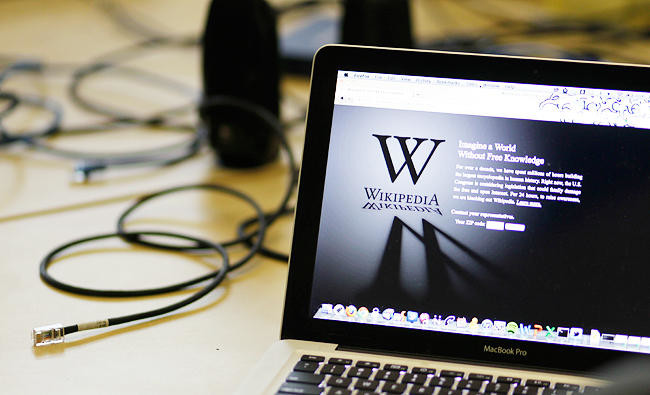
ANKARA: Turkey will not allow access to Wikipedia inside the country until rulings ordering the online encyclopedia to remove content that Ankara deems to be false are implemented, the head of the country’s communications agency said Wednesday.
Turkey’s Information and Communication Technologies Authority (BTK) implemented the ban on wikipedia.org on Saturday as an “administrative measure” and an Ankara court on Monday then backed this up with a formal court order.
The site remains inaccessible.
Local media said that the ban on the entire site was implemented as Wikipedia failed to remove two English-language pages that Ankara believes falsely linked Turkey to the activities of terror groups.
“It’s impossible for access to Wikipedia to be allowed until judiciary decisions are followed,” BTK head Omer Fatih Sayan said, quoted by the website of the Hurriyet daily.
State media said the ban was imposed as Wikipedia failed to respond to repeated requests by Ankara to remove content it believes are promoting terror and accusing Turkey of cooperation with various terror groups.
The Wikimedia Foundation has appealed the Ankara court’s ruling, Hurriyet reported.
Istanbul municipality officials on Tuesday also removed Wikipedia founder Jimmy Wales from the guest list of the World Cities Expo, a major international conference to be held in the city on May 15-18. Reacting to the ban for Wikipedia on Saturday, Wales said on Twitter: “Access to information is a fundamental human right. Turkish people, I will always stand with you to fight for this right.”
Turkey has frequently blocked access to websites temporarily including popular websites such as Facebook, Twitter and YouTube following terror attacks or anti-government demonstrations.
While opponents claim they are a restriction on freedom of speech and civil liberties, the government insists they are necessary for national security and temporary.

Turkey to keep Wikipedia blocked until court order followed: official
Khartoum markets back to life but ‘nothing like before’
- The hustle and bustle of buyers and sellers has returned to Khartoum’s central market, but “it’s nothing like before,” fruit vendor Hashim Mohamed told AFP, streets away from where war first broke out
KHARTOUM: The hustle and bustle of buyers and sellers has returned to Khartoum’s central market, but “it’s nothing like before,” fruit vendor Hashim Mohamed told AFP, streets away from where war first broke out nearly three years ago.
On April 15, 2023, central Khartoum awoke to battles between the Sudanese army and the paramilitary Rapid Support Forces (RSF), who had been allies since 2021, when they ousted civilians from a short-lived transitional government.
Their war has since killed tens of thousands and displaced millions.
In greater Khartoum alone, nearly four million people — around half the population — fled the city when the RSF took over.
Hashim Mohamed did not.
“I had to work discreetly, because there were regular attacks” on businesses, said the fruit seller, who has worked in the sprawling market for 50 years.
Like him, those who stayed in the city reported having lived in constant fear of assaults and robberies from militiamen roaming the streets.
Last March, army forces led an offensive through the capital, pushing paramilitary fighters out and revealing the vast looting and destruction left behind.
“The market’s not what it used to be, but it’s much better than when the RSF was here,” said market vendor Adam Haddad, resting in the shade of an awning.
In the market’s narrow, dusty alleyways, fruits and vegetables are piled high on makeshift stalls or tarps spread on the ground.
Two jobs to survive
Khartoum, where entire neighborhoods have been damaged by the fighting, is no longer threatened by the mass starvation that stalks battlefield cities and displacement camps elsewhere in Sudan.
But with the economy a shambles, a good living is still hard to provide.
“People complain about prices, they say it’s too expensive. You can find everything, but the costs keep going up: supplies, labor, transportation,” said Mohamed.
Sudan has known only triple-digit annual inflation for years. Figures for 2024 stood at 151 percent — down from a 2021 peak of 358 percent.
The currency has also collapsed, going from trading at 570 Sudanese pounds to the US dollar before the war to 3,500 in 2026, according to the black market rate.
One Sudanese teacher, who only a few years ago could provide comfortably for his two children, told AFP he could no longer pay his rent with a monthly salary of 250,000 Sudanese pounds ($71).
To feed his family, pay for school and cover health care, he “works in the market or anywhere” on his days off.
“You have to have another job to pay for the bare minimum of basic needs,” he said, asking for anonymity to protect his privacy and to avoid “problems with security services.”
Beyond Khartoum, the war still rages, with the RSF in control of much of western and southern Sudan and pushing into the central Kordofan region.
For Adam Haddad, the road to recovery will be a long one.
“We don’t have enough resources or workers or liquidity going through the market,” he said, adding that reliable electricity was still a problem.
“The government is striving to restore everything, and God willing, in the near future, the power will return and Khartoum will become what it once was.”
On April 15, 2023, central Khartoum awoke to battles between the Sudanese army and the paramilitary Rapid Support Forces (RSF), who had been allies since 2021, when they ousted civilians from a short-lived transitional government.
Their war has since killed tens of thousands and displaced millions.
In greater Khartoum alone, nearly four million people — around half the population — fled the city when the RSF took over.
Hashim Mohamed did not.
“I had to work discreetly, because there were regular attacks” on businesses, said the fruit seller, who has worked in the sprawling market for 50 years.
Like him, those who stayed in the city reported having lived in constant fear of assaults and robberies from militiamen roaming the streets.
Last March, army forces led an offensive through the capital, pushing paramilitary fighters out and revealing the vast looting and destruction left behind.
“The market’s not what it used to be, but it’s much better than when the RSF was here,” said market vendor Adam Haddad, resting in the shade of an awning.
In the market’s narrow, dusty alleyways, fruits and vegetables are piled high on makeshift stalls or tarps spread on the ground.
Two jobs to survive
Khartoum, where entire neighborhoods have been damaged by the fighting, is no longer threatened by the mass starvation that stalks battlefield cities and displacement camps elsewhere in Sudan.
But with the economy a shambles, a good living is still hard to provide.
“People complain about prices, they say it’s too expensive. You can find everything, but the costs keep going up: supplies, labor, transportation,” said Mohamed.
Sudan has known only triple-digit annual inflation for years. Figures for 2024 stood at 151 percent — down from a 2021 peak of 358 percent.
The currency has also collapsed, going from trading at 570 Sudanese pounds to the US dollar before the war to 3,500 in 2026, according to the black market rate.
One Sudanese teacher, who only a few years ago could provide comfortably for his two children, told AFP he could no longer pay his rent with a monthly salary of 250,000 Sudanese pounds ($71).
To feed his family, pay for school and cover health care, he “works in the market or anywhere” on his days off.
“You have to have another job to pay for the bare minimum of basic needs,” he said, asking for anonymity to protect his privacy and to avoid “problems with security services.”
Beyond Khartoum, the war still rages, with the RSF in control of much of western and southern Sudan and pushing into the central Kordofan region.
For Adam Haddad, the road to recovery will be a long one.
“We don’t have enough resources or workers or liquidity going through the market,” he said, adding that reliable electricity was still a problem.
“The government is striving to restore everything, and God willing, in the near future, the power will return and Khartoum will become what it once was.”
© 2026 SAUDI RESEARCH & PUBLISHING COMPANY, All Rights Reserved And subject to Terms of Use Agreement.