

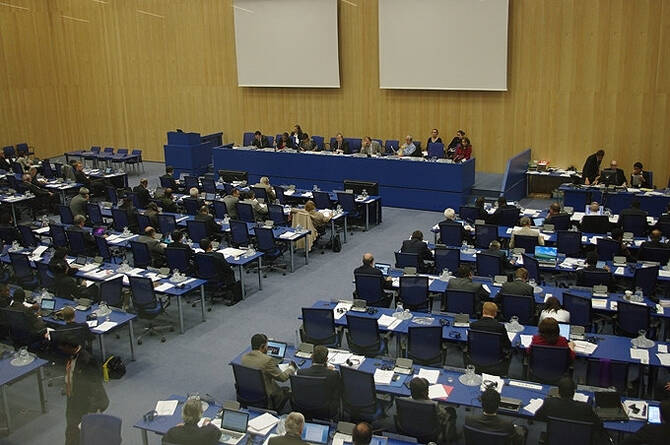

VIENNA: Saudi Arabia has been elected first vice-chair of the UN Committee on the Peaceful Uses of Outer Space, a senior leadership position that underscores the Kingdom’s growing influence in the global sector and international governance.
The COPUOS appointment was announced during the committee’s latest session in Vienna, the Saudi Press Agency reported on Wednesday. The role will be filled by Muryah Al-Shahrani, general manager of Space Systems and Infrastructure at the Saudi Space Agency.
Al-Shahrani is regarded as one of the Kingdom’s leading specialists and has contributed to international initiatives on governance, including participation in COPUOS activities and the global DebriSolver competition focused on addressing space debris challenges.
He has also played a key role in developing Saudi Arabia’s national capabilities in Space Situational Awareness, a field critical to monitoring and managing activities in Earth’s increasingly congested orbital environment.

The first vice-chair position forms part of the five-member bureau that guides the work of COPUOS and its subsidiary bodies. The bureau helps manage committee proceedings, facilitate consensus among member states and shape discussions on international policies governing the peaceful and sustainable use of outer space.
Established by the UN General Assembly in 1959, COPUOS is the principal international forum for cooperation in space affairs and currently comprises 110 member states.
The committee works to strengthen the legal and regulatory framework governing outer space while promoting international collaboration in science, technology and exploration.
The committee meets annually in Vienna to discuss issues including space debris, orbital safety, weather, asteroid threats, climate monitoring, satellite navigation systems and the development of international law.
Its work is supported by the UN Office for Outer Space Affairs, which oversees scientific, technical, legal and policy aspects of international activities.
Saudi officials said the election reflects international confidence in the Kingdom’s contributions to the space sector and its support for the UN system.
The Kingdom has expanded its space ambitions in recent years through investments in research, satellite technologies, astronaut programs and international partnerships, positioning itself as an increasingly active player in the global space economy.


