
ISLAMABAD: Pakistan on Wednesday told the United Nations Security Council (UNSC) that lasting peace in the Middle East requires more than normalization agreements, arguing that any durable settlement must address the region’s deep-rooted historical, political, cultural and religious complexities through balanced diplomacy and genuine political processes.
The statement came at a UNSC debate on ‘Advancing Political Solutions in the Middle East’ weeks after US President Donald Trump said Pakistan, Saudi Arabia, Qatar, Türkiye and several other countries should join an expanded Abraham Accords framework as he tried to negotiate an agreement to end the war with Iran.
Pakistan rejected the proposal and said it could not become part of any arrangement that conflicted with its “fundamental ideologies,” while none of the other countries publicly reacted to the US president’s call as public mistrust of Israel remains high in these Muslim nations over its military offensive in Gaza.
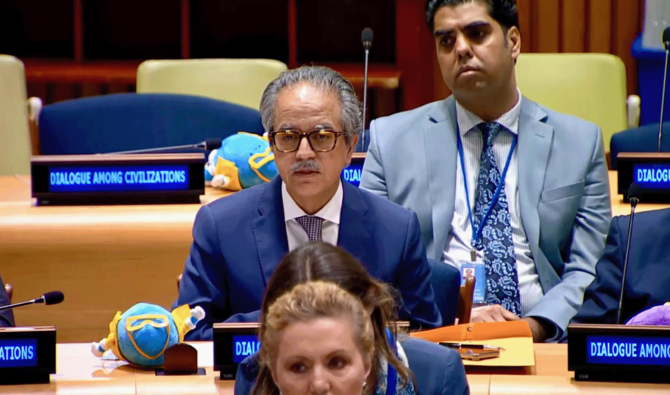
Speaking at Wednesday’s debate, Pakistan’s UN envoy Asim Iftikhar Ahmad said the situation in the Middle East was fragile and persistent disregard for international law, non-implementation of UNSC resolutions, and the absence of genuine political processes had diminished the prospects for achieving lasting peace.
“The Arab-Israeli conflict is one of the oldest and biggest issues on this Council’s agenda. Middle East is one of the world’s most complex political landscapes where history, identity, culture, civilization, and religion intersect profoundly,” he told the council.
“These realities cannot be ignored or oversimplified. Peace efforts must therefore account for these sensitivities with care, balance, objectivity, and deep understanding.”
The Abraham Accords, brokered during Trump’s first presidency in 2020, established diplomatic relations between Israel and several Arab states, including the United Arab Emirates and Bahrain. Morocco and Sudan later joined the framework, which Washington has promoted as a cornerstone of a broader Middle East normalization process.
Trump last month said that countries involved in discussions surrounding an ongoing US-Iran conflict should “simultaneously” join the Abraham Accords, describing the arrangement as a pathway toward a more unified and economically integrated Middle East.
Pakistan does not recognize Israel and has no diplomatic relations with the country. Islamabad has historically supported the creation of an independent Palestinian state based on pre-1967 borders with East Jerusalem as its capital, a position that enjoys broad political and public support across Pakistan.
“In Gaza, after nearly three years of devastating conflict and Israeli onslaught, humanitarian suffering reached catastrophic proportions. Concerted efforts led by US President Donald Trump and supported by a group of eight Arab-Islamic countries, including Pakistan, culminated in the Gaza Peace Plan and Resolution 2803. However, despite the ceasefire, violations and killings of Palestinians continue,” Ahmad said.
“The Palestinian question remains at the very core of efforts to achieve lasting peace in the region. A time-bound and irreversible political process anchored in relevant UN resolutions must lead to the establishment of a sovereign, independent, and contiguous state of Palestine on pre-1967 borders with Al-Quds Al-Sharif as its capital.”