Famed Swiss climber killed near Mount Everest in Nepal

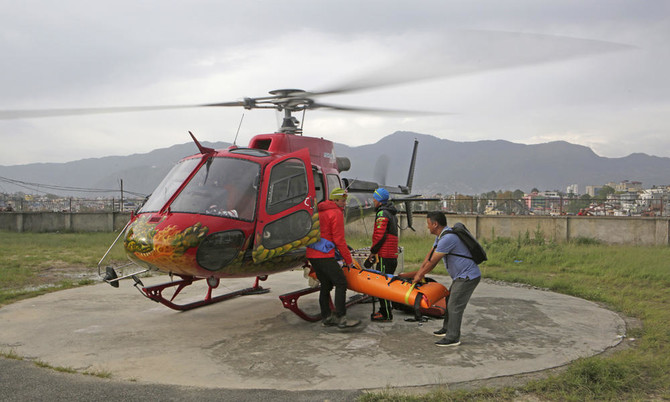
The body of famed Swiss climber Ueli Steck is unloaded from a helicopter at Teaching Hospital in Katmandu, Nepal, on Sunday. (AP Photo/Niranjan Shrestha)
Updated 30 April 2017
Follow

Famed Swiss climber killed near Mount Everest in Nepal

KATMANDU, Nepal: A Swiss climber acclaimed for his rapid ascents — including scaling dozens of peaks in the Alps in a little more than two months — was killed Sunday in a mountaineering accident near Mount Everest in Nepal, expedition organizers said.
Ueli Steck was killed at Camp 1 of Mount Nuptse, Mingma Sherpa of Seven Summit Treks said. Steck’s body has been recovered from the site and been taken to Lukla, where the only airport in the Mount Everest area is located.
Steck’s family said the exact circumstances of his death were still unclear.
“The family is infinitely sad and asks that the media refrain from speculating about his death out of respect and consideration for Ueli,” it said in a statement on Steck’s website. “As soon as reliable information about Ueli Steck’s death becomes available, the media will be informed.”
Steck was planning to climb 8,850-meter (29,035-foot) Mount Everest and nearby Mount Lhotse next month.
He was the first casualty in the spring mountaineering season in Nepal that began in March and will end in May. Hundreds of foreign climbers are on the mountains to attempt scale Himalayan peaks in May when there are a few windows of favorable weather.
The 40-year-old Steck was one of the most-renowned mountaineers of his generation. He was best known for his speed-climbing, including setting several records for ascending the north face of the Eiger, a classic mountaineering peak in the Bernese Alps that he climbed in two hours and 47 minutes without using a rope.
In 2013, he achieved the first solo climb of the Annapurna south face in Nepal after almost losing his life in a fall there in 2007. For that he received the “Piolet d’Or” — considered the Oscar of mountaineering — the following year.
In 2015, Steck decided to climb all 82 peaks in the Alps higher than 4,000 meters (13,100 feet) traveling between mountains by foot, bike and paraglider only. He completed the feat in 62 days, helping cement his reputation as the “Swiss Machine.”
Steck once said he considered himself an “outsider” in the mountaineering scene because athletic achievement was more important to him than adventure.
In a recent post on his website, Steck mused about the transience of success in mountaineering and the inevitable decline that comes with age.
“A record is broken again and again, and the world keeps on turning,” he wrote. “You are getting older and there comes a time when you have to adjust your projects to your age.”
Steck suffered a setback during his last trip to Everest, in 2013, when he became involved in a violent altercation with a group of local guides. On his return this year, he aimed to perform a quick climb of Everest and Lhotse, including an overnight stop at more than 8,000 meters, an altitude that’s known as the “death zone” because the human body’s performance is reduced to 20 percent of its normal rate.
Asked about the upcoming expedition, Steck told Swiss daily Tages-Anzeiger in an interview last month: “When I’m on Everest I can stop at any point. The risk is therefore quite small. For me it’s primarily a physical project. Either I get through, or I don’t have the strength for the whole traversal.”
“Of course I want to climb Everest and Lhotse,” Steck told the paper when asked about his measure of success. “But that’s a very high goal. Failure for me would be to die and not come home.”
___
Frank Jordans reported from Berlin.


St. Francis relics go on public show for first time in Italy

Updated 22 February 2026
Follow

St. Francis relics go on public show for first time in Italy

Assisi, Italy: Saint Francis of Assisi’s skeleton is going on public display from Sunday for the first time for the 800th anniversary of his death, drawing hundreds of thousands of visitors.
Inside a nitrogen-filled plexiglass case with the Latin inscription “Corpus Sancti Francisci” (The Body of St. Francis), the remains are being shown in the Italian hill town’s Basilica of St. Francis of Assisi.
St. Francis, who died on October 3, 1226, founded the Franciscan order after renouncing his wealth and devoting his life to the poor.
Giulio Cesareo, director of communications for the Franciscan convent in Assisi said he hoped the display could be “a meaningful experience” for believers and non-believers alike.
Cesareo, a Franciscan friar, said the “damaged” and “consumed” state of the bones showed that St. Francis “gave himself completely” to his life’s work.
His remains, which will be on display until March 22, were transferred to the basilica built in the saint’s honor in 1230.
But it was only in 1818, after excavations carried out in utmost secrecy, that his tomb was rediscovered.
Apart from previous exhumations for inspection and scientific examination, the bones of Saint Francis have only been displayed once, in 1978, to a very limited public and for just one day.
Usually hidden from view, the transparent case containing the relics since 1978 was brought out on Saturday from the metal coffer in which it is kept, inside his stone tomb in the crypt of the basilica.
The case is itself inside another bullet-proof and anti-burglary glass case.
Surveillance cameras will operate 24 hours a day for added protection of the remains.
St. Francis is Italy’s patron saint and the 800th anniversary commemorations of his death will also see the restoration of an October 4 public holiday in his honor.
The holiday had been scrapped nearly 50 years ago for budget reasons.
Its revival is also a tribute to late pope Francis who took on the saint’s name.
Pope Francis died last year at the age of 88.

‘Not a movie set’

Reservations to see the saint’s remains already amount to “almost 400,000 (people) coming from all parts of the world, with of course a clear predominance from Italy,” said Marco Moroni, guardian of the Franciscan convent.
“But we also have Brazilians, North Americans, Africans,” he added.
During this rather quiet time of year, the basilica usually sees 1,000 visitors per day on weekdays, rising to 4,000 on weekends.
The Franciscans said they were expecting 15,000 visitors per day on weekdays and up to 19,000 on Saturdays and Sundays for the month-long display of the remains.
“From the very beginning, since the time of the catacombs, Christians have venerated the bones of martyrs, the relics of martyrs, and they have never really experienced it as something macabre,” Cesareo said.
What “Christians still venerate today, in 2026, in the relics of a saint is the presence of the Holy Spirit,” he said.
Another church in Assisi holds the remains of Carlo Acutis, an Italian teenager who died in 2006 and who was canonized in September by Pope Leo XIV.
Experts said the extended display of St. Francis’s remains should not affect their state of preservation.
“The display case is sealed, so there is no contact with the outside air. In reality, it remains in the same conditions as when it was in the tomb,” Cesareo said.
The light, which will remain subdued in the church, should also not have an effect.
“The basilica will not be lit up like a stadium,” Cesareo said. “This is not a movie set.”