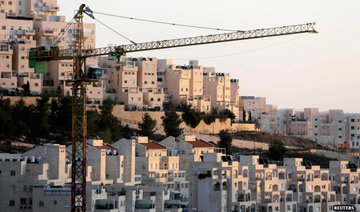
Israeli plan for 15,000 more settlement homes in Jerusalem condemned

A general view shows the Israeli settlement of Ramot in an area of the occupied West Bank that Israel annexed to Jerusalem, in this photo taken on January 22, 2017. (REUTERS)
Updated 29 April 2017
Follow

Israeli plan for 15,000 more settlement homes in Jerusalem condemned

JERUSALEM: Israel intends to build 15,000 new settlement homes in East Jerusalem, the Housing Ministry said on Friday despite US President Donald Trump’s request to “hold back” on settlements as part of a possible new push for Israeli-Palestinian peace.
A formal announcement of the settlement plan, quickly condemned by the chief Palestinian negotiator, could come around the time Trump is scheduled to visit Israel next month.
Israel views all of Jerusalem as its “eternal and indivisible capital,” but the Palestinians also want a capital there. Most of the world considers Jerusalem’s status an issue that must be decided through negotiations. The last peace talks between Israel and the Palestinians collapsed in 2014.
Housing Minister Yoav Galant told Israel Radio that his ministry and the Jerusalem Municipality had been working on the plan for two years, with proposals for 25,000 units, 15,000 of which would be in East Jerusalem, which Israel captured in the 1967 Middle East war and later annexed.
“We will build 10,000 units in Jerusalem and some 15,000 within the (extended) municipal boundaries of Jerusalem. It will happen,” he said.
Chief Palestinian negotiator Saeb Erekat said Israel’s move was a systematic violation of international law and a “deliberate sabotage” of efforts to resume talks.
“All settlements in occupied Palestine are illegal under international law,” he said in a statement. “Palestine will continue to resort to international bodies to hold Israel, the occupation power, accountable for its grave violations of international law throughout occupied Palestine.”
Channel 2 news said an announcement on building could be made on Jerusalem Day which this year, according to the Hebrew calendar, falls on May 24, when Israel celebrates its capture of the eastern part of the city.
This year marks the 50th anniversary, with a large number of celebrations planned. Trump’s visit is expected to take place on or shortly after May 22.
Palestinians want East Jerusalem as the capital of a state they hope to establish in the occupied West Bank and the Hamas-ruled Gaza Strip.
Trump told Reuters in an interview at the White House on Thursday that he wanted to see a peace deal.
“I want to see peace with Israel and the Palestinians,” he said. “There is no reason there’s not peace between Israel and the Palestinians — none whatsoever.”
The US leader met Israeli Prime Minister Benjamin Netanyahu in Washington in February and is to see Palestinian President Mahmoud Abbas at the White House on May 3.


Anti-Daesh coalition issues joint statement after Riyadh meeting

Updated 57 min 10 sec ago
Follow

Anti-Daesh coalition issues joint statement after Riyadh meeting

RIYADH: Saudi Arabia hosted a meeting of senior diplomatic and defense officials from the Small Group of the Global Coalition to Defeat Daesh in Riyadh on Monday.

Saudi Vice Foreign Minister Waleed Elkhereiji opened the meeting, which was co-chaired by US Special Envoy for Syria Ambassador Tom Barrack.

Participants expressed their appreciation to the Kingdom for hosting the meeting and for its continued role in supporting regional and international efforts to counter terrorism and promote stability.

Participants welcomed the comprehensive agreement between the Government of Syria and the Syrian Democratic Forces, including the permanent ceasefire and arrangements for the civil and military integration of northeast Syria. 

They noted the Government of Syria’s stated intention to assume national leadership of counter-Daesh efforts and expressed appreciation for the sacrifices made by the Syrian Democratic Forces in the fight against Daesh. 

Participants also thanked the Government of Iraq for its continued leadership in the Defeat Daesh campaign.

The participants reaffirmed their priorities, including the swift transfer and safeguarding of Daesh detainees, third-country repatriation, the dignified reintegration of families from Al-Hol and Roj camps to their communities of origin, and continued coordination with Damascus and Baghdad on the future of the Defeat Daesh campaign in Syria and Iraq.

Participants welcomed the Syrian government as the 90th member of the D-Daesh Coalition. Coalition members underscored their readiness to work closely with the Syrian government and encouraged members to provide direct support to Syrian and Iraqi efforts.

Coalition defense officials highlighted the close coordination between diplomatic and military lines of effort. 

Participants received briefings on the current Defeat Daesh campaign, including ongoing detainee transfer operations. 

Officials commended Iraq’s efforts to securely detain Daesh fighters and welcomed Syria’s assumption of responsibility for detention facilities and displacement camps housing Daesh fighters and their family members. 

Participants reiterated the need for countries to take responsibility for and repatriate their nationals from Iraq and Syria.

Coalition members thanked Iraq for its leadership and recognized that the transfer of detainees into Iraqi custody is essential to regional security. 

They reaffirmed their shared commitment to defeating Daesh in Iraq and Syria and pledged continued support to both governments in securing Daesh-affiliated detainees.