WASHINGTON: Dismissing concerns about ballooning federal deficits, President Donald Trump on Wednesday proposed dramatic tax cuts for US businesses and individuals — outlining an overhaul his administration promises will spur economic growth and simplify America’s tangle of tax code rules.
His proposal, a one-page sketch short on detail, would reduce the top corporate tax rate by 20 percentage points and allow private business owners to claim the new lower rate for their take-home pay. It would whittle the number of tax brackets for individuals from seven to three, lower the top tax rate from 39.6 percent to 35 percent and double the standard amount taxpayers could deduct.
It would eliminate the estate tax and reduce taxes on investments, typically paid by the rich. It would further reduce the tax burden for the wealthy by eliminating the catch-all alternative minimum tax, which takes an additional bite out of high-income Americans.
More lower-income Americans would pay no tax at all, and there would be relief — still undefined — for families with child care expenses.
The plan does not propose any budget cuts or tax increases that might offset the lost revenue, a choice that alarms some fiscal conservatives in Trump’s party who have spent years railing about the dangers of deficit spending.
It also does not fully embrace tax proposals backed by Republican House Speaker Paul Ryan, an essential ally if the president is to make good on his promise to deliver a tax overhaul that creates growth and brings jobs to struggling parts of the country.
Still, “I would never, ever bet against this president. He will get this done for the American people,” said Gary Cohn, director of the White House National Economic Council. “He understands that there are a lot people who work hard and feel like they’re not getting ahead.”
The president’s proposal marks a rehash of an economic theory popularized in the 1980s. Trump officials essentially argue that benefits from the tax cuts will trickle down from higher profits for companies into stronger pay raises for workers and greater consumer spending. This expected surge in growth, in theory, would be enough to keep the federal budget deficit from shooting upward.
Some economists agree, but most budget experts say it’s unlikely.
“Unfortunately, it seems the administration is using economic growth like magic beans — the cheap solution to all our problems,” said Maya MacGuineas, president of the non-partisan Committee for a Responsible Federal Budget. “But there is no golden goose at the top of the tax cut beanstalk, just mountains of debt.”
Trump’s plan resembles aspects of the tax ideas he campaigned on last year. The right-learning Tax Foundation estimated that, even after accounting for growth, the Trump campaign plan would put a $2.6 to $3.9 trillion hole in the budget over 10 years.
“We know this is difficult,” Cohn said. “We know what we’re asking for is a big bite.”
Despite the details provided Wednesday, the proposal leaves significant open questions that could affect its impact on taxpayers and the economy.
The administration has yet to decide the incomes at which the new personal tax rates — 10 percent, 25 percent and 35 percent — would apply, meaning that some Americans might see their taxes increase if they get bumped into a higher bracket. It also has yet to spell out how the plan would stop wealthier Americans from exploiting a lower corporate rate to reduce their own taxes.
Administration officials intend to finalize details with members of the House and Senate in the coming weeks for what would be the first massive rewrite of the US tax code since 1986.
The possibility of a deficit increase, unacceptable to some Republicans, means that Trump would need to attract Democratic support to make the overhaul permanent.
Senate Democrats say his plan tilts its benefits to the wealthy, including Trump himself. The real estate magnate might save millions of dollars in his personal taxes because of the changes.
“This is an unprincipled tax plan that will result in cuts for the one percent, conflicts for the president, crippling debt for America and crumbs for the working people,” said Sen. Ron Wyden, or Oregon, ranking Democrat on the Finance Committee.
The Trump proposal would double the standard deduction for married couples to more than $24,000, while keeping deductions for charitable giving and mortgage interest payments.
On the other hand, it would trim other deductions, including for state and local tax payments, a change that could alienate lawmakers in states such as California and New York with higher state taxes.
“It’s not the federal government’s job to be subsidizing the states,” said Treasury Secretary Steve Mnuchin.
The administration has emphasized that the plan is focused on simplifying the tax code and helping middle class Americans. The median US household income is slightly above $50,000 annually.
In a boon for wealthier taxpayers, it would repeal the 3.8 percent tax on investment income from President Barack Obama’s health care law
The proposal has yet to be vetted for its precise impact on top earners, as several specifics are still being determined.
On the corporate side, the top marginal tax rate would fall from 35 percent to 15 percent. Small businesses that account for their owners’ personal incomes would see their top tax rate go from 39.6 percent to that corporate tax rate of 15 percent. Mnuchin said the change for small business owners — a group that under the current definition could include doctors, lawyers and even major real estate companies — would be done in a way that would ensure wealthier Americans could not exploit the change to pay less than intentioned in taxes.


![]()
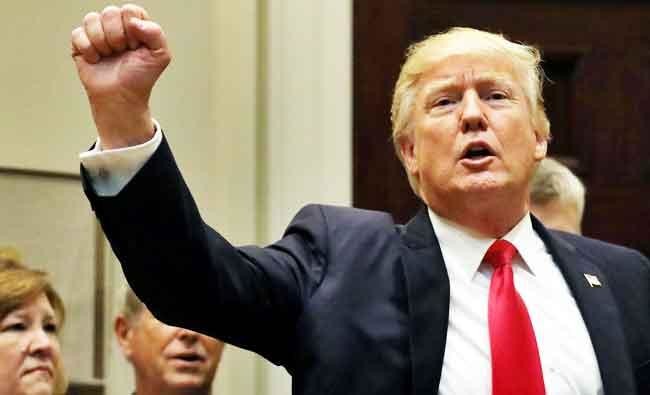
Trump tax plan could be good news for many, bad for deficit
Trump tax plan could be good news for many, bad for deficit
Latest updates




© 2026 SAUDI RESEARCH & PUBLISHING COMPANY, All Rights Reserved And subject to Terms of Use Agreement.