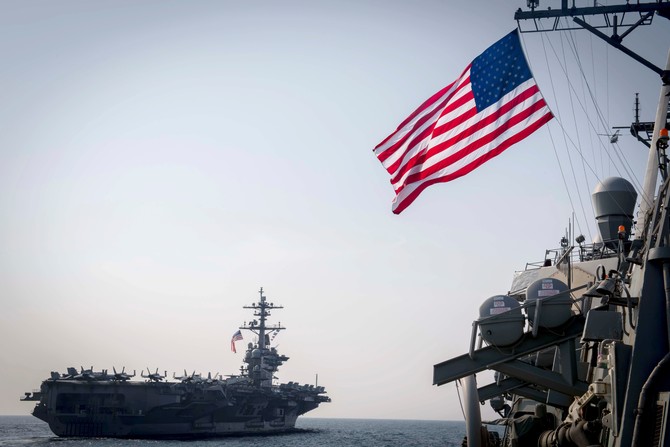
DUBAI: A US Navy guided-missile destroyer fired a warning flare toward an Iranian Revolutionary Guard vessel coming near it in the Arabian Gulf, an American official said on Wednesday, the latest tense naval encounter between the two countries.
The incident happened Monday as the vessel attempted to draw closer to the USS Mahan despite the destroyer trying to turn away from it, said Lt. Ian McConnaughey, a spokesman for the Bahrain-based 5th Fleet.
The “Mahan made several attempts to contact the Iranian vessel by bridge-to-bridge radio, issuing warning messages and twice sounding the internationally recognized danger signal of five short blasts with the ship’s whistle, as well as deploying a flare to determine the Iranian vessel’s intentions,” McConnaughey said in a statement to The Associated Press.
The Iranian vessel came within 1,000 meters (1,100 yards) of the Mahan during the incident, the lieutenant said. The vessel later turned and sailed away.
Iranian authorities did not immediately report the incident on Wednesday.
The US and Iran routinely have tense encounters in the Arabian Gulf and the nearby Strait of Hormuz, through which a third of all oil traded by sea passes. Iran views the American presence as a provocation and its paramilitary Revolutionary Guard shadows US Navy ships in the Gulf, occasionally firing missiles or rockets nearby.
Since the nuclear deal with world powers, the hard-line Revolutionary Guard has stepped up its encounters with the Americans. The Navy recorded 35 instances of what it describes as “unsafe and/or unprofessional” interactions with Iranians forces in 2016, compared to 23 in 2015. With Monday’s event, there have been seven so far in 2017, McConnaughey said.
Of the incidents last year, the worst involved Iranian forces capturing 10 US sailors and holding them overnight.

US Navy fires warning flare at Iran vessel in Arabian Gulf
Syrian leader to meet Putin, Russia seeks deal on military bases
MOSCOW: Syrian President Ahmed Al-Sharaa will meet Russian counterpart Vladimir Putin in Moscow on Wednesday, as the Kremlin seeks to secure the future of its military bases in the country.
Putin and Sharaa struck a conciliatory tone at their previous meeting in October, their first since Sharaa’s rebel forces toppled Moscow-ally Bashar Assad in 2024.
But Russia’s continued sheltering of Assad and his wife since their ouster remains a thorny issue. Sharaa has repeatedly pushed Russia for their extradition.
Sharaa, meanwhile, has embraced US President Donald Trump, who on Tuesday praised the Syrian leader as “highly respected” and said things were “working out very well.”
Putin, whose influence in the Middle East has waned since Assad’s ouster, is seeking to maintain Russia’s military footprint in the region.
Russia withdrew its forces from the Qamishli airport in Kurdish-held northeast Syria earlier this week, leaving it with only the Hmeimim air base and Tartus naval base on Syria’s Mediterranean coast — its only military outposts outside the former Soviet Union.
“A discussion is planned on the status of bilateral relations and prospects for developing them in various fields, as well as the current situation in the Middle East,” the Kremlin said of the upcoming meeting in a statement on Tuesday.
Russia was a key ally of Assad during the bloody 14-year Syrian civil war, launching air strikes on rebel-held areas of Syria controlled by Sharaa’s Islamist forces.
The toppling of Assad dealt a major blow to Russia’s influence in the region and laid bare the limits of Moscow’s military reach amid the Ukraine war.
The United States, which cheered Assad’s demise, has fostered ever-warmer ties with Sharaa — even as Damascus launched a recent offensive against Kurdish forces long backed by the West.
Despite Trump’s public praise, both the United States and Europe have expressed concern that the offensive in Syria’s northeast could precipitate the return of Islamic State forces held in Kurdish-held jails.
Putin and Sharaa struck a conciliatory tone at their previous meeting in October, their first since Sharaa’s rebel forces toppled Moscow-ally Bashar Assad in 2024.
But Russia’s continued sheltering of Assad and his wife since their ouster remains a thorny issue. Sharaa has repeatedly pushed Russia for their extradition.
Sharaa, meanwhile, has embraced US President Donald Trump, who on Tuesday praised the Syrian leader as “highly respected” and said things were “working out very well.”
Putin, whose influence in the Middle East has waned since Assad’s ouster, is seeking to maintain Russia’s military footprint in the region.
Russia withdrew its forces from the Qamishli airport in Kurdish-held northeast Syria earlier this week, leaving it with only the Hmeimim air base and Tartus naval base on Syria’s Mediterranean coast — its only military outposts outside the former Soviet Union.
“A discussion is planned on the status of bilateral relations and prospects for developing them in various fields, as well as the current situation in the Middle East,” the Kremlin said of the upcoming meeting in a statement on Tuesday.
Russia was a key ally of Assad during the bloody 14-year Syrian civil war, launching air strikes on rebel-held areas of Syria controlled by Sharaa’s Islamist forces.
The toppling of Assad dealt a major blow to Russia’s influence in the region and laid bare the limits of Moscow’s military reach amid the Ukraine war.
The United States, which cheered Assad’s demise, has fostered ever-warmer ties with Sharaa — even as Damascus launched a recent offensive against Kurdish forces long backed by the West.
Despite Trump’s public praise, both the United States and Europe have expressed concern that the offensive in Syria’s northeast could precipitate the return of Islamic State forces held in Kurdish-held jails.
© 2026 SAUDI RESEARCH & PUBLISHING COMPANY, All Rights Reserved And subject to Terms of Use Agreement.