DUBAI: New Zealand is considering additional security checks on flights from some countries in the Middle East, its transport minister said.
The new rules would follow similar measures introduced last month by the US, Britain and Australia.
New Zealand’s civil aviation authority “is assessing the evidence to determine what is appropriate,” Transport Minister Simon Bridges said in an interview in Dubai.
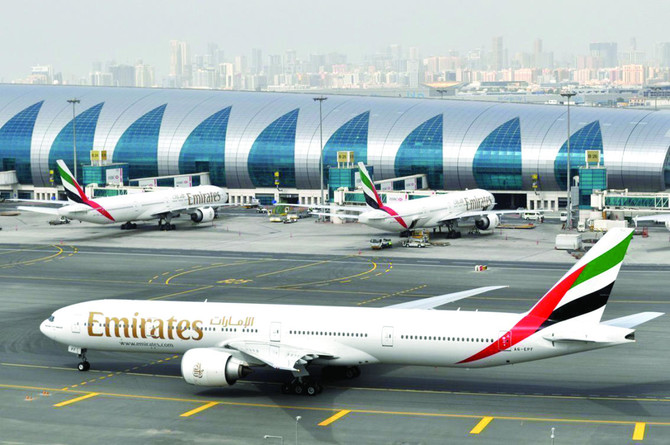
Additional security measures would affect passengers flying from Dubai in the UAE and Doha, Qatar, where carriers Emirates and Qatar Airways, respectively, fly direct to New Zealand.
Bridges said a decision to add new checks would be made independent of the government by the aviation authority .
He declined to say when a decision could be made. He did not say what measures were being considered.
On March 25, the US banned electronic devices larger than a mobile phone from passenger cabins of direct flights from eight countries in the Middle East, North Africa and Turkey, including Qatar and the UAE.
Britain followed the same day with similar measures, including banning larger electronics on flights from some Middle East countries but not Qatar and the UAE where it instead requested additional security checks.
Australia’s additional checks on passengers and baggage apply to Qatar and the UAE as they are the only Middle East countries with which it has direct air links.
The additional security measures were made based on intelligence suggesting flights could be targeted for attack.
“What we have seen from them is a less than uniform way of doing things,” Bridges said of the different measures introduced by the United States, Britain and Australia, all close allies of New Zealand.
Last week, Emirates said it was cutting flights to the United States after new restrictions weakened demand.
Bridges said he is scheduled to meet with Emirates Chairman Sheikh Ahmed bin Saeed Al-Maktoum this week where he would make clear that New Zealand is open to additional services.
Emirates flies to New Zealand cities Auckland and Christchurch, mostly via Australia, although it operates a direct daily flight to Auckland. Qatar Airways only flies direct to Auckland.
Bridges, who is also minister for economic development, is in the UAE to formally announce New Zealand’s participation in the 2020 World Expo in Dubai.
New Zealand has committed NZ$53.3 million ($37.5 million) to build its country’s pavilion to host its companies at the trade fair, Wellington announced on Sunday.
Bridges’ visit is one of several senior ministerial trips to the region so far this year as New Zealand pushes to conclude a free trade agreement (FTA) with the Gulf Cooperation Council (GCC).
“We are hopeful over the next year or so we will get somewhere with that,” he said.
The UAE has said finalizing the trade deal with New Zealand is a priority.

New Zealand considering extra security on Middle East flights
US condemns RSF drone attack on World Food Programme convoy in Sudan’s North Kordofan
- Denise Brown, the UN Humanitarian Coordinator for Sudan, also expresses concern over the drone attack
WASHINGTON: The US has condemned a drone attack by Rapid Support Forces on an aid convoy in Sudan’s North Kordofan state that killed one person and injured three others.
“The United States condemns the recent drone attack on a World Food Program convoy in North Kordofan transporting food to famine-stricken people which killed one and wounded many others,” US Senior Adviser for Arab and African Affairs Massad Boulos wrote on X.
“Destroying food intended for people in need and killing humanitarian workers is sickening,” the US envoy wrote.
“The Trump Administration has zero tolerance for this destruction of life and of U.S.-funded assistance; we demand accountability and extend our condolences to all those affected by these inexcusable events and terrible war,” he added.
The Sudan Doctors Network, on its social media accounts, said the World Food Programme (WFP) convoy was struck by RSF drones in the Allah Karim area as it headed toward displaced people in El-Obeid, the state capital.
The network described the attack as a “clear violation of international humanitarian law,” warning that it undermines efforts to deliver life-saving aid to civilians amid worsening humanitarian conditions across the country.
There was no immediate comment from the rebel group.
The United States condemns the recent drone attack on a World Food Program convoy in North Kordofan transporting food to famine-stricken people which killed one and wounded many others. This follows an attack earlier this week in Blue Nile state that injured a @WFP staff member.…
— U.S. Senior Advisor for Arab and African Affairs (@US_SrAdvisorAF) February 6, 2026
Denise Brown, the UN Humanitarian Coordinator for Sudan, in a statement also expressed concern over the drone attack which hit the aid trucks in North Kordofan.
“I am deeply concerned by a drone attack earlier today on trucks contracted by the World Food Programme (WFP) in North Kordofan, the aftermath of which I came across a few hours later, as I left the state capital, El Obeid.”
“The trucks were en route from Kosti to deliver life-saving food assistance to displaced families near El Obeid when they were struck, tragically killing at least one individual and injuring many more. The trucks caught fire, destroying food commodities intended for life-saving humanitarian response.”
Brown added that “Humanitarian personnel, assets and supplies must be protected at all times. Attacks on aid operations undermine efforts to reach people facing hunger and displacement.”
“Safe and unimpeded humanitarian access remains critical to ensure assistance reaches the most vulnerable people across Sudan.”
Since April 2023, the conflict between Sudan’s army and the paramilitary forces has killed tens of thousands, displaced 11 million and which the UN has described as one of the world’s worst humanitarian crises.
An alert issued by the Integrated Food Security Phase Classification (IPC), confirmed famine conditions in El-Fasher and Kadugli, the capital of South Kordofan, about 800 kilometers to the east.
The IPC said that 20 more areas in Sudan’s Darfur and neighboring Kordofan were at risk of famine.
Of Sudan’s 18 states, the RSF controls all five states in the western Darfur region, except for parts of North Darfur that remain under army control. The army holds most areas of the remaining 13 states across the south, north, east and center of the country, including the capital, Khartoum.
The conflict between the army and the RSF, which erupted in April 2023, has killed thousands of people and displaced millions.