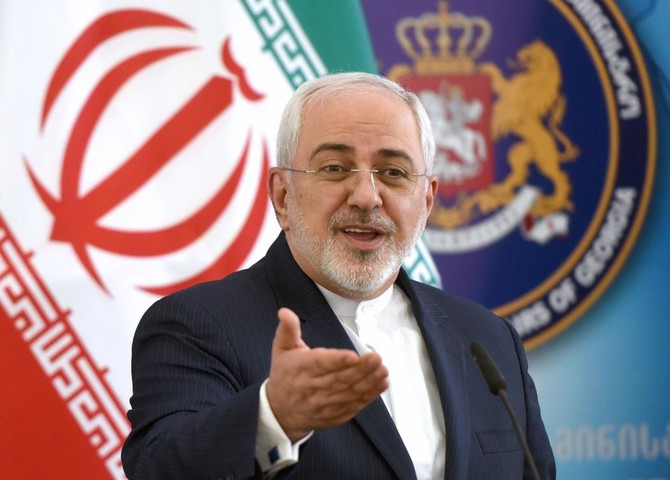
TEHRAN: Iran’s Foreign Minister Mohammed Javad Zarif on Thursday criticized “worn-out” US accusations that it was seeking a nuclear weapon to threaten the region and the world.
“Worn-out US accusations can’t mask its admission of Iran’s compliance” with a 2015 nuclear deal, Zarif wrote on Twitter.
Iran says its nuclear program is purely for peaceful purposes but signed a deal with world powers to restrict its fuel enrichment for 10 years in exchange for sanctions relief.
US Secretary of State Rex Tillerson said Wednesday that Tehran has so far met its obligations, but that the deal could only delay Iran’s development of a nuclear weapon.
The deal “fails to achieve the objective of a non-nuclear Iran,” he said, and was a product of “the same failed approach of the past that brought us to the current imminent threat we face from North Korea.”
Zarif said Iran’s compliance had forced the US administration of President Donald Trump “to change course and fulfill its own commitments.”
Trump described the accord as the “worst deal ever negotiated” during his campaign and threatened to tear it up, but analysts say that is increasingly unlikely.
Trump’s spokesman Sean Spicer said a review would be conducted by US government agencies over the next 90 days on whether to stick by the deal.

Iran FM slams ‘worn-out’ US nuclear accusations
Sudanese nomads trapped as war fuels banditry and ethnic splits
- War disrupts nomads’ traditional routes and livelihoods
- Nomads face threats from bandits as well as ethnic tensions
NEAR AL-OBEID: Gubara Al-Basheer and his family used to traverse Sudan’s desert with their camels and livestock, moving freely between markets, water sources, and green pastures. But since war erupted in 2023, he and other Arab nomads have been stuck in the desert outside the central Sudanese city of Al-Obeid, threatened by marauding bandits and ethnic tensions. The war between the Sudanese army and the paramilitary Rapid Support Forces (RSF) has left nearly 14 million people displaced, triggered rounds of ethnic bloodshed, and spread famine and disease. It has also upset the delicate balance of land ownership and livestock routes that had maintained the nomads’ livelihoods and wider relations in the area, local researcher Ibrahim Jumaa said. Al-Obeid is one of Sudan’s largest cities and capital of North Kordofan state, which has seen the war’s heaviest fighting in recent months. Those who spoke to Reuters from North Kordofan said they found themselves trapped as ethnic hatred, linked to the war and fueled largely online, spreads.
“We used to be able to move as we wanted. Now there is no choice and no side accepts you,” al-Basheer said. “In the past there were a lot of markets where we could buy and sell. No one hated anyone or rejected anyone. Now it’s dangerous,” he said.
RISK OF ROBBERY
As well as the encroaching war, the nomads — who Jumaa said number in the millions across Sudan — face a threat from bandits who steal livestock.
“There are so many problems now. We can’t go anywhere and if we try we get robbed,” said Hamid Mohamed, another shepherd confined to the outskirts of Al-Obeid. The RSF emerged from Arab militias known as the Janjaweed, which were accused of genocide in Darfur in the early 2000s. The US and rights groups have accused the RSF of committing genocide against non-Arabs in West Darfur during the current conflict, in an extension of long-running violence stemming from disputes over land. The RSF has denied responsibility for ethnically charged killings and has said those responsible for abuses will be held to account. Throughout the war the force has formed linkages with other Arab tribes, at times giving them free rein to loot and kidnap.
But some Arab tribes, and many tribesmen, have not joined the fight.
“We require a national program to counter hate speech, to impose the rule of law, and to promote social reconciliation, as the war has torn the social fabric,” said Jumaa.
“We used to be able to move as we wanted. Now there is no choice and no side accepts you,” al-Basheer said. “In the past there were a lot of markets where we could buy and sell. No one hated anyone or rejected anyone. Now it’s dangerous,” he said.
RISK OF ROBBERY
As well as the encroaching war, the nomads — who Jumaa said number in the millions across Sudan — face a threat from bandits who steal livestock.
“There are so many problems now. We can’t go anywhere and if we try we get robbed,” said Hamid Mohamed, another shepherd confined to the outskirts of Al-Obeid. The RSF emerged from Arab militias known as the Janjaweed, which were accused of genocide in Darfur in the early 2000s. The US and rights groups have accused the RSF of committing genocide against non-Arabs in West Darfur during the current conflict, in an extension of long-running violence stemming from disputes over land. The RSF has denied responsibility for ethnically charged killings and has said those responsible for abuses will be held to account. Throughout the war the force has formed linkages with other Arab tribes, at times giving them free rein to loot and kidnap.
But some Arab tribes, and many tribesmen, have not joined the fight.
“We require a national program to counter hate speech, to impose the rule of law, and to promote social reconciliation, as the war has torn the social fabric,” said Jumaa.
© 2026 SAUDI RESEARCH & PUBLISHING COMPANY, All Rights Reserved And subject to Terms of Use Agreement.