Talbina is made from barley flour. Milk and honey are added to the dried barley and the name of the dish comes from the Arabic word “laban” meaning yogurt, because of its resemblance to yogurt. It is soft and white.
Our second recipe this week is a versatile mutton dish or an “Ishtoo” as it is called in regions of India. It is actually a stew that was probably inspired by the brown stew of the British Raj. Every region of India has its own varieties and can be made with yogurt, milk and different spices.
Next is a street food dish called “momos,” a type of South Asian dumpling, native to Tibet, Nepal, Bhutan and Sikkim. It is similar to Chinese baozi, Japanese gyoza and Korean mandu. This stuffed dumpling is one of the most popular dishes in Nepal and the minimally flavored veg momos with red chutney make for a light yet satisfying dinner.
TALBINA
Serves: 2
Cooking time: 10 minutes
INGREDIENTS:
1. 100% whole grain barley flour
2. Milk or coconut milk
3. Water
4. Honey
STEP 1: Pour 1 to 2 tbsps of barley flour into 1 to 2 cups of water or milk (I like to use half water with half milk).
STEP 2: Stir on low heat for about 10-15 minutes or until a porridge-like consistency is reached.
STEP 3: Sweeten with honey to your liking.
WHITE MUTTON STEW
Serves: 4
Cooking and preparation time: 45 minutes
INGREDIENTS:
1 kg mutton
6 to 7 medium onions
3/4-cup yogurt or 1 cup laban
4 to 5 whole red chili peppers (more if you want spicy)
2 teaspoons of zafrani garam masala powder
Salt as required
1 tbsp ginger garlic paste
Whole garam masala: 2 bay leaves, 3 to 4 cloves, 1 cinnamon stick, a few black pepper corns, 2 cardamom
Whole and crushed coriander, optional for garnishing
3/4 cup of Canola or Afia oil
Coriander leaves for garnishing
METHOD:
1. Chop onions finely and set aside.
2. To oil, add whole garam masalas along with ginger garlic paste.
3. Fry and add mutton pieces, frying until brown.
4. Add chopped onions; lower the flame and let the onions leave their water.
5. Add the garam masala powder, salt and whole red chili peppers.
6. Cook in the oven.
7. Let the onion merge into mutton pieces. When mutton becomes tender, add laban or beaten yogurt to it (this recipe doesn’t require water at all). Keep stirring.
8. Cook for another 15 to 20 mins.
9. Add crushed coriander, green chili peppers and coriander leaves
10. Enjoy with chapatis, bread or naan.
MOMOS
Serves: 3
Cooking and preparation time: 45 minutes
Flour and cabbage are the main ingredients.
OTHER INGREDIENTS:
All purpose flour — 2 cups
Oil — 1 tsp
Salt to taste
Water — lukewarm to knead the flour
FOR VEGETABLE FILLING:
1 cup cabbage, finely chopped
3/4 cup finely chopped carrots
1 medium onion, finely chopped
1-2 finely minced green chili peppers
2 cloves finely minced garlic
1/2 tsp finely minced ginger
1 tsp soy sauce
1/4 tsp of black pepper powder
1/4 tsp of sugar (optional)
Salt to taste
METHOD:
Momos dough:
1. Place the flour, oil and salt in a bowl.
2. Mix well and slowly add warm water to make a smooth and soft dough.
3. Cover with a lid and set aside.
Vegetable filling:
1. Heat oil in a wide pan and add garlic.
2. Sautee for a minute; add the chopped green chili peppers and ginger and mix well.
3. Add chopped onions and sautee for 3 mins till they are translucent.
4. Add the chopped carrot and cook for 3-4 mins on medium heat.
5. Add the chopped cabbage and cook for at least 8-10 mins.
6. Add soy sauce, black pepper powder and sugar, and mix well.
7. Turn off the heat and allow to come to room temperature. Just before placing the filling on the rolled out circle, add salt and mix.
Making the momos:
1. Knead the dough again for 2-3 mins and pinch out small lemon-sized balls of the dough and dust with flour.
2. Roll each ball into a 3” or 4” diameter circle. It should not be too thick or too thin in thickness.
3. Place a tbsp of prepared vegetable filling in the center of each rolled out circle. Do not overstuff, as it will be difficult to form a neat pouch shape.
4. Beginning at one end of the flat circle, gather the edge to form pleats working your way around the circle. Bring the pleats together to form a pouch-like dumpling and seal the top.
5. Fill and shape all the rolled out circles into pouch-like dumplings.
6. Cover them with a damp cloth to avoid drying out.
7. Grease an aluminum or stainless steel steamer and place the shaped dumplings leaving a little space between each of them.
8. Fill a vessel or pot that is large enough to place the steamer with 3” to 4” of water and bring water to a boil.
9. Ensure that the bottom of the steamer is not in the water.
10. Bring water to a rolling boil; place the steamer in the vessel and cover.
11. Steam on high heat for 10 mins. The momos are done when a shiny sheen appears over them.
12. You can use a pressure cooker or a bamboo steamer to steam the momos.
• [email protected]


Tasty talbina in ten minutes


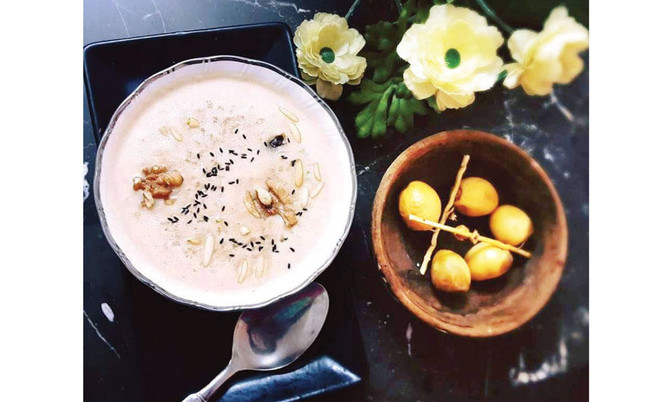
Tasty talbina in ten minutes

Where We Are Going Today: Makbous Express in Riyadh
- Each option complements the dish in its own way, though the mandi rice seems best suited to absorb the savory depth of the sauce
Sometimes comfort arrives in a takeout box. Makbous Express in Riyadh brings the warmth of home-style cooking to your doorstep, offering familiar Gulf flavors designed for casual indulgence rather than fine dining.
Even without the dine-in experience, the food travels well, retaining much of its authentic charm. The tabolah stands out immediately. A bright mix of parsley, bulgur, tomato, and onion, it tastes crisp and refreshing, cutting through richer dishes with balance and simplicity. It is a welcome palate-cleanser.
The Makbous meat, the restaurant’s bestseller, shows why it carries that title. Tender meat cooked in aromatic saffron sauce arrives perfectly seasoned, with your choice of biryani, mandi, or plain rice.
Each option complements the dish in its own way, though the mandi rice seems best suited to absorb the savory depth of the sauce. This plate captures the essence of Kuwaiti soul food: generous, fragrant, and deeply satisfying.
Less exciting was the shrimp pasta, tossed in Makbous hot sauce. The shrimp were well-cooked, but the overall dish felt predictable, with the sauce adding heat but not much complexity.
The jareesh, made from crushed wheat groats simmered in chicken stock and cumin, then topped with butter or wild ghee, is pure comfort food. Warm, wholesome, and nostalgic, it delivers understated satisfaction rather than surprise. It’s the kind of dish that feels like home cooking done right.
The potato stew was runny for my taste and lacked the richness needed to tie its flavors together. A thicker texture or deeper spice could have made it more enjoyable, especially if it had more body.
Despite a few uneven dishes, Makbous Express succeeds in delivering the homely warmth of Kuwaiti cuisine, one that speaks of tradition, spice, and generosity. It may not dazzle at every turn, but for days when you crave hearty, unpretentious comfort food, this express route hits close to home.


